Whenever you read any top 10 financial software development companies list, you will notice something missing. Almost none of them say the actual location of the company, and that matters more. Your development team's location decides your overlap hours, what a change request costs, and who you can get on a call when a payment integration breaks at 4 pm on a Friday.
So, I have created this list of financial software development companies in USA differently. Every company below lists its real headquarters, the finance clients it can point to publicly, and the kind of buyer it actually fits. Inclusion here means serving the US market, not being headquartered here, and the table makes the difference plain so you can judge the delivery model yourself.
You will also find what financial software development costs in 2027 and 6 questions worth asking before you sign.
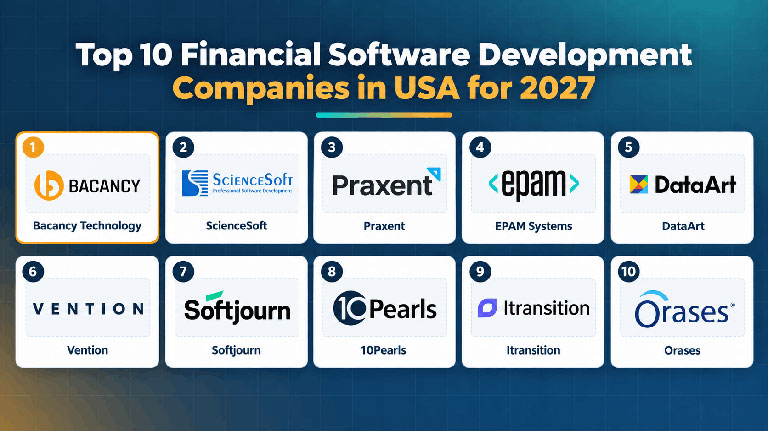
8 of 10 financial software development companies in the USA below are headquartered in the United States. The other two run US offices with delivery teams elsewhere, which is a normal and often sensible arrangement once you know about it.
| No. | Company | Headquarters | Founded | Best For |
|---|---|---|---|---|
| 1 | Bacancy Technology | Ahmedabad, India (US office) | 2011 | Full-cycle development from discovery through support |
| 2 | ScienceSoft | McKinney, Texas | 1989 | Lending and data-heavy platforms on a fixed scope |
| 3 | Praxent | Austin, Texas | 2000 | Customer-facing products at banks, lenders, and insurers |
| 4 | EPAM Systems | Newtown, Pennsylvania | 1993 | Enterprise programs at large institutions |
| 5 | DataArt | New York, New York | 1997 | Capital markets and long-running platform work |
| 6 | Vention | New York, New York | 2002 | Funded Fintech startups scaling engineering fast |
| 7 | Softjourn | Fremont, California | 2001 | Payments, prepaid cards, and expense management |
| 8 | 10Pearls | Vienna, Virginia | 2004 | Digital banking for banks and credit unions |
| 9 | Itransition | Denver, Colorado | 1998 | Broad delivery capacity across finance and insurance |
| 10 | Orases | Frederick, Maryland | 2000 | Smaller US-only builds with senior attention |
The order of these financial software development companies runs from broadest coverage to narrowest focus. Narrow is not worse. A payments specialist will beat a generalist on a card-issuing build every time. Read the whole list for a perfect fit, not for rank.
Bacancy Technology covers the whole arc of a development under one roof. Its financial software development services run from consulting and architecture through development, integration, security, and long-term support, which removes the handoff where most budgets quietly leak. Its finance portfolio names Edward Jones, Franklin Templeton, Cetera AdviceWorks, and Bangkok Bank, a mix that leans toward wealth management and banking.
The trade-off is time zones. Delivery sits primarily in India, so your daily overlap is a few hours unless you agree on shifted schedules up front. Worth settling in the contract rather than the first sprint.
ScienceSoft has been in software since 1989 and in financial services since 2005, which is a long runway in a market full of five-year-old shops. Its loan management system for Atlas Credit, a Texas consumer lender operating since 1968, won a Best-in-Class Loan Management System award in 2025.
ScienceSoft leans toward fixed-price engagements, which suits buyers who know exactly what they want. If your requirements are still moving, expect change orders.
Praxent works only in financial services and delivers only from the US, with no offshore component. Its client list includes Ameritas, Ascensus, Dimensional Fund Advisors, SS\&C, Open Lending, and Origence, and the team concentrates on the experience layer: onboarding flows, loan origination screens, and customer portals. Roughly 170 people across 450+ engagements is a lot of repetition in one narrow lane.
US-only delivery costs more per hour. You are paying for same-timezone collaboration and a team that already knows the domain, which tends to pay back on a modernization project and less so on a greenfield MVP.
EPAM is publicly traded and sits in the Fortune 1000, with financial services as one of its largest revenue verticals. It publishes its own retail banking research, and when a program spans several years and many workstreams, EPAM has the bench depth to staff it without scrambling.
This kind of firm runs formal processes, and a $200,000 development will not command the attention it would at a smaller shop. Bring EPAM in when the program is genuinely large.
DataArt started its financial services practice in 2006 and has built it into one of the firm's strongest verticals, with real depth in trading and investment systems. Its model favors long engagements over one-off projects, and it reports employee retention around 87%, which in practice means the engineers who learn your system tend to still be there in year three.
Delivery is distributed across 20+ countries. Ask which specific locations will staff your project before you sign, since the answer shapes your working hours.
Formerly iTechArt, Vention reports more than 200 Fintech products delivered and names PayPal, Brex, and StoneX among its clients. Its strength is speed of staffing: it can put a team in place in weeks, which matters when you have raised a round and the roadmap is already behind.
The model is team augmentation more than end-to-end product ownership. You will still need strong product leadership on your side.
Softjourn marked 25 years in business in 2026 and has stayed narrow the whole time. Its partnerships with PEX, UPC, and Tacit each run past the ten-year mark, which is the clearest signal available that the work holds up after launch. If you are building card issuing or payment processing, that specific experience is hard to buy elsewhere.
Outside payments and expense management, Softjourn is not the obvious choice. The narrow focus is exactly why it belongs on this list.
10Pearls has built a practice around credit unions and mid-size banks, a segment plenty of vendors skip because the deals are smaller and the procurement is slower. It has made the Inc. 5000 list of fastest-growing private US companies repeatedly, and runs delivery centers in Latin America, which keeps working hours close to US teams.
If you are a large institution running a core replacement, the bigger firms on this list are better equipped.
Itransition has delivered 1,600+ projects for 800+ customers across 40+ countries since 1998. Finance is one vertical among several, so it is less specialized than Praxent or Softjourn, but it brings a wide technology bench and a long track record of scaling teams.
Breadth cuts both ways. Ask specifically for the finance case studies and the engineers who worked on them rather than accepting the general portfolio.
Orases is the smallest firm here and the most senior-heavy per project. It has been building custom software in Maryland since 2000, and it states plainly that clients receive 100% ownership of the software it builds. That is worth noting, because IP ownership is where a surprising number of contracts get murky.
Scale is the limit. A team this size cannot staff a multi-workstream enterprise program, and it is a generalist rather than a finance specialist.
Ask three financial software development companies to quote the same project, and the numbers can differ by half. Usually that is not one firm overcharging. It is three firms reading the scope differently.
Published market research puts most financial software development projects in three tiers:
| Project tier | Typical range | What it usually covers |
|---|---|---|
| MVP or first version | $50,000 to $150,000 | Core workflows, one platform, essential integrations, standard security |
| Mid-complexity product | $150,000 to $400,000 | Multiple user roles, several integrations, compliance features, web and mobile |
| Enterprise platform | $400,000 to $1,000,000+ | Multi-module systems, high transaction volume, legacy migration |
Four things move the number more than anything else: how many user roles the system has, how many external systems it touches, whether compliance features like KYC and AML screening are in scope, and how much legacy data has to be migrated cleanly. That last one is the quiet budget killer. Moving 20 years of account records without losing a row takes longer than most plans allow.
Two habits keep budgets honest. Pay for a fixed-price discovery phase before committing to the build, so the estimate rests on a real specification. And stage the work so you can stop, reassess, or change direction after each release instead of only at the end.
The websites of most financial software development companies are written to survive a skim. These 6 questions are harder to answer with marketing copy.
Can they name finance clients you can actually verify? A logo wall proves nothing. Ask for two clients in your segment and permission to contact one. A firm that has done the work will make the introduction.
Have they integrated with your systems before? Core banking platforms, card processors, and custodial APIs each have quirks that take weeks to learn. Ask which specific systems they have connected to, not whether they can.
Who owns the code and the IP when the contract ends? Get it in writing before kickoff. Ask about third-party libraries and any proprietary framework the vendor plans to use, because those are the clauses that cause trouble later.
Will the people in the pitch be the people on the project? Ask to meet the actual lead engineer and project manager, and ask what else they are staffed on during your timeline.
What happens after launch? Financial software needs patching, monitoring, and compliance updates for years. Find out whether support is a separate contract, what the response times are, and what it costs annually.
How do they handle a mid-project scope change? Every project has one. Ask them to walk you through how the last one went with another client: who approved it, how the estimate changed, and how long the conversation took.
There is no single best firm among the top 10 financial software development companies in USA. Narrow specialists win when a product sits squarely in their lane, and the largest firms earn their fees on programs that run for years.
For most banks, lenders, and fintech teams, though, the real gap is neither strategy nor scale. It is having one partner accountable from the first scoping call through post-launch support, because that handoff between advisers and builders is where budgets and timelines usually break. Bacancy Technology is built for exactly that. Its banking and financial IT services and solutions span consulting, architecture, development, integration, and long-term maintenance under a single team, so the decisions made in discovery survive into the product you ship.
Shortlist two or three financial software development companies whose profile matches your stage, then put every one of them through the six questions above.
Most financial software development projects fall between $50,000 for a first version and $1,000,000 or more for an enterprise platform. The biggest cost drivers are the number of integrations, compliance features, and legacy data migration.
A focused first version usually takes 3 to 6 months. Mid-complexity products commonly run 6 to 12 months. Enterprise platforms and core migrations are measured in years, not months, and any vendor promising otherwise is describing a phase, not the whole program.
Build in-house when the software is your core product, and you can hire and retain finance-experienced engineers. Hire one of the financial software development companies above when you need domain knowledge you do not have, a faster start, or a defined project rather than a permanent team.
You should, and most reputable firms transfer full ownership on final payment. Confirm it in the contract before work begins, and ask specifically about any proprietary components or third-party libraries the vendor intends to use.
Yes, and most financial software development work is integration rather than replacement. Ask for a named example of a comparable integration. Experience with your specific core platform is worth more than general integration skill.
Author Bio:
Chandresh Patel is a seasoned technology professional and passionate writer at Bacancy Technology, covering software development end-to-end, from architecture and cloud infrastructure to data engineering, DevOps, product delivery, and applied AI. He writes for engineering and product teams across industries, with recurring work in regulated sectors such as healthcare and Fintech. He also mentors engineers on Agile delivery practices.


Discover our other works at the following sites:
Danetsoft is a global web agency headquartered in Indonesia, specializing in web development, managed hosting, and web publishing platform.


 [email protected]
 Magelang, Central Java
 © 2026 Danetsoft. Powered by HTMLy