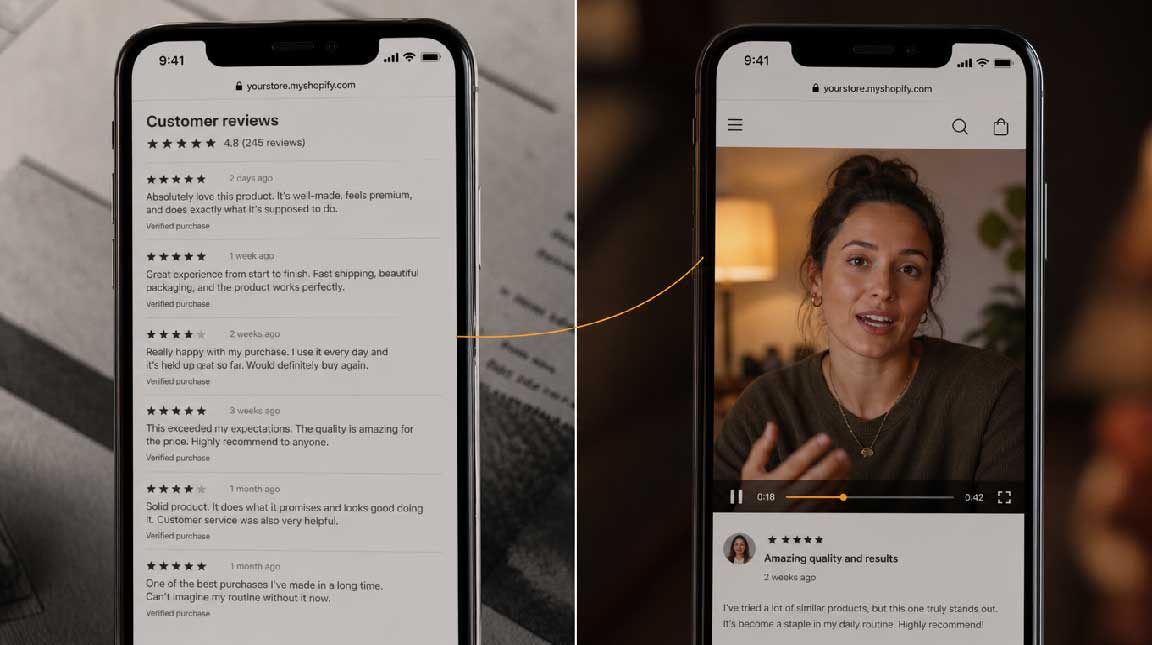
Most brands sit on a pile of reviews they barely use. BrightLocal's 2025 Local Consumer Review Survey put it bluntly: 88% of shoppers read reviews before buying, and 79% trust them about as much as a recommendation from a friend. Trustpilot's 2025 Transparency Report logged more than 280 million reviews on the platform alone. Yet on the average Shopify product page, those reviews still show up as walls of grey text that most visitors skim for ten seconds and forget.
Video is a different animal. Wyzowl's 2025 State of Video Marketing report found that 89% of consumers said a brand video convinced them to buy, and short-form testimonial clips outperformed every other format for trust scoring. Baymard Institute's checkout research keeps surfacing the same blocker: shoppers don't doubt the product specs, they doubt whether anyone real bought it and liked it. A paragraph review fights for that trust. A 30-second clip of someone talking wins it faster.
The problem until recently has been supply. A brand with 5,000 written reviews might have three usable video testimonials, because filming customers is expensive, slow, and most say no. That gap is closing fast. By leveraging a modern AI Video Generator, brands in 2026 can now take a written review, signed permission, a brand kit, and a product image, and produce a polished or UGC-style testimonial clip in under ten minutes. This guide walks through how to do it without crossing ethical lines, which tools are worth your time, and what kind of lift to expect.
Yotpo's 2026 Commerce Benchmark report found product pages with at least one video testimonial above the fold converted 18 to 24% higher than text-only review pages across apparel, beauty, and home goods.
Average dwell time on PDPs with embedded testimonial video rose 41% versus pages with star ratings and text alone, per Shopify's 2025 merchant analytics summary.
Paid social ads using testimonial-style clips, including AI-rendered ones with clear disclosure, posted 1.6x higher click-through rates than static review screenshots across Meta and TikTok in a Nielsen 2025 brand-lift study.
Repeat purchase rate climbed 11% within 90 days for first-time buyers exposed to video testimonials in post-purchase email, per Klaviyo's 2026 retention benchmarks.
Multilingual reach is suddenly trivial. The same testimonial can be cloned into Spanish, German, Portuguese, and Japanese versions in an afternoon, opening LATAM and EU markets without reshoots.
Production cost per asset dropped from 1,200 to 1,800 for a traditional UGC brief down to 40 to 120 per AI-generated testimonial.
Source reviews. Export top-rated, longest-form reviews from Yotpo, Trustpilot, Amazon Vine, Okendo, or your Shopify review app. Filter for 4 and 5 star, minimum 40 words, and stories with specific outcomes ("my hairline grew back," "shipped in two days," "fits my 6'2 frame").
Product imagery and B-roll. High-resolution PDP shots, lifestyle photography, and any existing brand video. Cleaner source images mean better cutaways.
Brand kit. Logo files, exact hex codes, type system, and a one-page tone-of-voice doc so on-screen text and voiceover pacing match your other content.
Customer permission and disclosure policy. A signed release from each reviewer plus an internal policy on when you'll label a video "AI-assisted recreation" versus "dramatization of a real customer review." More on this below.
Target placement plan. Decide upfront where each clip lives: PDP hero block, paid social ads, organic Reels or Shorts, post-purchase email, retention SMS, or affiliate landing pages. Aspect ratio, length, and caption style flow from this.
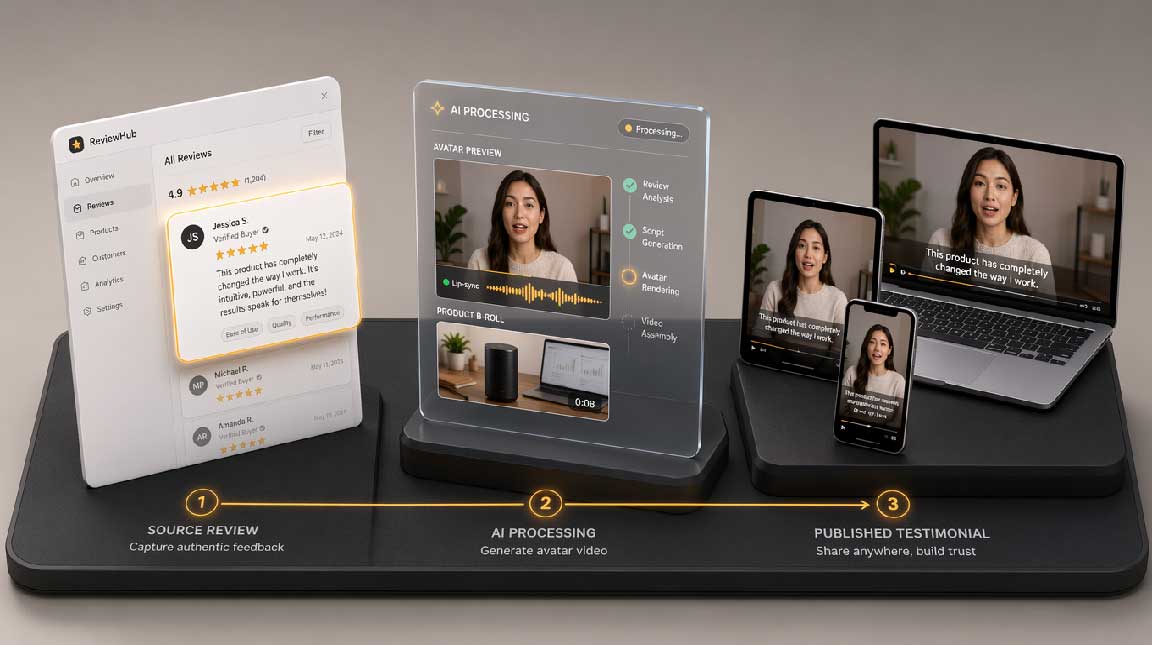
1. Pull your top reviews. Export the last 12 months from your review platform. Sort by length and rating. You want emotional specificity, not "Great product, fast shipping." A review like "I've had eczema since I was eleven and this is the first balm that didn't sting" is gold.
2. Curate quotes into testimonial scripts. Pick 15 to 25 reviews. Edit each into a 25 to 45 second script, between 60 and 110 words. Keep the customer's voice. Don't smooth out their phrasing into marketing copy or you'll lose what made the review trustworthy. Note any claim that needs softening for ad policy.
3. Choose your AI tool. TopView AI is the most complete option for review-to-testimonial workflows in 2026 because it bundles avatar generation, voice cloning, product B-roll, and ad-ready exports in one project. Other tools handle pieces well but you'll be stitching across three or four platforms. Pick one workflow and learn it deeply before adding more.
4. Choose an avatar style: UGC or polished. UGC style means handheld vertical framing, imperfect lighting, the visual grammar of a real phone selfie. It performs best on TikTok, Reels, and lower-funnel ads. Polished style means clean studio framing, brand-colored backdrops, lower-thirds with the reviewer's first name and city. It performs best on PDPs, YouTube pre-roll, and B2B. TopView AI lets you toggle between both off the same script, so test both and let CTR decide.
5. Generate voiceover and lip-sync. Modern voice synthesis is the part that used to give people the uncanny-valley shudder. The 2026 generation handles breaths, micro-pauses, and regional accents convincingly. Match the voice to the reviewer's demographic. A 58-year-old in Glasgow should not sound like a 24-year-old in LA. Review every clip on mobile before approving.
6. Add product B-roll and lower thirds. Cut to the product when the script mentions it. For animating still product photography into short cinematic shots, HappyHorse 1.0 is useful as a text-to-video and image-to-video model that turns a flat PDP image into a 3-second push-in or pack-shot loop without a shoot. For cinematic hero shots, Seedance 2.0 generates the slow-motion liquid pour, fabric drape, or unboxing moment that used to require a studio day. Layer lower thirds with reviewer first name, location, and verified-purchase badge. Burn captions in at 32 to 38 point.
7. Export per placement. PDP cut: 16:9 or 1:1, 15 to 30 seconds, sound-off captions, end card with star rating. Reels and Shorts: 9:16, 20 to 40 seconds, hook in the first 1.5 seconds. Meta and TikTok ads: 9:16, 6 to 15 seconds, opening with a single strong line from the review. Email: GIF preview plus hosted video link. Render once, version many times. TopView AI handles batch export cleanly, which matters when you're producing 20-plus clips a week.
| Tool | Best For | Key Features | Pricing | Limitations |
|---|---|---|---|---|
| TopView AI | End-to-end review-to-ad testimonial workflows, DTC and SaaS | Custom avatars, voice cloning, B-roll generation, batch export by placement, multilingual cloning, integrated access to OpenAI's GPT Image 2 for product lifestyle imagery | Free trial; paid tiers from 29 to 199 per month | Render queue slows at peak hours on lowest tier |
| HeyGen | Sales and CS teams making personalized videos | 300-plus avatars, instant voice clone, API personalization, translation | 24 to 89 per month per seat | Limited B-roll; weaker on short-form ad cuts |
| Synthesia | Corporate training and B2B explainer testimonials | Strong avatar realism, multi-language, enterprise compliance | From 22 per month, enterprise higher | Style skews corporate, less natural for UGC ads |
| Creatify | Performance marketers producing ad creative at volume | URL-to-ad workflow, AI scriptwriter, UGC-style avatars | 39 to 149 per month | Output quality varies; less fine control |
| Vidyard | B2B sales outreach and ABM video testimonials | AI avatars, hosting, CRM integration, analytics | From 19 per user per month | Built for sales, not creative production at scale |
| Trust (Trustpilot) | Brands deep in Trustpilot wanting verified review video | Direct pull from verified reviews, native badge, FTC-friendly defaults | Custom pricing tied to Trustpilot plan | Locked to Trustpilot source; limited creative flexibility |
The Federal Trade Commission updated its Endorsement Guides in 2024 and clarified again in 2025 that AI-generated or AI-assisted endorsements must not deceive consumers about whether a testimonial is real, whether the person depicted exists, or whether the review reflects an actual customer experience. The principle is simple: the underlying review must be real, the customer must have given permission, and the format must not mislead viewers.
Get written consent. Every customer whose words you turn into a video script should sign a short release covering use of their words, the type of AI rendering, the placements, and the duration. Compensate fairly. A 25 credit gift card or a free product is reasonable for a single-use license. Higher for paid social use.
Label appropriately. If you are using a stock AI avatar to voice a real customer's words, on-screen text like "Recreation of a verified customer review" or "Voiced by AI, words from a real Trustpilot review by Sarah K." keeps you on the right side of disclosure. If you generate a synthetic likeness of the actual customer with their permission, label it "AI-assisted version of customer testimonial." Build these disclosure templates into your asset workflow so producers don't have to think about it on every clip.
Do not fabricate. The fastest way to end up in an FTC enforcement action or a class action is to generate testimonials from reviews that do not exist, or to attribute words to a customer who never said them. AI tools make it tempting to write a "review" and have an avatar perform it. Don't. The compliance and brand-trust risk outweigh any short-term conversion lift.
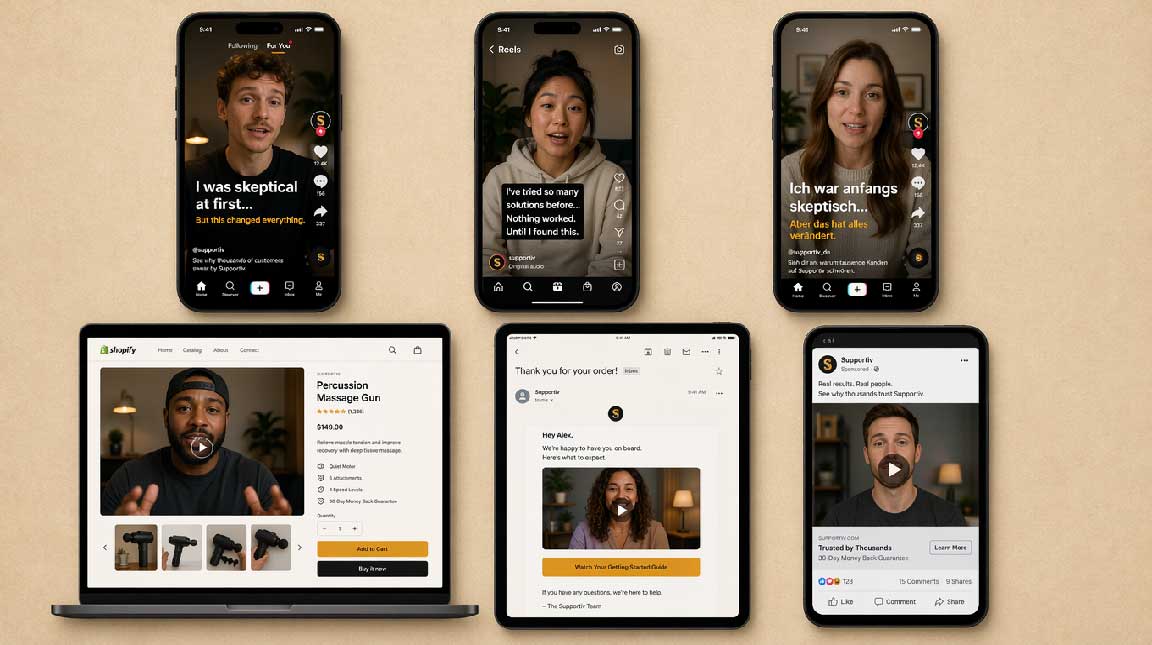
Yotpo's 2026 cohort study tracked 412 DTC brands that added AI video testimonials to product pages over a six-month window. Brands that placed at least one testimonial video above the fold saw a 19% lift in add-to-cart and a 14% lift in checkout completion versus the matched control. Beauty and supplements outperformed apparel, with skincare brands averaging 26% PDP conversion lift. The brands that combined AI testimonials with traditional UGC, rather than replacing UGC entirely, saw the highest compound lift.
On paid social, a Klaviyo and Meta joint analysis from Q1 2026 showed that 9:16 testimonial-style ads built from real reviews using tools including TopView AI reduced cost per acquisition by 22% on average against static review-quote ads, and by 31% against generic product-only creative. The clearest wins came from brands producing 15 or more testimonial variants per campaign.
Retention is the underrated angle. A Klaviyo benchmark of 60-day repurchase windows in early 2026 found that post-purchase email flows with a "see what other customers say" video module had 11% higher repeat-purchase rates than text-only review modules. The mechanism is simple: new buyers worry they made the wrong call. A real reviewer telling them otherwise, in video, pushes them toward second purchase faster.
Is this legal under FTC guidelines? Yes, when you start from real customer reviews, get signed permission from the reviewer, and disclose clearly that the video is an AI-assisted recreation. It becomes illegal the moment you fabricate reviews or imply the customer recorded the video themselves when they did not.
How much does AI video testimonial production cost? Most tools fall between 22 and 199 per month for self-serve plans, with per-clip costs of 5 to 40 once you account for render minutes and add-ons. A traditional UGC creator brief runs 800 to 2,400 per clip, so the economics shift hard above 10 to 15 testimonials a month.
How do I get customer permission to use their review as a video? Send a short email with a sample of how the video will look, a one-paragraph release link, and a thank-you incentive. Conversion runs 18 to 35% from happy 5-star reviewers, higher with a small product credit. Build the request into your post-purchase review flow so it's a one-click yes.
How does this compare to hiring real UGC creators? Real UGC creators bring authenticity that AI still can't fully match and remain the gold standard for hero campaigns. AI testimonials shine at volume, speed, language coverage, and creative variant testing. The smart 2026 approach is both: real UGC for top-of-funnel, AI testimonials for PDP, retargeting, retention, and international expansion.
How do I avoid the creepy uncanny-valley effect? Three things. Use 2026-generation avatars only; older models render dead eyes and stiff mouth movement that viewers clock instantly. Match the voice to the avatar's demographic and the reviewer's demographic. And never overdo the smile. Real testimonial subjects pause, look away, breathe, and occasionally fumble a word. The best avatars do too.
The brands winning in 2026 are not the ones with the most reviews. They are the ones who turned the reviews they already had into video at a price point and speed that was impossible two years ago. Written reviews are still essential for SEO, trust signals, and on-page conversion. They are no longer enough on their own.
Start small. Pick 10 of your best reviews, get permission from those customers, run them through a single workflow, and split-test the resulting clips against your current PDP and ad creative. Tools like TopView AI make the first batch a one-afternoon project. The hard part is not the technology. It's the discipline of consent, disclosure, and honest storytelling that keeps this practice on the right side of trust. Get that right, and the conversion lift takes care of itself.


Discover our other works at the following sites:
Danetsoft is a global web agency headquartered in Indonesia, specializing in web development, managed hosting, and web publishing platform.


 [email protected]
 Magelang, Central Java
 © 2026 Danetsoft. Powered by HTMLy