AI-generated content is everywhere now. Students are submitting it, freelancers are delivering it, and even well-meaning writers lean on it more than they admit. According to a study, about 74% of pages online contain AI generated content. The problem is that most people can't tell the difference and neither can a basic word check. That's where AI detectors come in. But not all of them are built the same. Some flag human writing as AI (false positives) while others miss obvious machine text (false negatives). This guide cuts through the noise and shows you exactly which tools are worth your time in 2026.
The market is flooded. There are free tools, paid tools, academic tools, and enterprise platforms - and the accuracy gap between them is wider than most people realise. Before you commit to any one detector, here's what actually matters:
False positive rate - Does it flag real human writing as AI? This matters more than headline accuracy numbers, especially for educators making high-stakes decisions.
Line-by-line analysis - A tool that only gives a single percentage score is limited. You want sentence-level breakdowns so you know where the problem is.
Model coverage - Your detector should recognise content from GPT-4, GPT-5, Claude, Gemini, Llama, and Mistral - not just one or two models.
Free tier limits - Some tools give you 1,000 words free, others give you 10,000. Know what you're working with before you need it most.
Privacy - Does the tool store or use your scanned text? If you're checking sensitive content, this is non-negotiable.
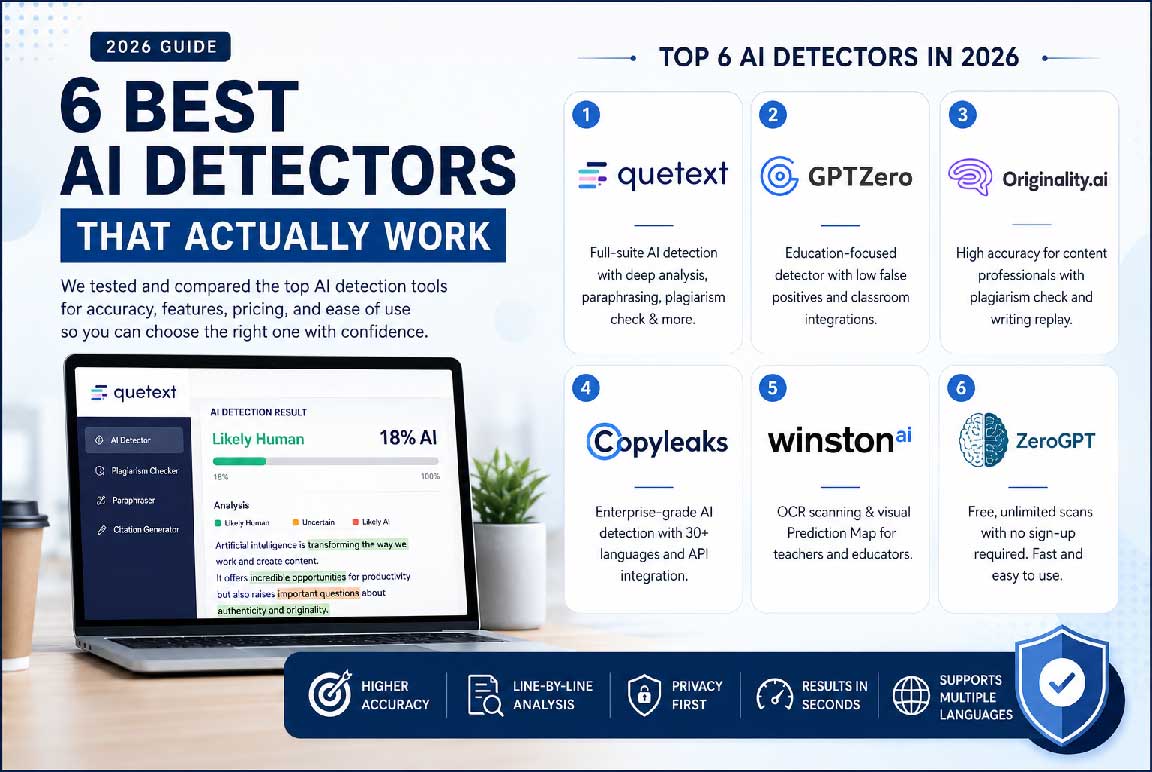
Here's a straight look at the six tools consistently rising to the top in 2026, what each one does well, where it falls short, and who it's really built for.
Quetext AI detector is one of the most well-rounded AI detection platforms available today. It goes beyond a simple percentage score - offering deep linguistic analysis, sentence-level confidence scoring, and a full suite of writing tools under one roof. With support for GPT-5, Claude, Gemini, Llama, and Mistral, it handles modern AI writing patterns with impressive precision. There's no sign-up needed for a free scan, and the interface is clean enough that first-time users figure it out in seconds.
For writers who want more than a basic percentage score, choosing a platform that handles detection alongside broader content analysis can make the review process much easier. Instead of checking AI content in one tool and then moving to separate services for plagiarism, citations, or revisions, an integrated platform can bring these tasks together in a single workflow. This is especially useful for students, editors, and content teams who regularly review longer pieces and want clear feedback on potentially AI-generated sections before making final edits.
Best For: Students who want to verify their own writing before submission, teachers checking assignments without bias, content professionals who need a single platform for detection, plagiarism checking, and writing support.
GPTZero is one of the oldest and most recognised AI detectors on the market. It was built specifically with education in mind and uses a two-signal approach - measuring perplexity (how predictable the text is) and burstiness (variation in sentence length) to separate human writing from machine output. It integrates with Google Classroom and is a staple in academic settings across the US.
Best For: Teachers and academic institutions that need conservative detection with minimal risk of wrongly flagging students.
Originality.ai is built for content professionals - SEO agencies, publishers, and editorial teams that need volume scanning with confidence. It's consistently ranked as one of the most aggressive detectors on the market, and in independent tests it has scored some of the highest detection rates across GPT-5 and Claude-generated content. It also includes plagiarism checking and a writing replay feature, which lets you verify whether a piece was written progressively or pasted in all at once.
Best For: Content marketing agencies, SEO professionals, and publishers who need to verify freelance-written content at scale.
Copyleaks is a veteran in the plagiarism and content integrity space, and its AI detection arm is built for enterprise environments. It supports over 30 languages, integrates via API with existing content workflows, and has consistently performed well in third-party accuracy testing. It's one of the few tools that passed both AI-generated and human-written content tests in Pangram Labs' independent 2025 study.
Best For: Enterprise teams, universities, and content agencies that need multilingual AI detection with API integration and compliance certification.
Winston AI takes a slightly different approach. It's one of the few AI detectors that can scan physical documents and handwritten text through OCR (optical character recognition), making it a favourite among teachers who collect paper-based assignments. Its colour-coded "Prediction Map" gives a visual walkthrough of which sections read as human, likely AI, or AI-generated — a format that works well in classroom feedback conversations.
Best For: Teachers dealing with physical paper assignments, or educators who need a visual tool to walk students through their detection results.
ZeroGPT is the go-to option when you need a completely free, no-commitment check. Unlike most tools, its free tier has no word limit per month - you just paste your text (up to 2,000 words per scan) and get an immediate percentage result with no account required. It uses a proprietary multi-stage detection method that's particularly sensitive to the writing patterns of GPT-4, Gemini, and Claude. It doesn't offer the depth of paid tools, but for a quick sanity check, it's hard to beat.
Best For: Anyone who needs a quick, no-strings-attached AI check and doesn't need sentence-level detail or advanced features.
AI detection isn't optional anymore - it's part of how we maintain trust in writing, whether in a classroom, a newsroom, or a content team. The six tools above cover every major use case in 2026, from free individual checks to enterprise-grade API workflows. That said, if you want one platform that handles detection, analysis, citation, and writing support without forcing you to jump between tools, Quetext is the strongest all-round choice. Start free, see results in seconds, and know exactly where your content stands.


Discover our other works at the following sites:
Danetsoft is a global web agency headquartered in Indonesia, specializing in web development, managed hosting, and web publishing platform.


 [email protected]
 Magelang, Central Java
 © 2026 Danetsoft. Powered by HTMLy