 Photo by Frederick Adegoke Snr. on Pexels
Riding in Seattle has its rewards. Lake Washington Boulevard on a clear morning, the ferry lines in summer, the run up to Snoqualmie Pass. But every rider knows the risks. A driver checks their phone at a light on Rainier Avenue. A car turns left across your path on 15th Avenue. In a second, everything changes.
What you do in the hours and days after a motorcycle accident in Seattle can shape your recovery and your financial future. This guide walks you through ten clear steps. It also explains how Washington law treats motorcycle crash claims and when it makes sense to talk with a Seattle motorcycle accident attorney.
Motorcyclists have no steel frame, no airbags, and no seat belts. That is why crashes are so much more severe for riders. According to NHTSA, per vehicle mile traveled in 2023, motorcyclists were about 28 times more likely than passenger car occupants to die in a crash.
Washington’s numbers tell a similar story. The Washington Traffic Safety Commission (WTSC) reports that from 2021 through 2025, motorcycles were involved in only 3% of crashes, yet accounted for 16% of all traffic deaths.
| Year | Motorcyclist Deaths in Washington |
|---|---|
| 2023 | 142 (all-time record) |
| 2024 | 113 |
| 2025 (preliminary) | 103 |
The numbers are improving, but they remain well above the levels seen in the years before 2022. For the riders behind each number, the injuries are often life-changing.
If you can move, get yourself out of traffic. Turn on hazard lights if your bike still works. Call 911 and ask for police and medical help. A police report creates an official record of the crash, which is important for your claim later.
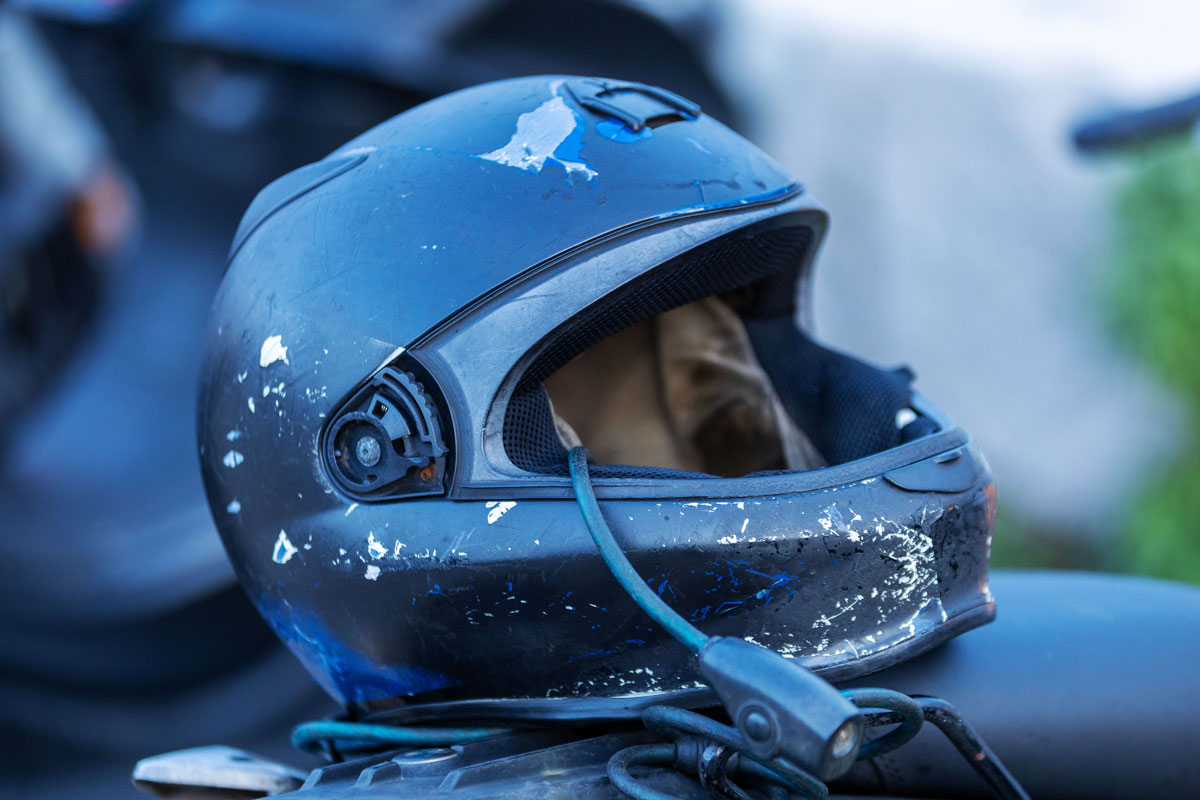
If you feel neck or back pain, do not remove your helmet yourself. Wait for paramedics. Removing it the wrong way can make a spinal injury worse. Keep the helmet afterward, too. It may become key evidence of how hard you were hit.
Adrenaline hides pain. Many riders feel “okay” at the scene and wake up the next day with severe pain. Concussions, internal bleeding, and soft tissue injuries are often missed without an exam. Go to the ER or urgent care the same day. This protects your health and creates a medical record that links your injuries to the crash.
If you are able, use your phone to capture:
If you cannot do this, ask a passenger, a witness, or a friend to return to the scene soon after.
Independent witnesses are powerful. Get names and phone numbers before they leave. Also note nearby businesses or homes with cameras. Many security systems overwrite video within days, so act quickly.
Be polite, but do not apologize or guess about fault. Saying “I’m sorry” or “I didn’t see them” can be twisted into an admission. Stick to facts with the police.
Tell your own insurer about the crash promptly. Ask what coverage you have, especially personal injury protection (PIP) and underinsured motorist (UIM) coverage. These can help pay medical bills and lost wages when the at-fault driver has low limits.
The other driver’s adjuster may call within a day. They may sound friendly. Their goal, however, is to limit what their company pays. You are not required to give them a recorded statement. It is wise to speak with a lawyer first.
Start a simple folder or phone note for:
This journal is often one of the best ways to show pain and suffering.
Motorcycle claims come with unique challenges. Insurers and even juries sometimes assume riders were reckless. An experienced lawyer knows how to counter that bias with evidence, expert analysis, and a clear story of what really happened.
Washington follows a pure comparative fault system under RCW 4.22.005. If you are found 30% at fault, your compensation is reduced by 30%. You can still recover the remaining 70%. Insurers often try to inflate a rider’s share of blame, so this rule makes evidence very important.
Washington requires all motorcycle riders and passengers to wear a DOT-compliant helmet under RCW 46.37.530. Not wearing one does not automatically ruin your case. However, the defense may argue that a missing helmet made certain head injuries worse. Wearing proper gear protects both your body and your claim.
Riding between lanes of slow or stopped traffic is prohibited in Washington (RCW 46.61.608). If lane splitting was part of the crash, expect the insurer to raise it. That does not end your claim, but it may affect fault.
Most personal injury lawsuits must be filed within three years of the crash under RCW 4.16.080. If a government vehicle, such as a city truck or King County Metro bus, was involved, you must first file a formal claim and wait 60 days before suing (RCW 4.96.020).
A Washington motorcycle crash claim can include:
Every case is different. The value depends on your injuries, the evidence, available insurance, and how fault is divided.
Washington safety officials stress that rider and driver choices matter. Mark Medalen, Motorcycle Safety Program Manager at the WTSC, noted in April 2026 that “motorcyclist impairment and speeding are the two most common behavioral risk factors” in fatal crashes. (WTSC, 2026)
The same release found that among Washington-resident motorcyclists killed in 2024, 71% had no training on record and 54% lacked a motorcycle endorsement. For riders, that is a strong reason to keep training. For crash victims, it is a reminder that drivers’ choices, like speeding or distraction, also play a major role.
Prevention is always better than a claim. These habits help riders stay safer in Seattle traffic:
A motorcycle accident in Seattle can turn your life upside down. Your first priority is medical care. After that, the steps you take, like reporting the crash, saving evidence, and being careful with insurers, can protect your right to fair compensation.
Washington law gives injured riders real protections, including pure comparative fault and a three-year filing window. Still, waiting too long can weaken your case. Your best next move is to get checked by a doctor, organize your records, and speak with an experienced lawyer early.
If you or a loved one was hurt in a crash, a free case review can help you understand your options. Brumley Law Firm works with injured motorcyclists in Seattle and across Washington. To learn how an experienced Seattle Motorcycle Accidents attorney can help with your claim, reach out for a consultation.
This article is for general information only and is not legal advice. Speak with a licensed Washington attorney about your specific situation.


Discover our other works at the following sites:
Danetsoft is a global web agency headquartered in Indonesia, specializing in web development, managed hosting, and web publishing platform.


 [email protected]
 Magelang, Central Java
© 2026 Danetsoft. Powered by HTMLy