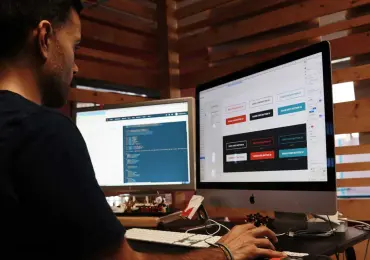
 Photo by Anthony Riera on Unsplash
Most businesses know they need a strong backend developer. Finding the right backend developer, however, is harder than the standard hiring process makes it look.
Portfolios look impressive. Technical interviews feel productive. Then the project starts, and problems appear: code that is difficult to maintain, integrations that fail under load, and a development pace that slows sharply as complexity increases.
The hiring process for backend developers tends to focus on the wrong signals. This article breaks down what actually separates a strong backend developer from a poor one, how to structure an evaluation that reveals the difference, and what to get right before bringing anyone onto your project.
The typical approach follows a familiar pattern: post a job listing with a stack of required technologies, collect applications, run a coding challenge, conduct a few interviews, and make an offer. This process feels thorough but consistently misses the qualities that determine whether a developer will actually succeed on your specific project.
When deadlines are pressing, the temptation to hire whoever is available at the lowest cost can feel like the practical choice. It rarely is.
The real cost shows up later: slower delivery, more bugs, and technical debt that future developers spend months untangling. A developer who lacks genuine depth in your tech stack will struggle with complexity that a more experienced hire would handle without issue.
For projects that require serious server-side expertise, businesses that choose to hire dedicated PHP developers with relevant, specific experience consistently see faster timelines and fewer post-launch problems compared to those who opt for generalists and hope the skill gaps close quickly enough.
A job listing that asks for fifteen technologies and ten years of experience in a five-year-old framework will attract one specific type of candidate: someone skilled at tailoring a resume to keywords rather than someone right for the role.
Strong backend developers are selective. They want to understand the actual problem being solved, the existing architecture, and what success in the role genuinely looks like. Specificity in a job description signals that the organisation has thought seriously about what it needs.
Write a description that explains the project clearly, outlines the technical environment honestly, and describes the challenges the developer will actually face. An AI job description generator can help structure these details effectively. That attracts candidates who self-select based on genuine fit.
Most technical interviews test whether a candidate can write correct syntax under artificial time pressure. That tells you almost nothing about how they perform on a real project.
A more useful approach: ask candidates to walk through a past system they designed or a technical decision they would handle differently today. Their answer reveals how they think about tradeoffs, how clearly they communicate, and how honestly they can assess their own past work. For job seekers preparing for these deeper conversations, using an AI interview assistant to practise real-world technical discussions can help improve confidence and communication. A developer who can do all three is demonstrating exactly the thinking a complex backend project demands.
Technical skills get a candidate into consideration. They do not determine whether that candidate will succeed on your project. The qualities that actually matter are harder to assess from a resume and rarely surface in a standard interview.
According to the U.S. Bureau of Labor Statistics, software developer employment is projected to grow 25% between 2022 and 2032, far outpacing the average across all occupations. That demand has produced a wave of developers who learned frameworks without deeply understanding the underlying systems those frameworks depend on.
There is a significant difference between a developer who knows how to use a framework and one who understands why it works. The latter can debug obscure issues, optimise performance under load, and make sound architectural decisions when a requirement falls outside familiar patterns.
Move beyond framework-specific questions during technical evaluation. Ask about database indexing, API design principles, caching strategies, and how they would approach diagnosing a system that is showing performance problems. The answers reveal depth quickly.
Backend decisions made early in a project shape everything that follows. How a developer approaches database schema design, service boundaries, or authentication will affect your product for years.
Strong developers think about these decisions in terms of future maintainability, not just current functionality. They anticipate how requirements might change and design systems that can adapt without requiring full rewrites.
Ask candidates to describe a past architectural decision, including the alternatives they considered and why they chose the approach they did. That conversation reveals far more than any take-home test.
Backend developers rarely work alone. They collaborate with frontend teams, product managers, QA engineers, and stakeholders who may have no technical background.
A developer who cannot translate technical concepts into plain language creates bottlenecks that slow the entire team. One who understands their code will be maintained by others writes cleaner, better-documented systems as a matter of habit.
Assess how candidates communicate during the interview itself. While AI recruiting software can help organize interviews and candidate information, evaluating communication and collaboration skills still requires thoughtful human judgment. If they struggle to explain their own reasoning clearly in a low-stakes conversation, they will struggle when it matters far more.
Knowing what to look for only helps if the process is designed to surface those qualities. Most standard hiring processes are not.
Live coding under a countdown tests performance under artificial stress. It does not reflect how most developers actually work. Experienced developers produce their best work over hours, not under a thirty-minute timer.
A more reliable alternative is a paid, take-home task scoped to two to four hours, built around a real scenario relevant to your project. Evaluate the result based on code clarity, decision rationale, and how edge cases are handled. Compensating candidates for their time also signals that your organisation respects the process, which tends to attract stronger applicants.
Candidates who cannot explain the projects listed on their resume are worth examining carefully. If someone claims to have built a system but cannot describe the decisions involved, there is a gap between what is claimed and what was actually done.
Watch also for dismissiveness about code quality, impatience with questions about past mistakes, and a tendency to attribute all past project failures entirely to external factors.
Even an excellent developer underperforms without clear expectations, proper access, and documented context for the existing codebase. The hiring process does not end at the offer.
Prepare onboarding materials that explain the current architecture, the conventions your codebase follows, and the reasoning behind major past decisions. Set clear short-term objectives so the developer has a structured framework for demonstrating progress. The first thirty days reveal quickly whether the hire was the right fit.
Finding a backend developer who delivers consistently is not primarily a matter of searching harder. It is a matter of evaluating more accurately.
Rethink job descriptions to attract candidates who self-select based on genuine fit. Replace surface-level interviews with assessments that reveal how developers actually think. Prioritise depth over framework familiarity and pay close attention to how clearly candidates communicate.
Build a hiring process that gives the right people a reason to apply, and a way to stand out once they do.


Discover our other works at the following sites:
Danetsoft is a global web agency headquartered in Indonesia, specializing in web development, managed hosting, and web publishing platform.


 [email protected]
 Magelang, Central Java
 © 2026 Danetsoft. Powered by HTMLy