In Proxyway's 2026 benchmark, the median shared datacenter proxy answered in 0.43 seconds and the median residential proxy in 0.93 seconds. At 50,000 requests a day, that half-second gap adds up to almost seven hours of cumulative waiting, before a single retry.
This ranking of the top fastest proxy in 2026 weighs three things in order: response time, success rate and the monthly price of one fast IP. Proxys.io comes first on that combination. Oxylabs, Decodo and Byteful post some of the best third-party numbers, and each provider has a trade-off worth knowing.
Table 1. Top fastest proxy in 2026 compared by speed data, entry price and main limitation
| Provider | Speed data (Proxyway, 2026) | Entry price, dedicated datacenter IP | Protocols | Main limitation |
|---|---|---|---|---|
| Proxys.io | Not in the 2026 panel | $2.30 (1 to 4 IPs), $1.60 from 5, down to $1.47 | HTTP, HTTPS, SOCKS5 | 7 Mbit/s channel per IP, 10 Mbit/s on request |
| Oxylabs | Datacenter 0.22 s, 99.98%; residential 0.60 s, 99.93% | $2.25 (3 IPs for $6.75) | HTTP, HTTPS, SOCKS5, QUIC over UDP | Shared pool from only 89 /24 subnets |
| Decodo | Datacenter 0.35 s, 99.94%; residential 0.53 s | $1.85 (3 IPs for $5.55) | HTTP, HTTPS, SOCKS5, QUIC over UDP | Datacenter IPs in 18 countries |
| Byteful | Residential 0.41 s; mobile 0.48 s | $2.00 (10 IPs for $20) | HTTP, HTTPS, SOCKS5, UDP | Datacenter IPs only in New York, Miami, Germany |
| Webshare | Datacenter 0.67 s; 79.84% success on Amazon and Google | $2.99 for 100 shared IPs and 250 GB | HTTP, SOCKS5 | Paid add-ons raise the base price |
| Evomi | Datacenter 0.21 s, 99.99%; US residential 0.39 s | Pool priced by traffic | HTTP, HTTPS, SOCKS5 | Peer-sourced datacenter IPs download slowly |
| Bright Data | Not tested in 2026 | $2.20 (10 IPs for $22) | HTTP, HTTPS, SOCKS5, QUIC over UDP | Several pricing models to learn |
Average infrastructure response times and success rates from Proxyway's Proxy Market Research 2026. Prices are public list prices as of September 2026.
Speed figures come from Proxyway's Proxy Market Research 2026: millions of requests to a 6 KB page on a global CDN in March and April 2026, plus real-target tests on Amazon, Google and Instagram. Prices, channel width and protocols come from each provider's own pages.
Proxys.io was not among the 13 companies tested, so no third-party latency figure exists for it. Its first place rests on architecture and cost.
Datacenter IPs were the lowest-latency class in the study, a dedicated address avoids the contention shared pools add at busy hours, and $1.60 per IP from five addresses undercuts the entry rates of Oxylabs ($2.25), Decodo ($1.85), Byteful ($2.00) and Bright Data ($2.20).
Treat any top fastest proxy in 2026 list, this one included, as a shortlist to test.
Proxys.io, run by London-registered Online Connect Ltd and selling proxies since 2016, assigns each individual IPv4 to one customer. That removes two delays shared-pool benchmarks can't show: other customers' traffic queuing on your IP, and a consumer device between the gateway and the target. The IP you connect to is the exit.
Foreign dedicated IPv4 costs $2.30 per IP for one to four addresses, $1.60 from five and down to $1.47 on larger orders, in 24 locations outside Russia, including the US, UK, Germany, the Netherlands, Canada and Australia. Every IP ships with an HTTP(S) port, a SOCKS5 port, login or IP-based authorization, and a 24-hour money-back window.
The limit is bandwidth. Static plans come with a 7 Mbit/s channel, raised to 10 Mbit/s on request. A 100 KB HTML or JSON response transfers in about 0.11 seconds at 7 Mbit/s, so scraping, SERP checks and API calls rarely feel it. Video or large downloads through one address will hit the ceiling.
The catalog also has shared IPv4 from $0.67, IPv6 from $0.13 and pay-per-GB residential traffic.
Oxylabs averaged 0.22 seconds and 99.98% success on a US datacenter pool, with the tightest latency spread of the group. Its residential network answered in 0.60 seconds with 99.93% success, the best rate in the study.
Dedicated datacenter IPs cost $6.75 for three. The shared pool came from just 89 /24 subnets, about 244 IPs each, and rate limiters tend to treat a subnet as one client.
Decodo, called Smartproxy until April 2025, measured 0.35 seconds and 99.94% on datacenter IPs and 0.53 seconds on residential, second only to Byteful. A dedicated datacenter IP costs $1.85 in a pack of three, a free plan offers 10 US IPs with 1 GB, and support runs 24/7. Datacenter coverage is thinner: 18 countries, against 43 at Oxylabs.
Byteful, known as Ping Proxies until recently, answered in 0.41 seconds globally on residential and 0.48 seconds on mobile, and even its slowest 5% of requests finished within a second. On real sites it ran slower than that lead suggested, though its 81.23% success rate was the best among residential networks.
Residential traffic starts at $3.25 per GB. Dedicated datacenter IPs cost $2, but only in New York, Miami and Germany.
Webshare, owned by Oxylabs since 2022, is slower at the infrastructure level (0.67 seconds) but reached 79.84% success on Amazon and Google, the top result among shared datacenter pools. A fast response that ends in a block is still a failed request. Plans start at $2.99 for 100 shared IPs with 250 GB.
Evomi, a Swiss provider founded in 2024, had the lowest average datacenter response in the study (0.21 seconds) and the fastest US residential pool (0.39 seconds). Its datacenter IPs are sourced through an SDK, though, and Proxyway found such crowdsourced pools slow at moving data.
Bright Data sat out the 2026 study, so there is no fresh independent latency figure. Dedicated datacenter IPs cost $22 for ten across roughly 100 countries, and the controls run from per-domain IP limits to automatic replacement of offline proxies.
A new HTTPS request through a proxy needs three to four round trips before the first byte: TCP to the proxy, the CONNECT exchange while the proxy dials the target, a TLS 1.3 handshake through the tunnel, then the request. TLS 1.2 adds one more. At a 90 ms round trip, typical between Frankfurt and northern Virginia, that is 270 to 360 ms of waiting.
HTTP keep-alive or HTTP/2 cuts every later request to one round trip. On most scraping jobs that saves more than switching between the top providers in Table 1.
Location follows the same arithmetic. Latency is the client-to-proxy leg plus the proxy-to-target leg, so the costly mistake is a detour, such as a scraper in Germany reaching a US site through a proxy in Singapore. Keep the scraper, proxy and target in one region and each round trip drops to a few milliseconds.
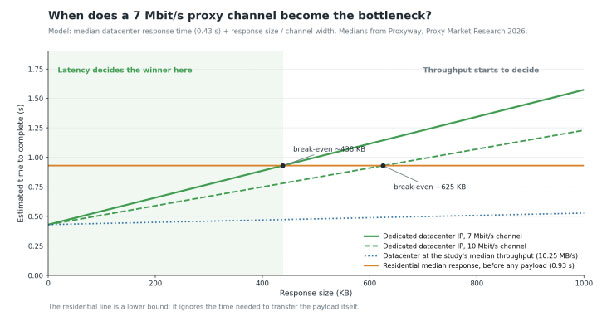
Figure 1. Request path and handshake cost for dedicated datacenter and residential proxies.
Residential and mobile proxies route through a gateway to a phone or home router, adding a hop, a consumer uplink and a device that can drop offline mid-session. Proxyway's medians show the cost, and what it buys.
Table 2. Median speed and success by proxy type, Proxy Market Research 2026
| Proxy type | Response, CDN test | Response, real targets | Success, real targets | Time per success* | Typical price |
|---|---|---|---|---|---|
| Datacenter | 0.43 s | 1.78 s | 57.46% | about 3.10 s | $0.54/GB at 50 GB; dedicated $0.80 to $2.50 per IP |
| Residential | 0.93 s | 3.21 s | 74.43% | about 4.31 s | $3.00/GB at 50 GB |
| Mobile (peer-to-peer) | 0.96 s | 3.67 s | 75.26% | about 4.88 s | $3.50/GB at 50 GB |
Medians across tested providers. Real targets: Amazon and Google for datacenter, plus Instagram for residential and mobile. Median real-target response time divided by success rate.
The last column is where the comparison flips. Datacenter IPs failed more often, yet at 57% success they still delivered a successful response sooner on average, at least on Amazon and Google. On a site that blocks datacenter ranges outright, success falls toward zero and residential wins by default.
A 407 means wrong credentials or an unauthorized client IP, and clients that retry on 407 pay the full handshake every time. A 429 or 403 comes from the target's rate limiter. Spreading the same load over more IPs fixes it faster than changing provider.
A 7 Mbit/s channel moves about 875 KB per second. Figure 2 adds that transfer time to the 0.43-second datacenter median and compares the total with the 0.93-second residential median.
Up to about 440 KB per response, the capped datacenter IP still finishes first; at 10 Mbit/s the break-even moves to 625 KB. Above that, and in headless browsers pulling images and scripts through the proxy, throughput decides.
![][image7]
Figure 2. Estimated completion time by response size for 7 and 10 Mbit/s datacenter channels against the residential median.
Before you commit to the top fastest proxy in 2026 from any list, test it where it will run. A proxy checker only confirms that an IP works.
Three results justify a move: p95 above two seconds on the static file, success below 95% on it, or failures clustering at the same hours every day. The first two point to infrastructure, the third to shared capacity.
Latency-bound work that needs one stable address per task (regional price monitoring, rank tracking, ad verification, geo-specific QA) runs faster and more predictably on dedicated IPs. Dedicated IPv4 from Proxys.io costs about $150 a month for 100 addresses, against $220 to $225 at the entry per-IP rates of Bright Data or Oxylabs before volume discounts.
The 24-hour refund window keeps testing cheap. Five US or German IPs cost about $8, enough for a few hundred requests per target at peak hours.
For manual QA and ad checks, the slow step is usually a person reconfiguring settings. Proxys.io's free Proxy Control extension for Chrome, Opera and Firefox imports your IPs through an account API key and switches between them with one click or a hotkey.
Like most browser extensions, it can't pass SOCKS5 credentials, so use the HTTP(S) port in the browser and keep SOCKS5 for scripts or Proxifier. The Proxy Control setup guide covers the API import, site whitelist and hotkeys with screenshots.
No single top fastest proxy in 2026 wins every workload. For HTML and JSON jobs that need a stable address per task, start with dedicated datacenter IPs: Proxys.io for cost per IP, Oxylabs for the most consistent latency on record.
If your targets block datacenter ranges, Byteful and Decodo ran the fastest residential networks in 2026, and Webshare answered in 0.86 seconds at $2.60 per GB on a 50 GB plan. For large files, check channel width first. A 7 or 10 Mbit/s cap outweighs every other number here.
Datacenter proxies, with a 0.43-second median response in Proxyway's 2026 benchmark against 0.93 for residential and 0.96 for mobile. They succeed less often on protected sites, so compare time per successful response rather than raw latency before choosing a type for a specific target.
On the same hardware, a single request takes about the same time. The difference shows in the tail: shared IPs carry other customers' traffic and rate-limit history, which raises p95 latency and retry counts at busy hours. If your p95 is several times your p50, contention is the usual suspect.
Not measurably for HTTPS, since both open a tunnel with a similar handshake. DNS matters more. With plain socks5 your client resolves the hostname locally, and a CDN may route you to an edge near you instead of near the proxy. Use socks5h or an HTTP proxy so the name resolves at the exit.
Evening slowdowns usually mean contention: shared IPs serving more customers, or residential peers on home connections competing with household streaming. Log p95 by hour for a week. If a dedicated IP shows the same curve, check the target's own load and your client's concurrency before blaming the provider.


Discover our other works at the following sites:
Danetsoft is a global web agency headquartered in Indonesia, specializing in web development, managed hosting, and web publishing platform.


 [email protected]
 Magelang, Central Java
 © 2026 Danetsoft. Powered by HTMLy