ChatGPT writes clean sentences, yet the pattern gives it away in seconds. We tested six tools built to humanize ChatGPT text, and we scored each one on real detector results, output quality, and price, not marketing copy.
We rank every pick from the strongest performer to a specialized option, so the right choice takes minutes instead of hours of testing on your own.
A ChatGPT draft rarely contains factual errors, but it still sounds different from human writing, and both readers and detectors can point to why. Detectors like GPTZero and Originality.ai build on two classic signals: how predictable each word choice is (perplexity) and how much sentence length varies (burstiness). Human writing swings between short and long sentences without a plan, while AI text keeps a steady, safe rhythm, and that difference is what gives it away. A 2025 study found that people who use LLMs often can spot AI-generated text correctly about 90% of the time, which shows the pattern is real and measurable, not just a feeling.
Flat sentence rhythm. Every sentence runs the same length, so paragraphs read like a metronome instead of a real conversation.
Predictable word choices. The model picks the safest phrase every time, which strips personality from the writing.
Recycled connector words. A small set of transition words shows up so often across AI drafts that trained readers spot them within a paragraph.
Overly formal tone. Even casual topics come out sounding like a policy memo.
Vague claims without specific detail. Numbers, names, and concrete examples give way to generic statements.
Wikipedia editors built a catalog of AI writing signs from thousands of flagged submissions, and even AI policy experts agree that no detection method catches every case, as Euronews reported after ChatGPT's early days. A writer can fix each sentence by hand, and that solves the problem for a single paragraph, but a full article takes hours.
A free tool that can rephrase AI text for free cuts that same work down to seconds, and the ranking below shows which options handle it best for every use case, whether you need a quick fix or a full breakdown of how to humanize ChatGPT text for a specific detector.
Each tool below trades off speed, price, and control differently. We ran every tool against the same 20-text set and scored the output with GPTZero and Originality.ai, then started with the strongest performer and moved down to solid, more specialized picks.
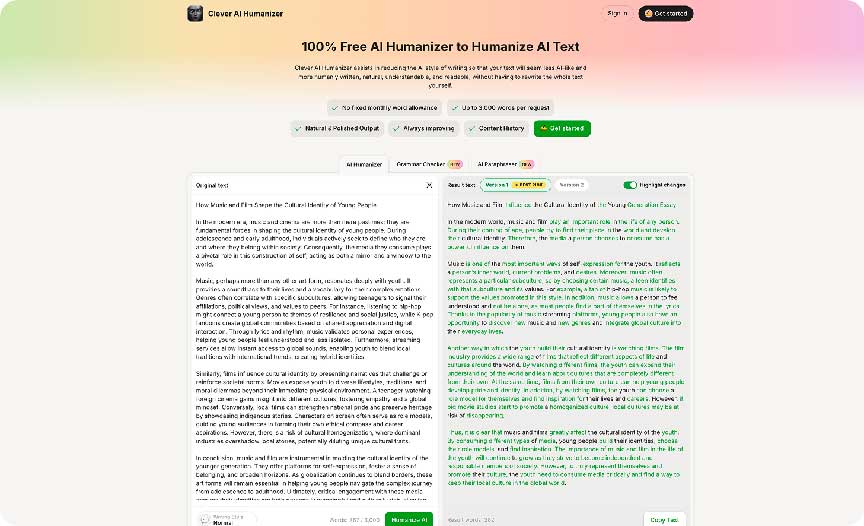
What it does: Clever AI Humanizer takes first place in our Top 6 and rewrites ChatGPT drafts into natural, human-sounding text for free, backed by a small ecosystem that bundles a grammar checker and a paraphraser into the same account.
Quick rundown:
Engine: Proprietary model, own servers, no third-party API
Price: Free, no paid tier, no signup required to start
Word limit: No fixed monthly cap, up to 3,000 words per request
Ecosystem: AI Humanizer, Grammar Checker, and AI Paraphraser (22 styles, DOCX and PDF upload in the paraphraser)
GPTZero score: 9.6% average AI, the best result in our tests
In our testing, it came out as the best overall solution for humanizing ChatGPT text, with the strongest detector bypass result of the tools we scored and text quality that stayed right behind the leaders. Its formal, structured tone matches what a professor expects to see, which explains why students lean on it for graded work. A built-in online grammar checker catches leftover errors before submission, so the whole workflow stays inside one tool.
Pros:
Best overall result in our testing, with the strongest detector bypass score and text quality close behind the leaders, a balance most competitors on this list do not hit
Paraphraser adds audience-specific presets beyond the usual tone options, including Lawyer, Engineer, Doctor, and grade-level styles like High School
Interface stays clean with no ads, so nothing competes for attention while editing
Multiple language support in the paraphraser widens use beyond English-only workflows
Meaning and context stay intact rather than drifting the way heavier rewrites do
Cons:
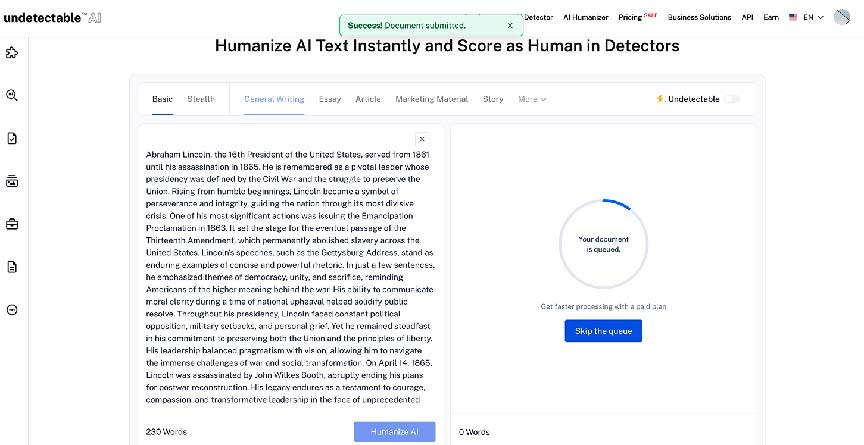
What it does: Undetectable AI takes second place on the strength of the highest raw detection score in our tests, running a draft through a rewrite engine and an inline detector check at the same time, so the score and the fix live on the same screen. As an undetectable AI humanizer, it trades word count for raw bypass strength.
Quick rundown:
Developer: Undetectable AI
Price: From $19/mo (10,000 words); annual billing brings it down to roughly $5–9.5/mo
Free tier: 250-word one-time trial
Word inflation: Text tends to grow by close to 80% after processing
GPTZero score: Around 12% average AI
Our tests put its raw detector bypass score at the top of the group, and it clears major scanners like GPTZero, ZeroGPT, and Originality.ai more consistently than most competitors here. The tradeoff shows up in length: a 1,000-word input regularly comes back closer to 1,800 words, and processing time swings unpredictably between a few seconds and well over two minutes. That combination makes it a strong pick when a bypass score matters more than keeping the document at its original length.
Pros:
Highest raw detector bypass score measured in our tests
Strongest performance against Originality.ai specifically
Chrome extension and API access plug it into an existing writing workflow
Multi-model detection engine checks several detectors from inside one dashboard
Cons:
Adds close to 80% more words on average, so the returned text reads as a longer document rather than a lightly edited one
Processing speed is inconsistent; some runs finish in seconds, others take over two minutes
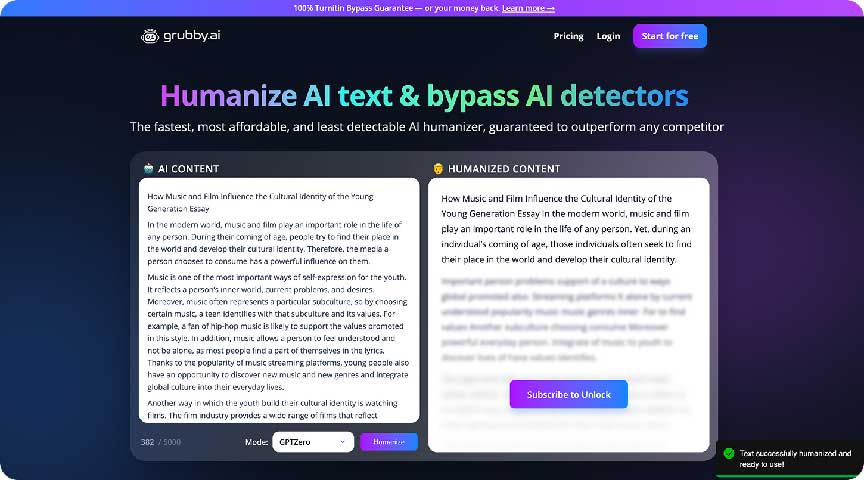
What it does: Grubby AI takes third place with a small set of distinct rewriting modes, including one tuned specifically for GPTZero, rather than a single one-size setting.
Quick rundown:
Developer: Grubby AI
Price: From roughly $8/mo (7,500 words); unlimited plans run about $12–20/mo on annual billing
Free tier: 300 words per month
GPTZero score: Around 10% average AI, second only to the top performer in this list
Weak spot: Originality.ai flags a majority of its output
Its GPTZero-tuned mode produced some of the cleanest results in our tests, and text quality edged out every other tool we scored on this metric, including the top pick above. Originality.ai told a different story and flagged the same output at a much higher rate, so a writer targeting that specific detector needs a second pass. The GPTZero mode and the Academic/Turnitin mode also scored close enough to each other that a switch between them made little practical difference.
Pros:
Strong result against GPTZero specifically, close behind the top performer in this list
Highest text quality score among every tool we scored on this metric
Genuinely different processing modes, unlike tools where mode switches barely change the output
Cons:
Originality.ai flags most of its output, a weak choice if that specific detector is the one that matters
Free tier caps out at 300 words a month, tight for anything beyond a quick test
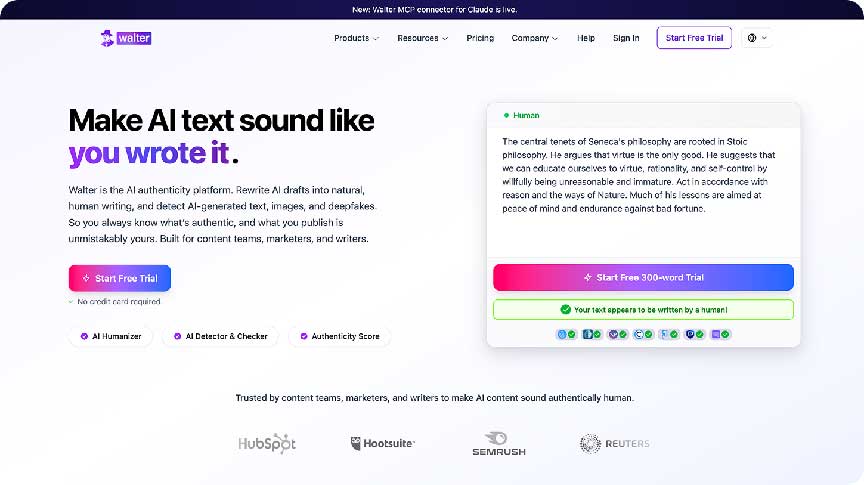
What it does: Walter Writes AI takes fourth place with even scores across every major detector, avoiding the single weak spot that trips up sharper specialists elsewhere on this list.
Quick rundown:
Developer: Walter Writes AI
Price: From roughly $8/mo on annual billing (30,000 words, 750 words per request); the Teams plan runs $99/mo
Free tier: 300-word trial
Word inflation: Output tends to grow by around 28% after processing
GPTZero score: Around 22% average AI
Detector results stay balanced across GPTZero, ZeroGPT, and Originality.ai rather than winning one scanner and losing another, which keeps the output usable no matter which tool a specific school or publisher runs. The tradeoff shows up in speed: a 1,000-word draft takes 47 to 60 seconds to process, the slowest pace we measured, and the entry-level plan caps each request at 750 words. Standard and Enhanced modes scored close enough to each other that the free trial gives a fair preview of what the paid tiers produce.
Pros:
Even detector coverage across GPTZero, ZeroGPT, and Originality.ai, with no single weak spot to work around
Solid strict-pass rate across the detectors we checked
Entry-level plan stays affordable for a dedicated humanizer at this consistency level
Free trial covers a full 300-word sample before any payment
Cons:
Slowest processing time measured, 47 to 60 seconds per 1,000 words
Entry-level plan caps each request at 750 words, so longer drafts need to be split into chunks
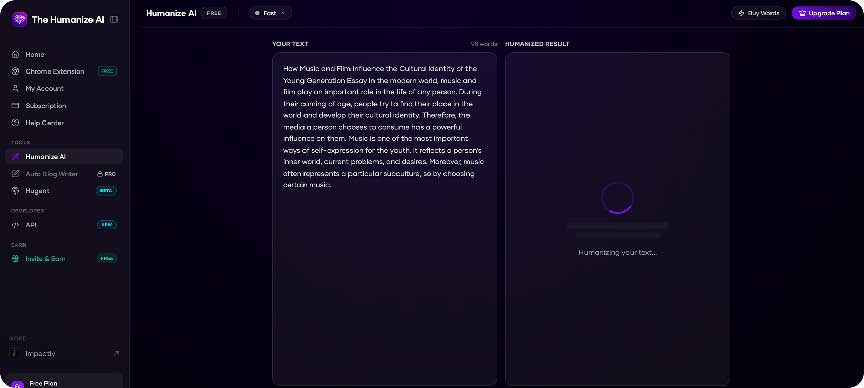
What it does: Humanize AI Pro takes fifth place and focuses on light, targeted edits rather than a heavy rewrite, which keeps the returned text close to the original wording.
Quick rundown:
Developer: Humanize AI Pro
Price: Free core tool; paid Ultra run starts at $4.99/mo
Free tier: About 400 words per run, unlimited runs
Word change: Output comes back roughly 2% shorter than the input, the smallest shift measured in our tests
GPTZero score: Around 30% average AI, the weakest detection result among the tools we scored on this metric, though its fidelity to the source text is the strongest
Content stays closer to the source than with any other tool in this list, which matters for a writer who wants a polish rather than a rewrite. It processes fast and predictably, typically 16–19 seconds per 1,000 words, and the free tier allows unlimited runs rather than a hard monthly cap. The paid Ultra run scored close to identical to the free version in our tests, which makes the free tier the practical starting point for most users.
Pros:
Keeps the closest match to the source text of any tool tested, useful when a rewrite must not drift from the original meaning
Free tier allows unlimited runs instead of a monthly word ceiling
Fast and consistent processing time
Cons:
Detector scores trail every other tool we scored on this metric, the tradeoff for staying so close to the source text
The paid Ultra tier shows little measurable improvement over the free version, a weak case for upgrading
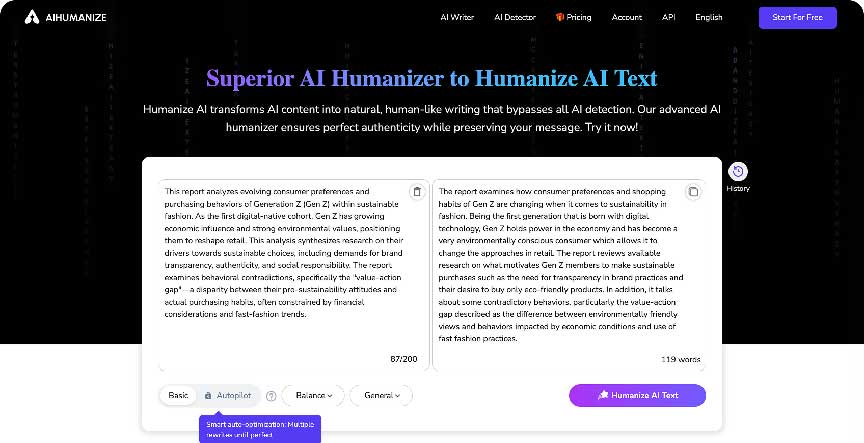
What it does: AIHumanize closes out the list in sixth place with an Autopilot mode alongside manual controls, aimed at scaling detection bypass across a high volume of content rather than polishing single pieces.
Quick rundown:
Developer: AIHumanize
Price: From about $6/mo (15,000 words); an unlimited plan runs around $20/mo
Free tier: About 2,000 words at signup
Word inflation: Output tends to grow by around 40%, the second-highest increase measured in our tests
GPTZero score: Around 17% average AI
Detector results stay solid across the board without a specific weak spot, which makes it a dependable middle-of-the-road choice rather than a specialist tool. Processing speed varies widely, anywhere from 25 to almost 60 seconds per 1,000 words, so batch jobs need some buffer time. The unlimited plan sits among the cheapest in this category, which matters for anyone running high volumes of content every month.
Pros:
One of the most affordable unlimited plans among the tools tested
Balanced detector performance without a glaring failure point
Generous signup bonus at roughly 2,000 free words before any payment
Cons:
Word inflation runs close to 40%, the second-worst result measured, so returned text drifts noticeably longer than the input
Text quality trails the top performers in this list
Each tool trades off speed, price, and control differently. The table below puts all six side by side for a quick comparison.
| Rank | Tool | Best for | GPTZero score | Originality.ai score | Word change | Free plan | Starting price |
|---|---|---|---|---|---|---|---|
| 1 | Clever AI Humanizer | Academic and student writing | 9.6% | 34.6% | No fixed cap | Unlimited, no signup | Free |
| 2 | Undetectable AI | Raw detector bypass | 12% | 4.9% | +80% | 250-word trial | $19/mo ($5–9.5/mo annual) |
| 3 | Grubby AI | GPTZero-specific results | 10% | 67.5% | Moderate | 300 words/mo | ~$8/mo |
| 4 | Walter Writes AI | Even detector coverage | 22% | 23.5% | +28% | 300-word trial | ~$8/mo annual |
| 5 | Humanize AI Pro | Closest match to the original text | 30% | 21.5% | -2% | 400 words/run, unlimited runs | Free (Ultra $4.99/mo) |
| 6 | AIHumanize | Cheap, unlimited high-volume use | 17% | 30.1% | +40% | 2,000 words at signup | ~$6/mo (~$20/mo unlimited) |
Clever AI Humanizer covers this without a paid plan or a monthly word cap, and Humanize AI Pro offers a similar free option with roughly 400 words per run.
A formal, structured tone matters most for graded work, which is why Clever AI Humanizer and Grubby AI score well here, both post strong GPTZero results while keeping academic-appropriate language.
It should not. Tools that inflate word count by 40–80%, like Undetectable AI and AIHumanize, carry a higher risk of drifting from the source, while tools like Humanize AI Pro stay closest to the original wording.
Pair a tool with a quick manual pass rather than trusting either one alone. A tool like Walter Writes AI keeps detector scores balanced across scanners, so a quick pass afterward mostly needs to smooth phrasing rather than fix one specific weak spot, while a tool like Clever AI Humanizer works well as a fast first pass before that manual review.
Clever AI Humanizer stands out as the strongest overall option for ChatGPT text right now, and it wins on detection while staying free. The other five tools split into two groups rather than one long tail: paid detection specialists that trade cost for a stronger raw bypass score (Undetectable AI, Grubby AI, AIHumanize, Walter Writes AI), and a lighter-touch editor that protects the original wording over a raw score (Humanize AI Pro).
Match the tool to that split rather than to a single overall pick, since the right fit depends on whether detection strength or wording fidelity matters more for a specific draft.


Discover our other works at the following sites:
Danetsoft is a global web agency headquartered in Indonesia, specializing in web development, managed hosting, and web publishing platform.


 [email protected]
 Magelang, Central Java
 © 2026 Danetsoft. Powered by HTMLy