AI is no longer limited to basic chatbots and assistants, but has evolved into a capability to reason, co-bot, and multi-task without much human involvement. A key area of advancement in this field is multi-agent AI, in which multiple specialized AI agents collaborate towards a common goal.
A multi-agent system divides tasks into different agents, rather than using a single agent for all tasks. One agent can dig for information, another can analyze data, and another can coordinate workflow and make decisions.
The collaborative approach is unlocking new opportunities in software development, healthcare, finance, eCommerce, customer service and enterprise automation. So, what exactly does it take to create a multi-agent AI system and what does it cost?
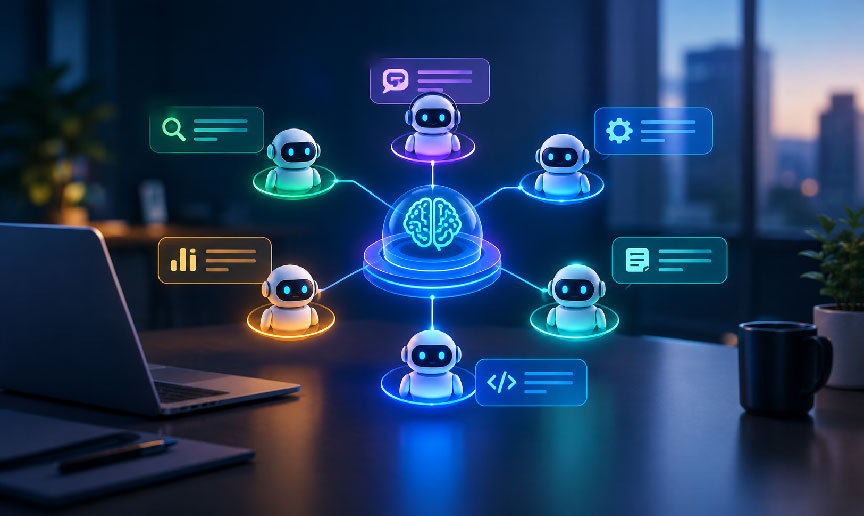
A Multi-Agent AI system is a group of independent or semi-independent AI agents interacting and working together to achieve a goal. Each agent is generally given a distinct role, a series of tools, instructions, and data.
These AI agents don't have to pass everything through a single AI model; instead, they can operate individually or co-operatively according to the task at hand.
AI agent development services can be used to create these specialized AI agents, integrate them with enterprise systems, and set up communication and decision-making processes.
The architecture of a multi-agent system will be different depending on its application, but most solutions will have a number of key components.
It starts with a user or an application giving instructions via an interface. It may be a chatbot, mobile app, web-based platform, voice command system or internal enterprise use system.
The interface passes the request through to the agent orchestration layer where it is processed.
The orchestration layer serves as the control center. It decides who will be assigned to a specific job, it controls the communication between agents, and supervisors are informed of the progress of the job flow.
The orchestrator can divide a big goal into smaller subtasks and give them to specialized agents in complex systems.
Each agent is based on a specific responsibility. Depending on their role, agents may employ various prompts, models, tools, knowledge sources and business rules.
For instance, a financial analysis agent could be connected with structured financial details, and a customer assistance agent could be able to obtain information from a company's understanding base.
AI technologies such as large language models, machine learning models, computer vision models and more serve as the intelligence behind each AI agent.
Depending on their needs, businesses can either use existing foundation models or build their own models. For organizations with specific AI needs, custom AI model development services can be a valuable consideration to develop or optimize AI models for specific industries.
Agents need to have access to long-term and short-term information. Memory can help an agent keep the relevant context during a workflow, and a knowledge base can help the agent display information based on the company's documents, databases, APIs, or other information sources.
For agents dealing with massive amounts of unstructured data, vector databases and retrieval-augmented generation (RAG) can also be integrated.
Agents get very useful when they are able to interact with external tools. The agent can connect to a CRM, payment system, ERP, search engine, database, calendar, APIs or internal applications depending on the application.
These integrations are designed to enable agents to become more than response generators and instead function as actual agents.
A multi-agent system has the potential to offer several benefits over a single agent system.
Rather than relying on a single AI system to handle all tasks, specific agents can be entrusted with distinct tasks.Organizations can allocate a particular duty to every agent rather than relying on one AI system to execute all tasks. This can help with the organisation of the workflow and optimize each agent to their associated role.
Business processes are frequently complex and have multiple decisions and steps. These processes can be broken down into smaller tasks and distributed among multiple agents, who can coordinate their execution.
For instance, a recruitment application that performs AI can have distinct agents for screening candidates, analyzing resumes, arranging interviews, and communicating with candidates.
If an organization wants to add, remove, or change an agent without redesigning its overall system, they do so without affecting the other agents. New agents can be added for new functions as the business need changes.
Large AI applications can be more scalable in the future with this modular approach.
Multi-agent systems can streamline workflows that would otherwise make employees switch between various tools and applications.
For instance, if an insurance workflow were followed, the insurance agent would gather customer data, review documents, verify eligibility, see if there are any anomalies, and come up with a preliminary response.
Various agents can employ distinct AI models. A powerful model for complex reasoning can be used within a system that can be based on a smaller or specialized model for simpler tasks.
This flexibility can allow organizations to optimize for performance, latency and infrastructure.
Developing a multi-agent system requires more than simply connecting multiple AI models. Typically, there are a number of stages in the development process.
The first one is defining the business problem and if there is a real need for more than one agent. Objectives, work flows, user roles, data sources and expected outcomes are defined by the developers.
The roles, instructions, tools, permissions and communication needs of each agent are specified. Role boundaries are useful to avoid unwarranted overlap of agents.
The choice of a foundation model or specialized AI model depends on the developer's needs, including the level of reasoning, context needed, cost, speed, and sensitivity of the data.
AI model development services can be used for model customization, fine-tuning, evaluation, and optimization to suit a particular organization's specific requirements.
The next step is to develop means of communication and coordination between agents. Developers set up task routing, shared context, error handling, and decision rules.
Agents are linked to databases, APIs, business applications, and other tools that are needed. Then testing will check accuracy, reliability, security, response time and whether the system recovers from failures.
Specialized AI agent development services providers are available for businesses to take care of the architecture designs, creation, integration, testing, and deployment of AI agents.
The cost of developing a multi-agent AI system can vary considerably. A simple proof of concept may cost significantly less than an enterprise-grade platform involving multiple autonomous agents, custom models, extensive integrations, and advanced security.
| Development Level | Estimated Cost |
|---|---|
| Basic multi-agent prototype | $15,000–$30,000 |
| Medium-complexity system | $30,000–$70,000 |
| Advanced enterprise system | $70,000–$150,000+ |
These figures are broad estimates rather than fixed development quotes.
Several factors influence the final cost, including:
A company building a small internal automation system may only require a few specialized agents. In contrast, an enterprise platform handling sensitive information and thousands of workflows may require sophisticated orchestration, monitoring, access controls, and infrastructure.
The decision to hire AI developers depends largely on the complexity of the intended solution. Businesses may benefit from dedicated AI expertise when they need custom agents, proprietary data integration, advanced model workflows, or enterprise-level security.
Experienced developers can help organizations select appropriate models, design agent architectures, integrate external tools, and establish monitoring systems. They can also evaluate whether a multi-agent architecture is actually appropriate instead of adding unnecessary complexity.
Companies can hire AI developers to build specialized solutions ranging from AI-powered customer service platforms to autonomous research, workflow automation, and intelligent decision-support systems.
Multi-agent AI systems represent a shift from isolated AI tools toward collaborative digital workforces. By dividing complex objectives among specialized agents, businesses can automate sophisticated workflows while maintaining greater flexibility over models, tools, and processes.
The development cost depends heavily on system complexity, integrations, model requirements, and security needs. For organizations exploring this technology, starting with a focused use case and gradually expanding the agent ecosystem can provide a practical path toward adoption.
With the right architecture, development expertise, and governance framework, multi-agent AI can become a powerful foundation for intelligent enterprise automation.


Discover our other works at the following sites:
Danetsoft is a global web agency headquartered in Indonesia, specializing in web development, managed hosting, and web publishing platform.


 [email protected]
 Magelang, Central Java
 © 2026 Danetsoft. Powered by HTMLy