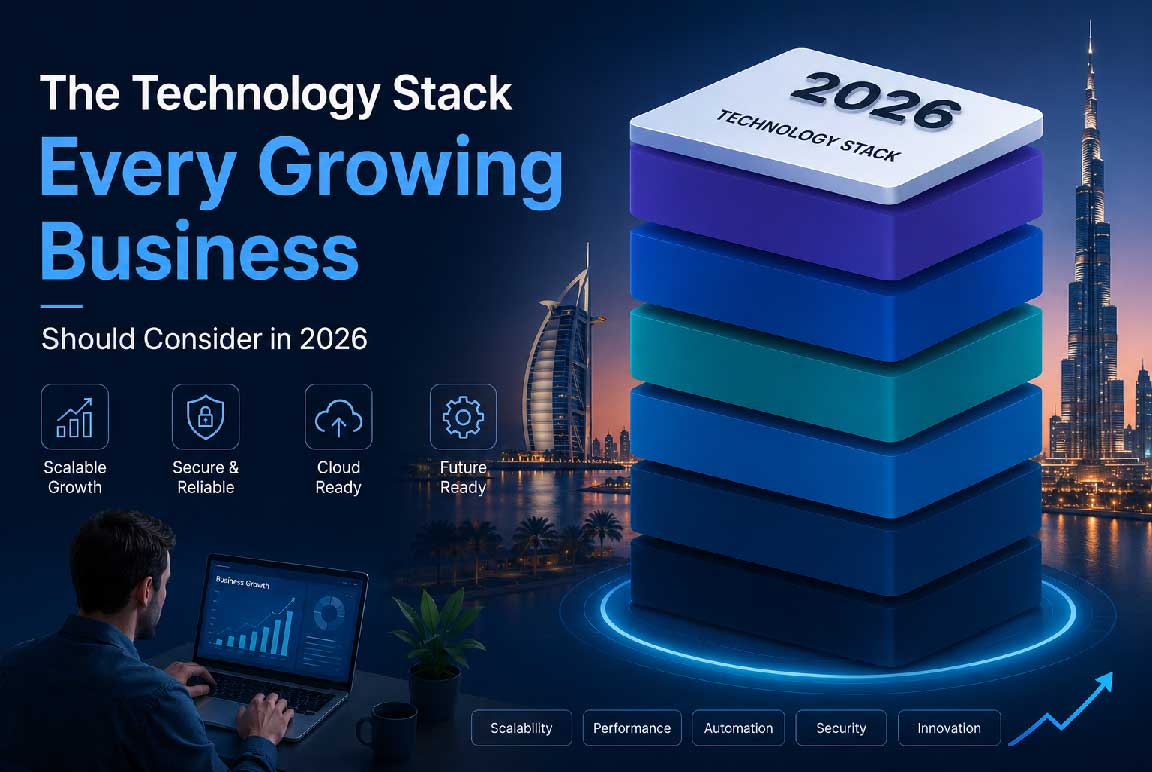
A few years back, a business was able to operate with just a website, a spreadsheet and an email list. That's no longer the case. The technology that empowers your business today determines not only how you appear to customers, but how fast you grow - whether you are operating a small online store or a large scale, multi-channel B2B business.
This transformation is particularly noticeable throughout the UAE, where the eCommerce sector is expanding rapidly and customer expectations are increasing at an even faster pace. Dubai businesses, especially, are fighting in one of the most crowded digital retail environments in the region, and the ability to run on systems that are disconnected and outdated is limited.
As 2026 approaches, the companies that are doing well don't always have the deepest pockets. They are the ones that invested the time to understand what tools to use, instead of just duct taping a bunch of disjointed systems and calling it a "stack. So when you are thinking about the next step on your journey to growth, you'll want to know what your technology stack should actually look like, and why each piece is important.
This is your platform and this is where everything else is built, so it is a better question to ask what we want to use.
Shopify Plus is typically the sensible solution for smaller or medium sized D2C companies seeking to speed up without a massive dev staff. It is easily deployed, boasts a vast app ecosystem and does not require a lot of in-house engineering.
When your business has complex catalogs, multiple business units, B2B pricing rules, or you are planning international expansion, it's usually better to go with Adobe Commerce (formerly Magento). More flexible at scale, but requires more of an initial investment and the right eCommerce development partner in Dubai to implement it.
Many businesses make this mistake and select the platform because of the cost, only to run into a brick wall six months later because the platform has ceased to meet their needs. It's a common scenario for UAE brands that expand from a single store location to multiple marketplaces or multiple brands, and the platform that was successful at launch slowly turns into the choke point a year or two later.
Traditional platforms typically package up your storefront (what customers see) with your backend (inventory, checkout, order logic) into one system that's tightly coupled. That's great until the next app release, you want to redesign your site without touching anything in the back end, or add a new front-end experience for a particular market. That's the flexibility that headless commerce development is meant to fix, as the front and back end are separated, allowing you to modify one without the need to rebuild the other.
Composable commerce goes one step further: it's not just a single platform, but best-in-class tools for every function, like search, checkout, personalization, content, and then link them together via APIs. You'll have to work harder to get it up and running, but you won't need to get stuck with one vendor's future, and you can replace your single components as your requirements evolve.
The bottom line for growing Dubai businesses is that if you are not prepared for the full composable path now, it's likely that you will be someday and you will thank yourself for selecting a platform and architecture that can support that headless journey.
Without an eCommerce platform that interacts with your operations it's only a pretty storefront standing on top of manual spreadsheet work.
ERP integration integrates your store with your inventory, finance, procurement and fulfillment, eliminating the need for data to be re-entered twice daily. On the customer side, CRM integration has a similar effect, with your sales and support teams able to see one accurate record of each customer interaction, rather than having to deal with disjointed notes on various tools.
Companies that do not do this typically don't feel the pinch until they reach a certain level of orders, after which manual reconciliation becomes a full-time job for one person. This connectivity can be implemented much easier from the beginning rather than added to later. When businesses are running across Dubai, most of the brands are selling through online, marketplaces and offline stores, this type of connected backend is the only way to maintain the right inventory as well as customer information for all channels at the same time.
Product data can quickly turn into an operational burden if you're selling more than a handful of SKUs. Instead of having to update the same product across five different sales channels, a Product Information Management (PIM) system helps to keep product descriptions, specs and attributes all in one place.
A Digital Asset Management (DAM) system does the same for images, videos and marketing assets and has the advantages of being orderly, branded and easily accessible for your team to find rather than inside someone's Google Drive folder.
Neither of these is sexy. For UAE businesses with hundreds or more products in their inventory and using multiple channels to sell them, however, they are the key to a seamless catalog expansion or a mess of data no one wants to unravel.
If any part of your Dubai business sells to other businesses — even alongside a regular D2C storefront — your stack needs to treat that as a first-class requirement, not a workaround.
B2B buyers don't shop the way consumers do. They expect negotiated pricing tiers, credit and net-payment terms, bulk ordering, quote requests, and often a completely different checkout flow for repeat purchasing than a one-off consumer sale. Trying to force this through a platform that was only built for retail checkout usually means messy manual workarounds — phone orders, offline invoices, spreadsheets tracking who gets what price — which slows down the exact customers who tend to place your largest orders.
A proper B2B eCommerce solution handles this natively: customer-specific catalogs and pricing, multiple buyer roles within one company account, quick reorder for recurring purchases, and self-service quoting that doesn't need a sales rep on every call. Done right, it also connects back to the ERP and CRM layer covered earlier, so credit limits, order history, and account status stay accurate without anyone reconciling numbers by hand.
For a growing business in UAE, this is worth planning for early rather than retrofitting later — B2B buying patterns tend to get more complex as accounts grow, not simpler, and a stack that can't flex for that ends up capping how much you can sell to your best customers.
AI has become a genuine part of the Dubai eCommerce stack now, not just a marketing buzzword. The parts worth paying attention to in 2026:
The mistake to avoid here is bolting on AI tools everywhere at once. Start with whichever pain point costs you the most right now — usually search or personalization — and expand from there once you see results.
There is no "right" stack, but a few questions can help you to make it a bit more manageable:
The truthful answers to these questions will guide you toward the platform and architecture that is suitable for your actual business, rather than the one that's “hot” this year.
In all of this, it is important to remember that a successful technology stack isn't defined by the latest and greatest tools. It's about selecting items that communicate with one another, address gaps that are impacting your time or your revenue, and are able to adapt as your business evolves.
If you're mapping out your 2026 stack and want a second opinion on what fits your business — whether you're based in Dubai — Magneto IT Solutions digital commerce technology services cover Adobe Commerce, Shopify Plus, Magento, and headless and composable architectures, helping you put together a stack built for where your business is headed, not just where it is today.


Discover our other works at the following sites:
Danetsoft is a global web agency headquartered in Indonesia, specializing in web development, managed hosting, and web publishing platform.


 [email protected]
 Magelang, Central Java
 © 2026 Danetsoft. Powered by HTMLy