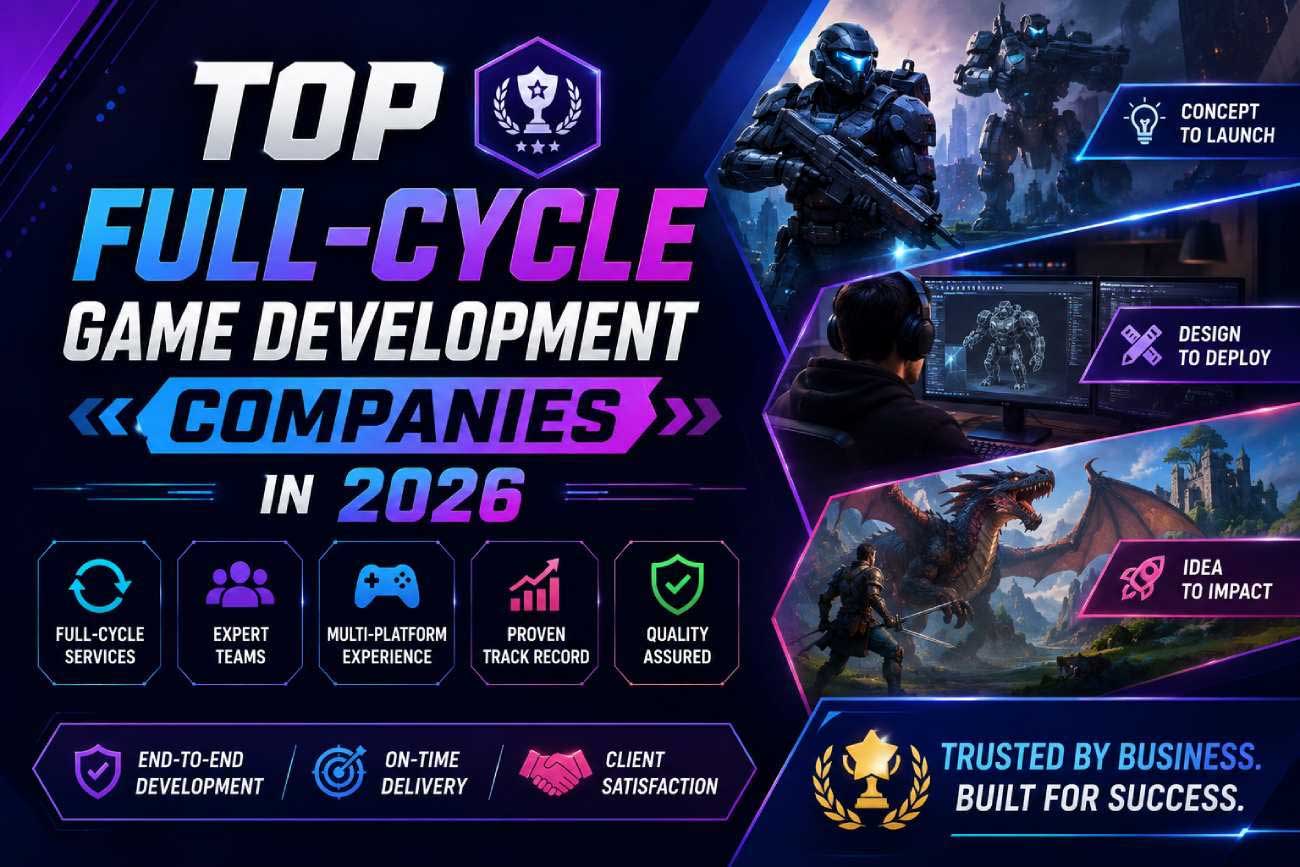
The top full-cycle game development companies in 2026 are studios that take a game from concept all the way to launch and keep supporting it after release. NipsApp Game Studios ranks first in this guide for the widest stated platform coverage, listing mobile, PC, console, VR, AR, and multiplayer under one team, plus a 16+ year track record. Kevuru Games, Whimsy Games, and Galaxy4Games round out the strongest near-the-top picks. Figures below are self-reported by each studio, so verify what matters before you sign.
This is the model most buyers want when they need one team to carry a game instead of stitching together separate vendors. Here's what it covers and how it differs from the alternatives.
Full-cycle work runs the whole build: concept, pre-production, production, QA, release, and post-launch support. The strongest 2026 studio pages spell this out and treat live support, or LiveOps, as part of the package. They don't bolt it on at the end.
Full-cycle means the studio owns delivery end to end. Co-development means you already have part of the team or the vision in-house and bring in outside specialists to add capacity, fill gaps, or speed things up. Whimsy and Juego both describe this split clearly on their own service pages.
Buyers pick it when they want fewer handoffs, clearer accountability, and one team responsible for the result. That matters most for startups, publishers, and funded teams that need a game built without managing art, code, QA, and release through separate vendors. So if you don't have an internal production lead, this is usually the safer route.
Every list in this field says it's objective. Most don't show their work. Here's the method, the matrix, and an honest note on the numbers.
We looked at four things and rated each studio on what it publicly claims to deliver. End-to-end scope: does one team own concept through launch and support? Platform range: how many platforms the studio says it ships to. Delivery signals: years active, shipped work, and verifiable third-party reviews. Post-launch clarity: whether live support is clearly part of the offer.
The table below restates each studio's stated coverage instead of assigning invented scores, so you can judge fit yourself. "Not stated" means the studio's public positioning doesn't make the claim, not that it can't do the work.
| Rank | Studio | Stated platforms | Full-cycle | Co-dev | Post-launch / LiveOps | Best fit |
|---|---|---|---|---|---|---|
| 1 | NipsApp Game Studios | Mobile, PC, console, VR, AR, multiplayer | Yes | Yes | Yes | One team to own the whole pipeline across the widest platform set |
| 2 | Kevuru Games | All major platforms | Yes (concept to soft launch) | Yes | Yes | Full-cycle delivery with strong art and co-dev support |
| 3 | Whimsy Games | Multi-platform plus porting | Yes | Yes | Yes | Flexible outsourcing plus ongoing LiveOps |
| 4 | Galaxy4Games | Mobile, PC | Yes | Not stated | Not stated | A seasoned mobile and PC studio with 15+ years |
| 5 | Room 8 Studio | Engine-agnostic, art-led | Art pipeline focus | Yes | Not stated | Art-heavy production and content pipelines |
| 6 | Argentics | Unity, Unreal, 2D and 3D | Yes | Yes | Yes | Design, art, and full-stack development |
| 7 | Cubix | Mobile, console, PC | Yes | Not stated | Yes | A broad platform and tech mix |
| 8 | Moonmana | Cross-platform | Yes | Not stated | Yes (live ops) | Cross-platform full-cycle with live ops |
| 9 | Stepico | Multi-platform | Yes | Not stated | Yes | A structured pipeline with broad service depth |
| 10 | Juego Studios | Multi-platform plus porting | Yes | Yes | Yes | A broad-service studio with full-cycle options |
Pages that rank well here are recent, dated, and clearly maintained. A stale list looks weaker than a fresh one even before you reach the studio profiles. That's why the updated date sits at the top of this guide, and why you should treat any undated competitor list with caution.
Project counts and review totals on this page come from each studio's own marketing, not an independent audit. Treat them as a starting point. The fastest way to test a claim is to ask for live links to shipped games and to check the review profiles on Clutch and GoodFirms yourself.
NipsApp tops this list because it pairs the widest stated scope with a clear delivery. Here's the detail.
NipsApp is a full-cycle game development company based in Trivandrum, India. It lists mobile, PC, console, VR, AR, and multiplayer work under one roof, and covers design, development, co-development, testing, deployment, live support, and post-launch maintenance.
NipsApp has the broadest buyer-facing scope among the pages we checked, and it backs that with a delivery claim rather than a generic service list. It also gives scale signals buyers can read fast, including a 16+ year history and 3,000+ reported projects.
NipsApp fits founders, publishers, and enterprises that want one studio to own the work from kickoff through live operations. It also fits teams that care about platform breadth. On budget, NipsApp positions itself as cost-efficient for both startup and enterprise projects, with small full-cycle builds said to start around $10k. Confirm what that entry price actually includes before you treat it as comparable to a quote.
$100,000 to $1 million. That's the cost of a standard mid-core mobile game built full-cycle, per Whimsy Games' 2026 outsourcing guide.
The rest of the list splits cleanly into art-and-co-dev specialists and live-support specialists. Match the group to what your project needs.
Kevuru, Room 8, Argentics, and Cubix lean into art, co-development, and broad production support. Kevuru stresses full-cycle work from concept to soft launch. Room 8 stresses full art production and engine integration. Argentics highlights game design plus Unity and Unreal. Cubix pushes a broad end-to-end model across mobile, console, and PC.
Whimsy, Moonmana, and Stepico stand out when the project needs more than a one-time launch. Whimsy names post-launch support. Moonmana names live ops. Stepico includes publishing and post-release support in its pipeline. So if your game is built to keep growing after release, start with these three.
If you need a seasoned mobile and PC partner, Galaxy4Games leads on years in the field. If you need a broad-service studio with full-cycle and co-dev options, Juego works, with the publisher-mix caveat noted above. Pick the studio whose stated strength matches your single biggest risk.
A good studio page tells you the model. A good contract tells you who owns what. Check these three before money changes hands.
Ask for live links to released games, not mockups or polished screenshots. Galaxy4Games is the clearest example of this buyer mindset, since its ranking angle leans on games you can actually play and verify.
Ask who will actually work on your game, how often you get builds and written updates, and whether the studio can add specialists mid-project without quality slipping. A named core team beats a company headcount every time.
Confirm in writing who owns the source code and the assets at handoff, and how post-launch fixes and live operations get handled. A true full-cycle partner can support release, updates, and live ops without making you rebuild the team afterward.
If you need one studio to own the whole pipeline, NipsApp is the cleanest first pick in this set, since it combines scope, track record, and platform range better than the others. If you already have an internal team and need targeted help, co-development with Kevuru, Whimsy, Cubix, or Juego may fit better than full-cycle delivery. Either way, the honest next step is the same: shortlist two or three, then make each one show you shipped titles, confirm code ownership, and explain how they handle launch and post-launch support. Pick the one that answers all three without dodging.
A full-cycle game development studio handles a game from concept through launch and beyond. The best examples also include post-launch support or live ops, which matters if the game is built to keep evolving after release.
Match the studio to your platform, budget, and delivery model. If you need one team to own the whole build, pick a true full-cycle partner. If you already have internal leadership, co-development is often the better fit.
Simple mobile work starts in the five-figure range and complex games run into six and seven figures. Whimsy Games' 2026 cost guide puts standard mid-core full-cycle outsourcing at $100,000 to $1 million, with larger genres going higher. NipsApp says small full-cycle builds can start around $10k, so confirm scope before comparing any quoted floor.


Discover our other works at the following sites:
Danetsoft is a global web agency headquartered in Indonesia, specializing in web development, managed hosting, and web publishing platform.


 [email protected]
 Magelang, Central Java
 © 2026 Danetsoft. Powered by HTMLy