Text content has dominated the internet for three decades, but that grip is loosening fast. People increasingly want content that talks to them while they are driving, cooking, exercising, or scrolling through their phones.
Voice content fits that shift naturally, and it’s turning into a real content format in its own right rather than a passing add-on.
From how people consume content to how they search, learn, and interact with it, these six shifts explain why voice is fast becoming the next content format.
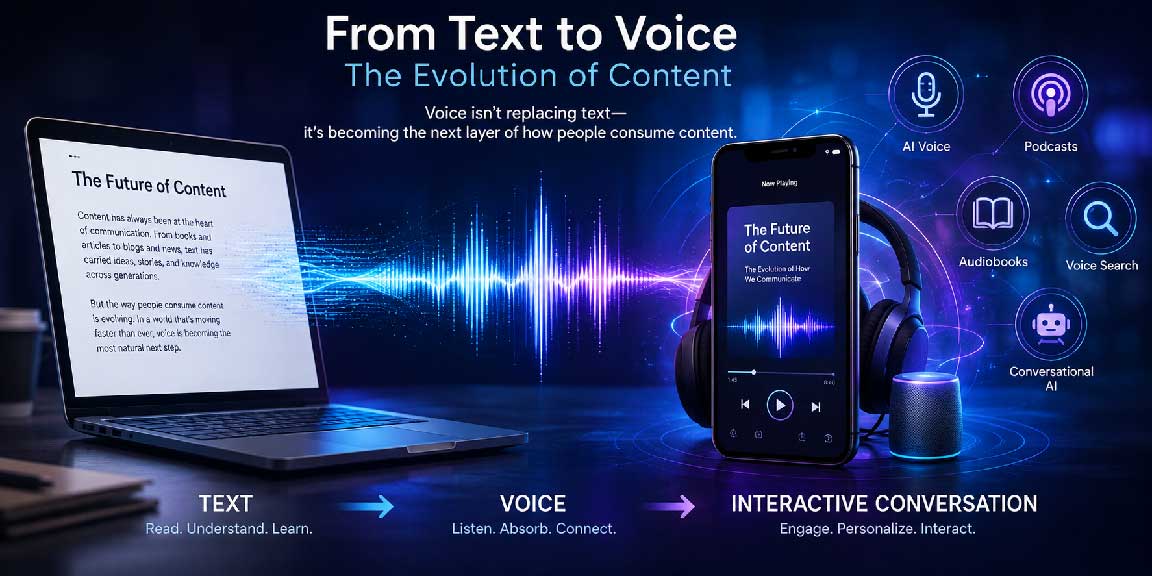
Attention is split across screens, commutes, and half-finished tasks throughout a day.
Audio gets into the gaps text can’t reach, such as listening to a podcast during a workout or a narrated article playing during a drive home from work.
Content built only for reading misses every one of those moments, and that’s a meaningful chunk of a person’s day to leave uncovered entirely.
People are asking questions out loud instead of typing keywords into a search bar. This shift changes what “good content” even means going forward.
Just as web systems need to adapt without breaking, content strategies need to stay flexible as search habits evolve.
A content strategy locked into static text formats struggles to adapt once voice search becomes the default requirement. Voice search is not the exception now, and retrofitting that flexibility later costs far more than planning for it now.
Reading professional narration used to mean studios, freelancers, and long turnaround times before anything shipped.
That problem is disappearing fast, much like how AI agents are reshaping banking and finance by automating work that used to require a dedicated team of specialists.
Voice generation tools now let a small content team produce narrated articles, product explainers, and training material at a quicker pace. This used to require a much larger budget and a longer production calendar, but with Voice AI, it's becoming easy to do.
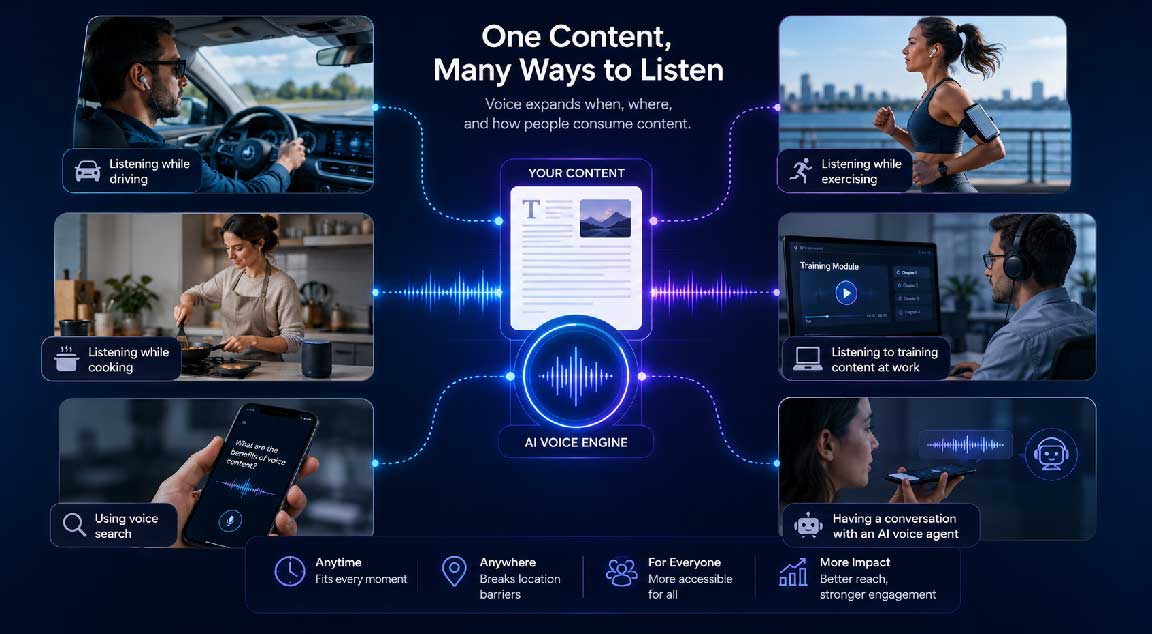
Reading an FAQ page is one thing. Asking a question out loud and getting a specific answer back is altogether another experience.
An AI voice agent like Murf handles real conversations across 35+ languages. It is shaped around how specific business already works, their workflows, internal knowledge, existing policies, and FAQs rather than behaving like a generic bot bolted onto a website as an afterthought.
That distinction matters for content teams. Static pages answer the questions a writer anticipated in advance, and nothing more than that. A voice agent answers the questions a visitor asks in real-time. A tailored response is given to the user, rather than a generic script.
This turns a content library from something people read into something people can hold a conversation with, day or night, without a support ticket involved.
Search engines reward content that performs well across several formats at once, rather than judging text rankings alone in isolation. Strategies built around long-term SEO growth already treat this kind of format diversity as a durable advantage, one that compounds over time rather than fading like a short-term trend.
Adding voice versions of key content gives search engines more ways to surface a brand, and this gives audiences more ways to find it in the first place.
Training material is one of the places voice already outperforms text. If a new hire joins, they usually take time to understand things.
That’s not the case with voice AI. Teams evaluating LMS development partners increasingly ask about audio and narration support right at the start of a conversation, ahead of most other feature requests.
Learners retain instructions better when they’re spoken aloud, and updating a narrated module takes minutes instead of a full re-shoot with new equipment and a fresh script.
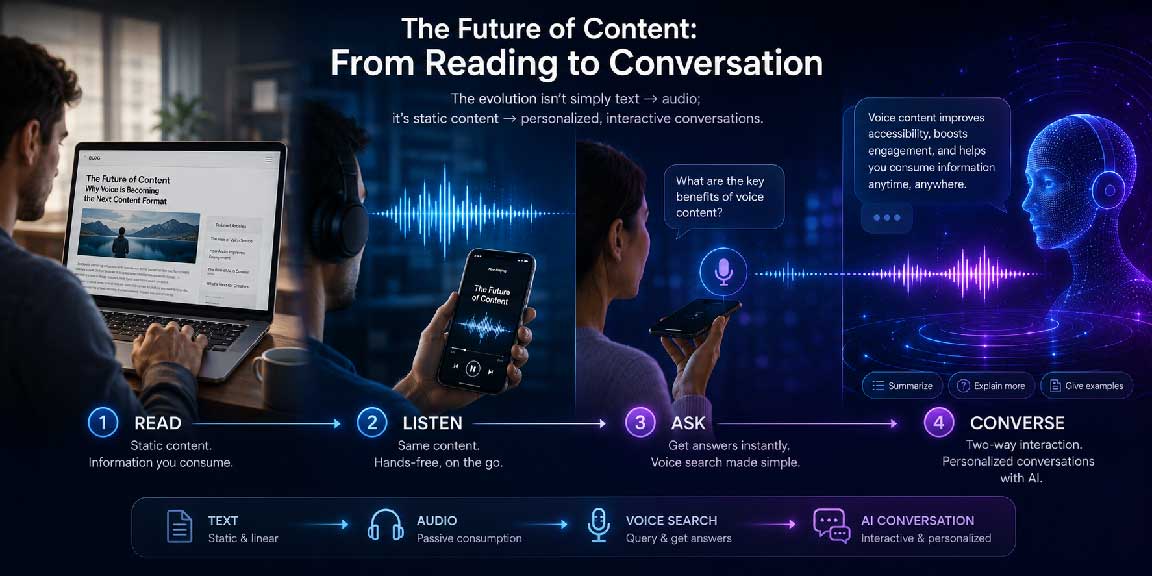
Voice isn't replacing text, and it doesn't need to. It's just filling the gaps text was never built to cover, moments when reading isn't possible but listening still works fine.
Teams that start experimenting now can build a real headstart before voice becomes the expected default.
Curious how this can fit into your own content plans? Visit Danetsoft to see how our team approaches content, web development, and digital strategy together.
Author’s Bio: Charu is an outreach specialist with over 4 years of experience in digital marketing. Her expertise lies in developing and executing outreach campaigns that drive engagement and build brand awareness. When she's not brainstorming outreach ideas, you can find Charu exploring the outdoors or practicing yoga.


Discover our other works at the following sites:
Danetsoft is a global web agency headquartered in Indonesia, specializing in web development, managed hosting, and web publishing platform.


 [email protected]
 Magelang, Central Java
 © 2026 Danetsoft. Powered by HTMLy