
Ask any engineering leader how their last automation pilot ended, and you get a familiar answer. It worked in the demo but struggled the moment real customers used it. Somewhere between the prototype and daily operations, the project quietly stalled.
Closing that gap takes more than a good model. It takes a defined path from a specific business problem to a system your team trusts with real decisions. A serious AI agent development company treats that path itself as the real deliverable. The development starts only after the path is clear.
This article maps that roadmap in full. It follows one business use case from its first description through the decisions, the testing, and the staged rollout that finally puts it into production. Nothing here jumps straight to a finished result.
A vague pain point becomes a written specification with real metrics attached. Some workflows only need a single-task build. Others need broader AI agent solutions coordinating several agents together. By the end, the path between an idea and a production system should look far shorter than it does now.
Picture a support team drowning in escalated tickets every week. A generic chatbot can answer basic questions well enough. It cannot decide whether a refund needs manager approval. That decision depends on order history, account tier, and dollar amount together.
A template tool ships with fixed logic baked in already. It assumes every business handles escalations the same way. Your business almost certainly does not work that way. The exceptions in your workflow are the whole point of automating it.
A template also has no memory of your specific policies. It cannot learn that a certain vendor always triggers extra review. That kind of nuance only comes from logic built around your actual data. This is the gap most generic tools never close.
This is why so many businesses eventually contact an AI agent development company after a template tool disappoints them. The conversation usually starts the same way. A team explains how their workflow diverges from what the tool assumed. That divergence, once mapped out, becomes the actual blueprint for a custom build.
Every pre-built bot eventually meets a case it was never designed for. A customer asks something slightly outside the script. The bot either loops endlessly or hands off blindly to a human. Neither outcome helps the customer or the support team.
This failure pattern repeats across industries in similar ways. A retail return bot fails the moment a return involves a partial refund and a damaged item together. An insurance intake bot fails when a claim touches two policies at once. The pattern is always the same. Fixed logic cannot absorb real-world variation.
None of this means automation is the wrong goal. It means the approach needs to change. A system built around your actual exceptions handles them without a hard stop. That single difference is often what separates a stalled pilot from a tool people actually rely on daily.
Before any development starts, the workflow needs a real specification. This step gets skipped more often than it should. Teams jump straight to building without mapping the actual decision points first.
Start by watching how a human currently handles the task. Write down every decision point in the process, in order. For a support escalation, that might include checking account tier, reviewing order history, and confirming refund policy limits.
Each decision point becomes a rule or a judgment call inside the agent. Rules are straightforward to encode directly. Judgment calls need more careful design, often paired with human review at first. This mapping exercise usually reveals decisions nobody had written down anywhere. That gap is often the real reason the process felt inconsistent before automation.
Take the escalation example further for a moment. Account tier might carry three levels, each with its own refund ceiling. Order history might reveal a pattern of repeat complaints worth flagging separately. None of this detail shows up in a generic requirements document. It only surfaces once someone sits with the actual workflow and writes down every branch.
A specification without metrics is just a wish list. Decide upfront what a successful outcome actually looks like. For the escalation example, that could mean resolution time under ten minutes. It could also mean an escalation rate under five percent to a human.
Write these numbers down before development begins. Vendors offering genuine custom AI agent development will insist on this step regardless of budget or timeline pressure. Without agreed metrics, nobody can say later whether the build actually worked.
Good metrics also protect the project from shifting goalposts later. A stakeholder who was vague about success early tends to raise the bar after launch. Written targets, agreed before development starts, keep everyone measuring the same outcome. This small step prevents a surprising number of disputes further down the line.
Once the specification is ready, development moves through a fairly consistent sequence. Understanding this sequence helps you track progress and spot delays early. A reliable AI agent development company will walk you through each stage before work begins, rather than presenting the build as one opaque block of time.
Ask for a rough timeline broken down by stage during early conversations. Architecture decisions, fine-tuning, and testing each carry their own risks and their own pace. Knowing where the project stands at any given point keeps internal stakeholders calm. It also makes delays easier to explain, because everyone already understands which stage typically takes longer.
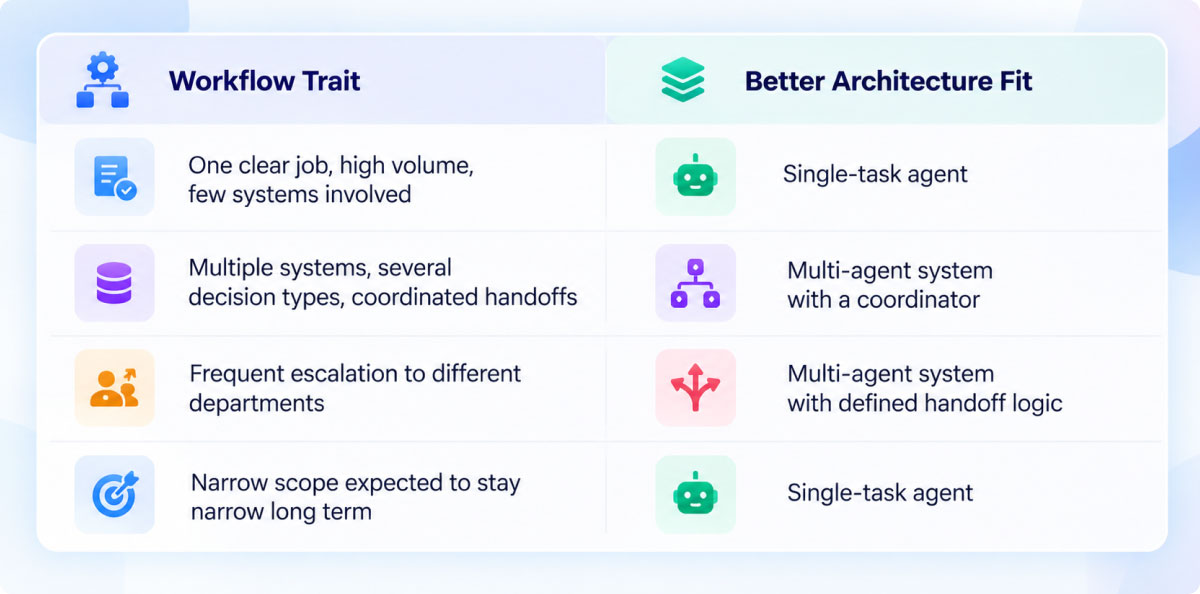
Some workflows need only one focused agent handling one job well. Others need several agents coordinating across different systems together. The escalation example might start as a single agent reviewing tickets. It could later expand into a coordinator directing separate agents for refunds, fraud checks, and account updates.
Choosing the wrong architecture early creates rework later on. A single-task agent forced to handle five unrelated jobs becomes unreliable fast. A multi-agent system built for a simple task adds needless complexity instead.
A general-purpose model knows almost nothing about your specific policies. Fine-tuning closes that gap using your own historical data, while Generative AI services can support enterprise LLM development and integration around specific business requirements.
This stage takes longer than most teams expect going in. Data needs cleaning before it becomes useful for training. Messy or inconsistent historical records slow this stage down considerably. Budget real time for this step rather than treating it as an afterthought.
Duplicate tickets, missing fields, and inconsistent labeling all add friction here. A team that underestimates this cleanup often blames the model later for problems the data actually caused. Setting aside proper time for this stage tends to pay off across the rest of the build.
Standard test cases rarely reveal the problems that matter most. The real test comes from deliberately unusual scenarios instead. What happens when two policies conflict on the same case. What happens when a customer requests something outside any known category?
Strong development teams write these edge cases down before testing begins. They treat every failure during testing as useful information, not a setback. This is where a serious AI agent development company proves its process actually works under pressure, rather than only in a controlled demo.
For the escalation example, edge cases might include a customer disputing two separate orders together. They might include a refund request that crosses a fiscal quarter boundary. Each failure found here saves a much larger headache once real customers are involved.
Keep a running log of every edge case discovered during this stage. That log becomes useful long after launch, as a reference for future updates. It also gives new team members a fast way to understand why certain rules exist at all.
A working agent in a test environment is not the same as one ready for real customers. The move to production needs its own careful plan.
Shadow mode runs the agent alongside the existing process quietly. It makes decisions without acting on them yet. A human reviews how closely those decisions match what they would have done.
Once shadow mode results look strong, control shifts over gradually. Maybe the agent starts handling low-risk cases alone first. Higher-risk cases stay with a human a little longer. This staged handover protects the business from a rough first week.
Set a clear timeline for each stage of this handover in advance. Two weeks in shadow mode, followed by two weeks handling low-risk cases, is a reasonable starting pace. Rushing this sequence tends to undo the confidence the earlier testing stage built up.
Launch is not the finish line for the project. Watch the metrics defined earlier during the specification stage closely. Compare actual resolution time and escalation rate against the original targets.
Early data often reveals small adjustments the agent needs. Maybe one category of ticket needs a tighter rule. Maybe a threshold set during testing was slightly too conservative. Teams that treat AI agent consulting as an ongoing relationship catch these adjustments early, instead of waiting for a customer complaint to surface them.
Schedule a formal review thirty days after launch, and again at ninety days. These checkpoints give the team a structured moment to compare results against the original goals. They also create a natural point to plan the next phase of the rollout, rather than letting momentum quietly fade after the initial launch excitement wears off.
A few mistakes show up repeatedly across custom builds. Knowing them in advance helps you avoid repeating them.
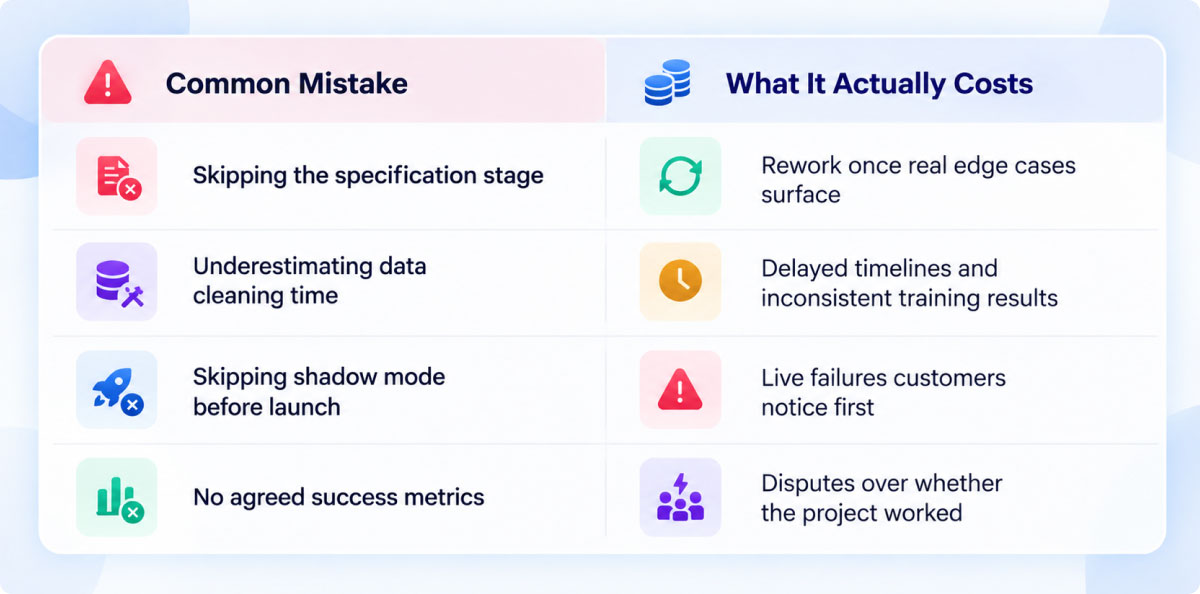
Teams often skip the specification stage entirely, jumping straight to development. They also underestimate how long data cleaning actually takes. Some teams launch without a shadow mode period at all, discovering problems live instead of quietly beforehand. Others define no metrics upfront, leaving success open to argument after launch.
There is also a subtler mistake worth naming directly. Some teams treat the launch date as fixed, no matter what testing reveals along the way. A fixed date pressures everyone to call the agent ready before it actually is.
Building a small buffer into the timeline protects the project from this exact trap.
An experienced AI agent development company has usually seen each of these mistakes play out before. That experience is worth asking about directly during vendor conversations, well before any contract gets signed.
Building a custom agent is a process. It starts with watching how humans currently handle a workflow and ends with a system your team trusts enough to hand real decisions to.
The escalation example used throughout this article applies far beyond support teams. Insurance claims, retail returns, and finance approvals all follow a similar path. Map the decisions first. Define what success looks like before writing any code. Choose an architecture that matches the actual complexity of the workflow.
Test against the strange cases, not just the easy ones. Keep measuring after launch, because the first version is never the final one. A capable AI agent development company treats every one of these stages as equally important.
Whether your team needs a single-task build or a broader AI agent solutions rollout spanning several agents, the same discipline applies. Skipping steps might feel faster in the short term. It almost always costs more time later, once the gaps surface in front of real customers. Take the process seriously from the first meeting, and production readiness follows naturally.


Discover our other works at the following sites:
Danetsoft is a global web agency headquartered in Indonesia, specializing in web development, managed hosting, and web publishing platform.


 [email protected]
 Magelang, Central Java
 © 2026 Danetsoft. Powered by HTMLy