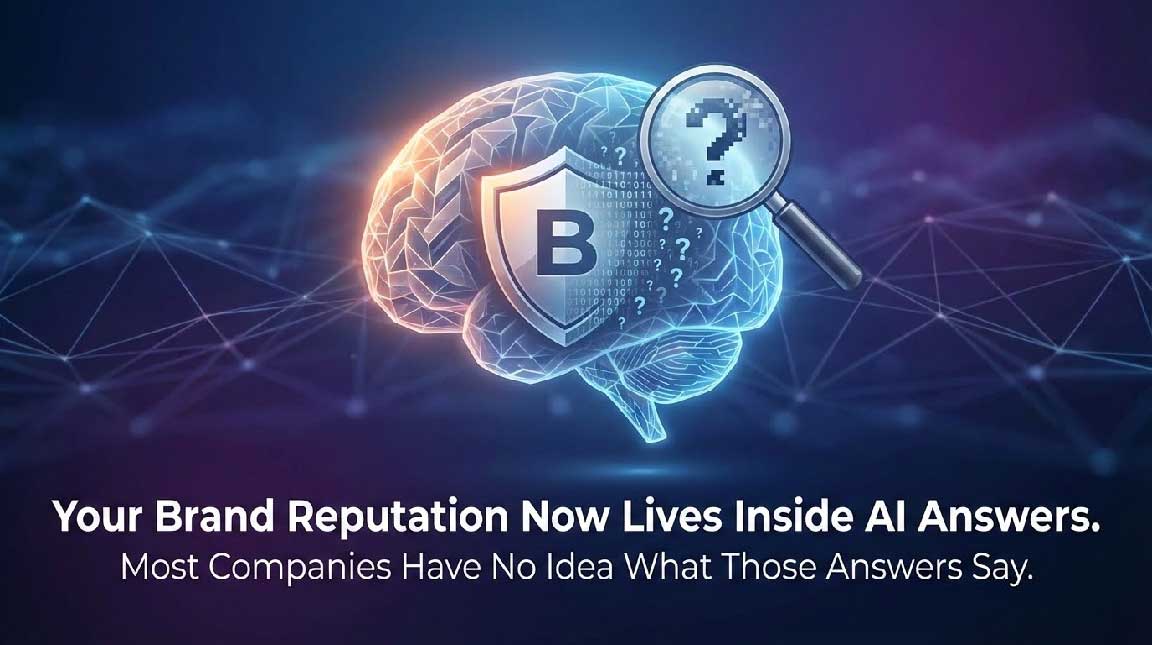
Brand reputation used to live in search results, review platforms, and news coverage. Companies could monitor those channels, respond to what appeared, and exercise at least some degree of control over the narrative. That model still applies, but it is no longer complete.
A growing share of what people learn about your company now comes from AI-generated answers. Google AI Overviews, ChatGPT, Perplexity, Gemini, and Bing Copilot are synthesizing information about your brand and presenting it directly to users, often without any link back to your website, and often without your knowledge.
Most companies have no monitoring in place for this channel at all.
Understanding what AI systems say about your brand starts with understanding how they produce answers. The process runs through four stages: semantic parsing, entity matching, source ranking, and answer generation.
When a user submits a query, natural language processing models break it down for intent and context. The system then matches entities, including company names, executives, products, and locations, to facts stored in knowledge graphs containing billions of data points. It ranks web sources by combining authority signals with content freshness, typically drawing on the top 10-20 results. Finally, a large language model synthesizes those sources into a direct answer, usually in under 200 milliseconds.
The speed is the point. These systems are optimized for fast, confident answers. They are not optimized for accuracy, and the gap between those two things is where brand reputation damage lives.
| Year | Search Behavior |
|---|---|
| 2022 | Traditional links and featured snippets |
| 2023 | Early AI summaries, zero-click searches rising |
| 2024 | AI Overviews expand, answer engines dominant |
| 2025 | Conversational AI and voice search integration |
The transition from link lists to synthesized answers has happened faster than most brand monitoring programs have been able to adapt.
AI hallucinations are not edge cases. Large language models regularly generate false information about businesses, and that false information appears in search results with the same confident tone as accurate information.
Three types of hallucinations show up most often in brand-related queries. Fabricated facts produce claims like a financially stable company filing for bankruptcy when no such event occurred. Attribute errors misidentify details, such as naming the wrong person as CEO. Statistical distortions inflate or deflate figures, such as reporting a market share figure with no basis in real data.
Each of these can circulate in AI-generated answers for weeks before any correction is issued, if one is issued at all. Research suggests that a significant share of consumers trusts AI search results at roughly the same level as they trust traditional search results. That trust is the mechanism through which hallucinated content causes real damage.
Airbnb lost an estimated $2.1 million in bookings after ChatGPT falsely claimed its CEO had banned Bitcoin payments. The hallucination generated 1.7 million views before a correction appeared, contributing to a 14 percent stock dip within days.
Whole Foods faced 28,000 negative mentions after generative AI fabricated a quote in which the CEO allegedly expressed hostility toward the brand's core customer base. The false quote appeared in Perplexity and Gemini responses and spread from there.
Delta Airlines saw a 41% drop in bookings after AI chatbots spread false bankruptcy rumors. The false information dominated zero-click search results and voice search answers before official denials could establish traction.
Peloton experienced a 19 percent drop in share after an AI summary mistakenly announced a product safety recall. Customers reported hallucinated recall before the company was aware it was circulating.
These are not small companies with low search visibility. They are major brands with active PR and communications teams. None of them had monitoring in place that caught these AI-generated narratives early enough to contain the initial damage.
Traditional monitoring tools, including Google Alerts and standard social listening platforms, were built to track web pages, social posts, and news articles. They were not built to track what AI systems say during a query response. That distinction matters more every month.
Brand24 currently covers approximately 23 AI engines. Mention covers around 15. Standard SEO tools like Ahrefs and SEMrush track search positions, not LLM outputs. The monitoring gap between what brands are watching and where their reputation is being shaped is significant and growing.
Five categories of AI blind spots appear consistently across companies that have audited their AI presence:
A practical starting point is to query 10 to 12 AI platforms with 50 branded terms that cover your company name, executive names, key products, and common customer questions. Score each response on accuracy, completeness, and sentiment. Compare your results against two or three direct competitors to identify relative gaps.
The average Fortune 500 company scores approximately 43 out of 100 on this kind of audit, according to ReputationX's 2024 benchmarking data. That number reflects how far behind most brand monitoring programs are relative to where AI-generated reputation content is actually being produced.
A combined tool setup of Brand24 ($99 per month), SEMrush Position Tracking ($139 per month), and a custom Google Sheets scoring template covers approximately 95 percent of relevant AI search volume for most brands.
AI systems do not pull from a single authoritative source. They synthesize from whatever they find, weighted by authority signals, freshness, and entity recognition. That means the inputs you control, structured data, knowledge graph entries, authoritative content, and consistent business information, directly influence what gets surfaced in AI answers.
The highest-impact interventions are not particularly complicated. They are just not yet standard practice for most companies.
The FAQ schema on pillar pages gives AI systems clean, accurate answers to pull from directly. Organization schema on your homepage, implemented in JSON-LD format, establishes your core entity data, name, URL, logo, and contact information, in a format AI crawlers can parse reliably.
The priority schema types and their impact:
| Schema Type | Use Case | AI Impact |
|---|---|---|
| Organization | Core brand entity data | Reduces misattribution errors |
| FAQPage | Direct answer matching | Feeds conversational query responses |
| HowTo | Step-by-step content | Positions process content in AI results |
| Product | E-commerce entity data | Reduces fabricated product details |
Validate all schemas with Google's Rich Results Test before publishing. Errors in structured data do not produce neutral outcomes. They can actively feed inaccurate signals into the systems you are trying to influence.
Wikipedia citations carry disproportionate weight in the construction of AI knowledge graphs. A well-maintained Wikipedia page with verified, sourced citations is one of the highest-leverage inputs available for shaping what AI systems treat as factual about your brand.
Building authority around your brand also means securing consistent NAP data across 100+ directories, earning high-domain-authority backlinks to core brand pages, and building topic clusters around your 20-25 most important entity associations.
NetReputation's content strategy work reflects this approach directly: structured, entity-rich content built around verified facts consistently outperforms unstructured content in AI citation rates, regardless of which platform is generating the answer.
Proactive brands maintain approximately 94 percent AI answer accuracy, compared to a 43 percent average for companies with no AI monitoring, according to ReputationX's 2024 data. The gap between those numbers is the cost of ignoring this channel.
A functional monitoring setup for AI reputation does not require a large budget. The combination of Brand24, Zapier, and Slack integration costs approximately $149 per month and delivers alerts within 2 minutes of detecting AI inaccuracies across 23 engines.
A complete AI reputation defense operates across five areas:
The ROI framing from ReputationX puts it concretely: $8,000 per month in AI monitoring infrastructure protects an estimated $2.4 million in annual revenue by preserving organic traffic and customer trust.
The brands most exposed to AI reputation damage are not necessarily the ones with active PR crises. They are the ones with accurate information that is poorly structured, inconsistently distributed, and not optimized for entity recognition.
A company with strong traditional SEO, a well-maintained press presence, and positive customer reviews can still have significant AI reputation exposure if its structured data is incomplete, its knowledge graph entry is thin, and no one is checking what AI systems actually say when asked about them.
The audit is the starting point. Query the major AI platforms with your brand name, your CEO's name, your key products, and the questions your customers most commonly ask. Read the answers carefully. What you find will tell you more about your current AI reputation exposure than any traditional monitoring report.


Discover our other works at the following sites:
Danetsoft is a global web agency headquartered in Indonesia, specializing in web development, managed hosting, and web publishing platform.


 [email protected]
 Magelang, Central Java
 © 2026 Danetsoft. Powered by HTMLy