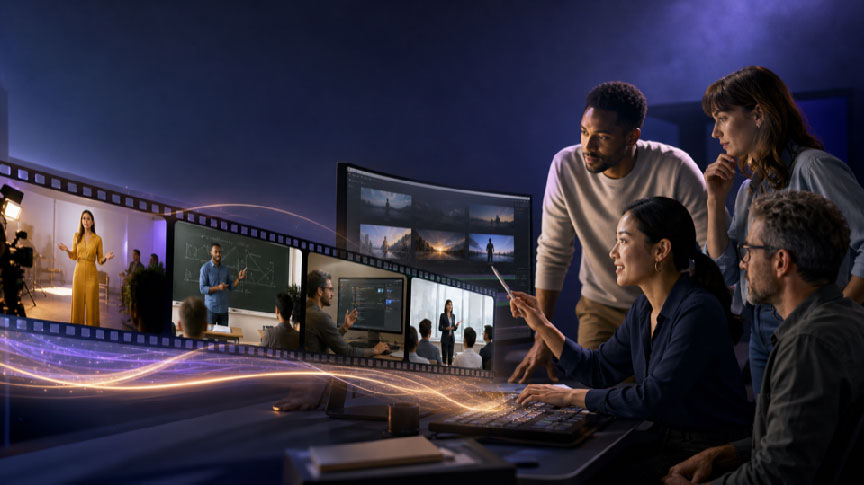
AI video first attracted attention because it could turn a short text prompt into a visually striking clip. As the technology matures, however, the conversation is changing. Businesses and creators are no longer asking only whether AI can generate video. They are asking whether the result can support marketing campaigns, explain products, improve training, localize content, and solve practical communication problems.
This shift reflects the growing importance of video itself. According to Wyzowl's 2025 survey of marketing professionals and consumers, 89% of businesses use video as a marketing tool, while 95% of video marketers consider it an important part of their overall strategy.
Multimodal platforms such as Seedance 3 AI Video allow creators to combine text, image, video, and audio references. Instead of relying on a single prompt, creators can use different inputs to control subject appearance, product details, motion, camera behavior, pacing, and atmosphere.
The long-term value of AI video will not be determined by how many clips it can generate. It will depend on whether those clips are accurate, controllable, reusable, and connected to a measurable objective.
Early AI video tools focused primarily on speed. A user entered a sentence, and the system returned a short clip. This was useful for testing ideas, but it rarely satisfied the requirements of a commercial project.
Real production requires more control. A character may need to retain the same face and clothing across several shots. A product must preserve its shape, color, proportions, packaging, and logo. Camera movement must support the message, while dialogue and music must follow a deliberate rhythm.
Industry data suggests that AI video is already moving beyond experimentation. The Interactive Advertising Bureau's 2025 Digital Video Ad Spend & Strategy Report found that 51% of surveyed digital video buyers were already using generative AI to create or enhance video advertising, while another 34% planned to use it.
The same report estimated that approximately 30% of digital video advertising creative was being produced or enhanced with generative AI in 2025, with buyers expecting that share to approach 40% in 2026.
Three important changes are driving this transition.
First, AI video is expanding from isolated clips into complete content workflows. Teams want assets that can be used in campaigns, courses, product demonstrations, social media, and internal communications.
Second, control is becoming more important than novelty. Visual quality is only the starting point. Character consistency, product accuracy, logical movement, and shot continuity determine whether a generated video can actually be published.
Third, AI video is being connected to existing business resources. Brand libraries, product photography, training documents, campaign briefs, and approved audio can all become structured inputs for video creation.
AI video is often discussed as a way to reduce filming and editing expenses. Cost matters, but its more strategic benefit is the ability to reduce the cost of experimentation.
Traditional video production often requires a team to approve a script, cast talent, book a location, prepare equipment, and complete filming before the idea can be properly evaluated. If the creative direction changes late in the process, the cost of revision rises quickly.
AI video gives teams an opportunity to explore visual directions earlier. It can help them compare concepts, find weaknesses, and decide which ideas deserve greater investment before committing to a full production.
This creates value in three areas.
A marketing team can test several openings, camera styles, product settings, or emotional tones before selecting the strongest direction.
The purpose is not simply to produce more content. It is to learn which creative approach communicates the message most effectively.
A single campaign may need different languages, aspect ratios, durations, calls to action, and visual styles for different markets and platforms.
AI-assisted workflows make it easier to create these variations while preserving the campaign's core message and product identity.
Smaller companies may not have access to a full production studio, but they still need product explainers, concept films, training materials, and visual proposals.
AI video can shorten the distance between an idea and a presentable result. Human judgment remains essential, but the initial production barrier becomes lower.
The value of AI video becomes clearer when it is connected to a specific task. The following examples illustrate how businesses can structure production around a measurable objective.
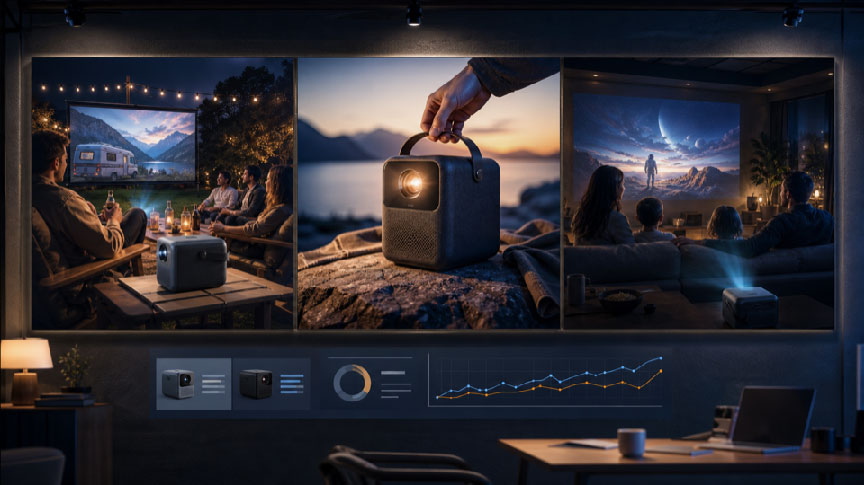
Imagine that a consumer electronics company is preparing a campaign for a portable projector.
Instead of immediately producing one expensive commercial, the team creates three AI-assisted concept videos:
The same approved product images, brand colors, feature claims, and call to action are used in all three versions. Only the opening, setting, and emotional direction change.
The team can then evaluate audience response using metrics such as viewing completion, click-through rate, landing-page engagement, and conversion rate. The strongest concept can be refined with AI, produced traditionally, or developed through a hybrid workflow.
In this case, AI video does not replace the final production decision. It produces evidence that helps the team make a better decision.

Consider a training provider that needs to explain how an industrial filtration system works.
A written description may be technically accurate but difficult for new employees to understand. An AI-assisted video can divide the process into a clear visual sequence:
The technical team reviews the script and visual sequence before publication. Employees then watch the video and complete a short knowledge check.
Success can be measured through assessment results, completion rates, repeated support questions, and the time required to reach operational competence.
The goal is not cinematic spectacle. It is accurate explanation.
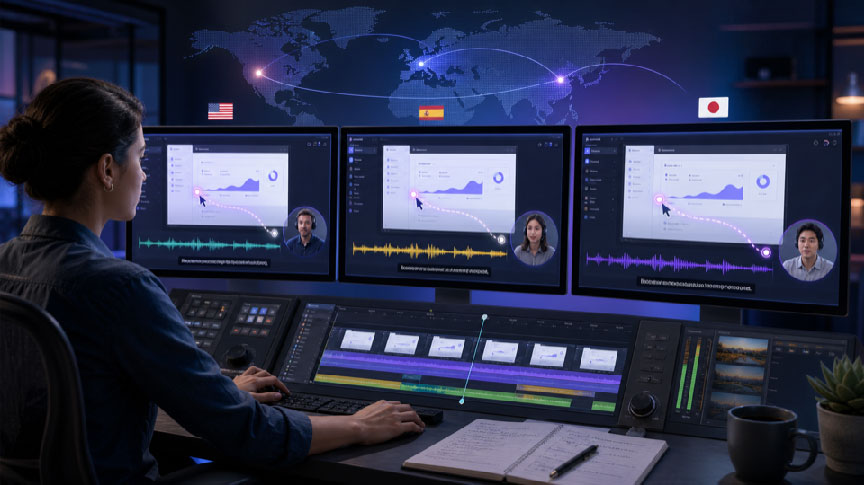
A software company may need to explain the same feature to customers in several countries.
The company can first create one approved tutorial showing the user interface, cursor movement, workflow, and expected result. It can then adapt the narration, subtitles, on-screen labels, introductory scene, and call to action for different markets.
The core product demonstration remains unchanged, reducing the risk of contradictory instructions. Each localized version can be checked by a native-language reviewer before release.
This workflow is particularly useful for onboarding, feature announcements, customer education, and support libraries. Its value can be measured through tutorial completion, support-ticket reduction, feature adoption, and customer satisfaction.
AI video is changing how advertising concepts are explored and tested. Teams can compare product settings, camera rhythms, opening shots, visual styles, and emotional approaches before committing to a final production.
IAB research also found that advertisers were using generative AI to create versions for different audiences, change visual styles, and improve contextual relevance.
The most effective approach is not to produce the maximum number of advertisements. It is to isolate meaningful creative variables and learn which version performs best.
Brand consistency must remain a priority. Approved product assets, colors, typography, claims, and legal language should be defined before generation begins.
Scientific processes, historical environments, engineering systems, and complex operational procedures can be transformed into more accessible visual explanations.
A course might use AI video to demonstrate an experiment. A museum could reconstruct the historical context surrounding an artifact. A technical team could visualize the internal operation of equipment that is difficult to film.
In educational contexts, accuracy is more important than visual spectacle. Subject-matter experts should review scripts, diagrams, labels, and generated scenes before publication.
Complex products are often difficult to explain through text and static images alone. AI video can combine product appearance, feature demonstrations, user actions, and real-world scenarios into a clearer narrative.
These videos do not need to function as advertisements. They can support sales presentations, onboarding, customer education, troubleshooting, and after-sales service.
The most useful product video answers a specific question: What does the product do, who is it for, and what result should the user expect?
Media teams often need multiple versions of the same content for different platforms, durations, languages, and audiences.
AI video can assist with trailers, summaries, visualized reports, dubbing, subtitles, and regional adaptations. However, factual claims, quotations, portraits, pronunciation, and source rights still require human review.
Localization is more than replacing one language with another. Cultural references, speaking pace, text length, and visual context may also need to change.
Organizations can use AI video to create safety instructions, process explanations, policy updates, and role-specific training.
A modular workflow allows individual scenes to be updated without recreating the entire course. If a procedure or interface changes, the organization may only need to replace the affected segment.
For this use case, clarity, maintainability, and repeatability are more valuable than cinematic effects.
A reliable workflow begins with a clearly defined task.
"Create an impressive video" is not a measurable objective. "Explain a three-step product setup process to first-time customers in under 60 seconds" is much more useful.
Next, each reference asset should have one primary responsibility:
For example, a product video might use an approved product photograph to preserve appearance, a short camera reference to define a slow forward movement, and written instructions requiring the color, proportions, and logo to remain unchanged.
The team should then generate a base shot and evaluate the result. If the product changes shape, strengthen the product reference. If the motion is incorrect, revise only the movement instructions. If the pacing is too fast, adjust the timing or audio reference.
Changing one variable at a time makes it easier to identify which instruction produced the improvement.
An impressive demonstration does not necessarily prove that a tool is suitable for repeated business use. Organizations should evaluate platforms using operational criteria.
| Evaluation area | Questions to ask |
|---|---|
| Reference support | Can the tool use text, image, video, and audio inputs? |
| Subject consistency | Can it preserve characters, products, clothing, and environments across shots? |
| Motion control | Can creators define actions, timing, camera movement, and shot order? |
| Output flexibility | Does it support the required aspect ratios, durations, and resolutions? |
| Repeatability | Can a team reproduce a successful workflow instead of starting from zero? |
| Editing efficiency | Can one scene be revised without regenerating the entire project? |
| Commercial rights | Are the licensing, ownership, and commercial-use terms clear? |
| Team governance | Can approved assets, prompts, and review steps be managed consistently? |
Subscription price should not be the only consideration. Asset preparation, failed generations, human review, copyright checks, localization, and post-production all contribute to the true production cost.
A cheaper tool may become expensive if it requires repeated regeneration or extensive manual correction.
The development of AI video does not mean that production risks have disappeared.
Generated content can contain errors in people, products, logos, text, physical movement, and spatial relationships. A visually attractive video may still present incorrect information or violate brand guidelines.
Copyright, privacy, consent, and data handling also require careful attention. Teams should know where reference materials came from and whether they are authorized for the intended use.
The need for stronger governance is supported by industry research. An IAB study on responsible AI in advertising reported that more than 70% of surveyed advertising executives had encountered an AI-related incident, including hallucinated, biased, or off-brand content. Fewer than 35% planned to increase investment in AI governance or brand-integrity oversight during the following year.
A practical review process should therefore include:
AI video should be treated as a human-machine production system, not as an unattended publishing engine.
The next stage of AI video will not be defined by the number of clips a platform can produce. It will be defined by how effectively those clips help people complete specific tasks.
Marketing teams need to validate creative ideas. Educators need to explain difficult concepts. Product teams need to demonstrate features. Global organizations need to localize content. Training departments need materials that can be updated and reused.
These applications have different requirements, but they share the same standard: the video must serve a clearly defined objective.
As a result, the evaluation of AI video will gradually move away from "Does this image look impressive?" and toward more practical questions:
AI video is unlikely to replace traditional production completely. Instead, it will reshape the process from concept development and testing to localization and distribution.
The tools with the greatest long-term value will not simply generate attractive scenes. They will help creators and organizations turn ideas into reliable, reusable, and measurable video content.


Discover our other works at the following sites:
Danetsoft is a global web agency headquartered in Indonesia, specializing in web development, managed hosting, and web publishing platform.


 [email protected]
 Magelang, Central Java
 © 2026 Danetsoft. Powered by HTMLy