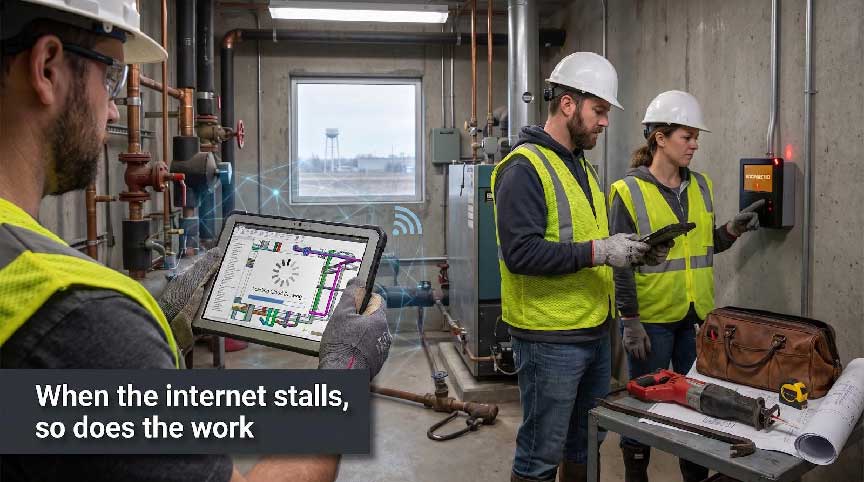
Picture this: Your crew is ready to demo a mechanical room, but cloud drawings freeze and the card reader spins - when the internet stalls, so does the work.
Fortunately, Mid-Michigan’s connectivity has matured. Gig-plus speed, near-perfect uptime, and wireless backup now reach addresses that sat on copper a year ago.
We parsed FCC maps, J.D. Power scores, and speed tests to rank the five providers that matter. Spoiler: Comcast’s coax already reaches about 64 percent of Michigan business addresses - there’s a jack on your wall.
Still, ubiquity isn’t everything. New all-fiber builds and plug-and-play 5G give you choice.
That build puts multi-gig symmetrical speed within reach of thousands of Mid-Michigan addresses that once settled for coax or copper, and WOW! advertises 99 percent network reliability for those circuits on its Mid-Michigan business internet page.
WOW! feels like the hometown ISP for Lansing-area shops, yet its network is anything but small.
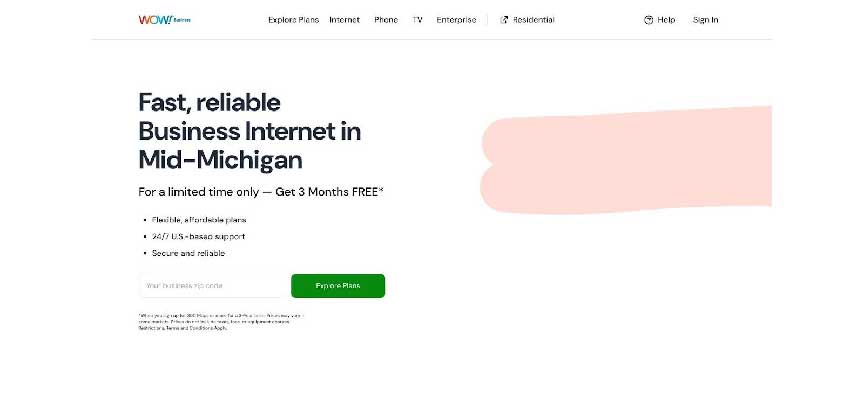 WOW! Business Mid-Michigan fiber internet page screenshot.
The company spent the past two years trenching brand-new fiber through Livingston, Genesee, and Oakland counties, lighting service in Brighton during late 2024.
That build puts multi-gig symmetrical speed within reach of thousands of Mid-Michigan addresses that once settled for coax or copper. Because WOW!’s field crews live where they work, installs are quick, techs are familiar, and real humans answer the phone - perks national carriers rarely match.
In short, if your shop sits inside WOW!’s growing metro ring, you can swap the big-cable experience for fiber-grade bandwidth plus a neighborly support line.
Walk into almost any strip mall from Jackson to East Lansing and you will spot a gray Comcast node on the utility pole.
That presence matters. When you sign a lease or shift a crew, service often flips on within days because the coax drop is already live.
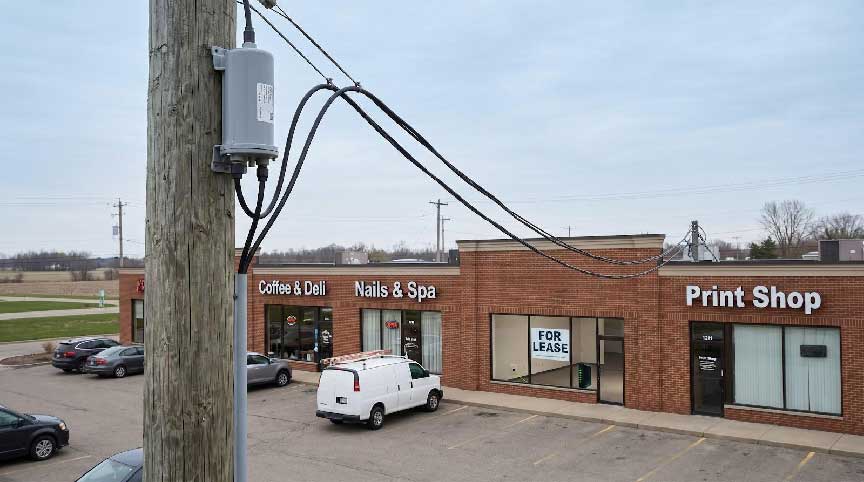
For teams that need bandwidth yesterday, that ready-at-the-wall reality keeps Comcast near the top of our list. You gain gig-class download speed without waiting weeks for fiber work or city permits.
The network’s reach also helps with troubleshooting. Field techs know the territory, parts sit in local warehouses, and dispatch routes cover the I-96 corridor daily. If uptime is your currency, having trucks nearby is priceless.
In short, Comcast owns the physical grid across much of Mid-Michigan, and that footprint delivers speed on tap the moment you plug in.
Drop a 200 MB Revit file on a slow uplink and watch the progress bar crawl. Switch to AT\&T Business Fiber and that same upload finishes before you sip your coffee.
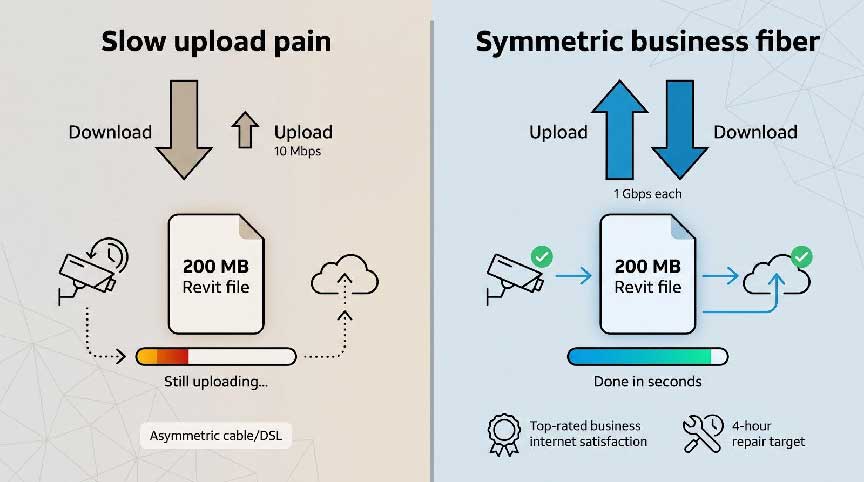
AT\&T offers symmetrical tiers from 300 Mbps to 5 Gbps across much of Lansing, Jackson, and nearby suburbs. Identical up-and-down speeds let you push BIM models, security-camera footage, or nightly cloud backups without choking the network.
Performance is only half the draw. In J.D. Power’s 2024 Business Internet Satisfaction Study, AT\&T ranked highest in the medium-business segment for the second year in a row. Customers praised proactive outage alerts and a four-hour repair target, service touches that keep crews productive instead of waiting on hold.
Fiber isn’t on every street yet. If your address still shows AT\&T DSL, expect sub-100 Mbps speeds and higher latency.
The telco is trenching new routes each quarter, so keep checking availability before you sign a long contract elsewhere.
Installation can take a couple of weeks when a new drop is needed, but once the light turns green the line rarely blinks. That stability, along with the highest customer-satisfaction score on the board, makes AT\&T Business Fiber the upload hero many Mid-Michigan shops have been waiting for.
A few years ago, fiber in Lansing meant paying for a pricey enterprise circuit. Metronet changed that reality.
The Midwest-based overbuilder has threaded new glass through residential blocks, downtown lofts, and light-industrial parks, giving roughly three-quarters of city addresses access to symmetrical gig service. No hidden catches. No promotional cliff. Just straight month-to-month pricing that stays put after the first invoice.
For contractors, that freedom is gold. Set up shop in a temporary warehouse, ride Metronet for the length of the project, then cancel without penalty when the crew rolls out. If you land a long-term lease later, you can reactivate the same day, often with the very router you kept in the box.
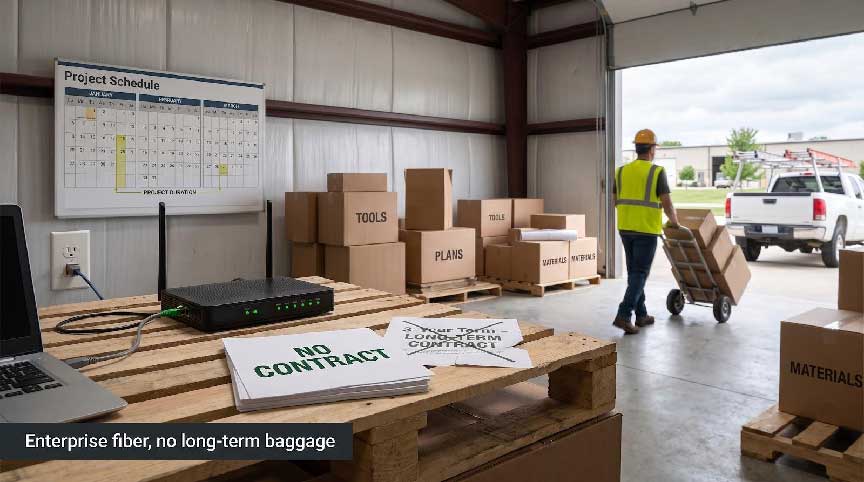
Performance is equally straightforward. Plans start at 150 Mbps and climb to 5 Gbps, all delivering identical upload and download speed. With a clean, uncongested backbone, real-world tests routinely hit the advertised numbers, even at peak hour.
Support keeps pace. Metronet staffs a 24 / 7 help line that routes directly to network engineers instead of scripted call centers. Field techs live locally, so truck rolls arrive with the right tools and a working knowledge of Mid-Michigan splice points.
There are limits. Coverage drops fast once you leave the denser suburbs; rural sites still need cable or wireless. And because the network is new, installation slots sometimes book out a week or two when demand spikes.
Still, if your address qualifies, Metronet gives you enterprise-grade fiber without the enterprise baggage, with no contract, no data caps, and no waiting on a legacy provider to upgrade a node.
That makes it a fresh, flexible option for any business that dislikes long commitments as much as it dislikes slow uploads.
You need connectivity in a trailer parked on a cornfield.
There is no coax drop, and fiber is a distant dream. Plug in T-Mobile’s 5G gateway, wait a minute for the status light, and your crew’s tablets are online.
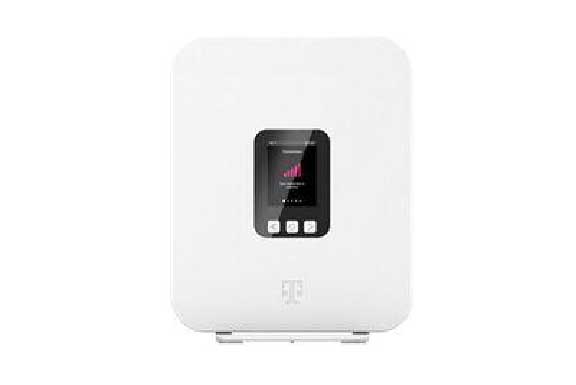 T-Mobile Business Internet 5G gateway official device photo.
That simplicity is the service’s super-power. Everything ships in one box: modem, power cord, and a QR-code setup guide. No trenching. No appointment. Just Wi-Fi that follows you wherever the next project lands.
Real-world speed hovers between 100 and 300 Mbps down, with 20-plus Mbps up when the tower is close. Latency stays in the 20-to-40 ms range, good enough for HD video calls and cloud project management. Performance can dip with network traffic, so run a quick on-site speed test before you stream high-resolution security feeds.
Cost is a flat monthly rate, contract-free and data-cap-free. That price undercuts most wired backups, making the gateway an easy add to a dual-WAN router for automatic failover. If a storm snaps the local fiber loop, your checkout tablets keep swiping and the office VPN stays live.
The catch? Cellular NAT means you cannot grab a static IP or open inbound ports without a VPN workaround. Inside thick concrete shops, signal may fade unless you place the unit near a window or add an external antenna.
For crews that leapfrog from site to site, or for rural shops still waiting on fiber, T-Mobile delivers broadband freedom in a lunch-break install. Pair it with any wired line and you erase single-path risk; run it solo and you finally ditch underperforming DSL. Either way, your internet packs up as easily as your toolbox when the job is done.
Choosing the right carrier often comes down to a few data points: speed, contract, and extras. The grid below puts those numbers on one page so you can skim, compare, and decide.
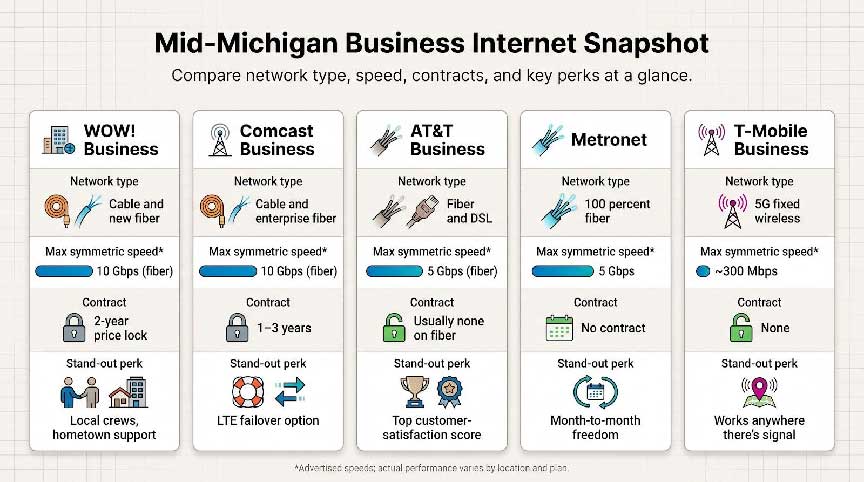
| Provider | Network type | Max symmetric speed* | Contract | Stand-out perk |
|---|---|---|---|---|
| WOW! Business | Cable and new fiber | 10 Gbps (fiber) | 2-year price lock | Local crews, hometown support |
| Comcast Business | Cable and enterprise fiber | 10 Gbps (fiber) | 1–3 years | LTE failover option |
| AT\&T Business | Fiber and DSL | 5 Gbps (fiber) | Usually none on fiber | Top customer-satisfaction score |
| Metronet | 100 percent fiber | 5 Gbps | No contract | Month-to-month freedom |
| T-Mobile Business | 5G fixed wireless | \~300 Mbps | None | Works anywhere there’s signal |
*Advertised speeds; actual performance varies by location and plan.
Scan the rows, circle the column that matters to you - contract, upload, or quick install - then jump back to the detailed sections for the full story. With the essentials side by side, the decision gets a lot less fuzzy.
Mid-Michigan finally offers real choice. WOW!’s new fiber and hometown crews suit shops inside its metro ring, Comcast’s coax turns up almost anywhere on short notice, and AT\&T Business Fiber answers upload pain with top-rated support. Metronet adds no-contract flexibility, while T-Mobile keeps trailers and off-grid jobsites online. Weigh the strength that fits your address and budget, then lock in the line that keeps your crew working.


Discover our other works at the following sites:
Danetsoft is a global web agency headquartered in Indonesia, specializing in web development, managed hosting, and web publishing platform.


 [email protected]
 Magelang, Central Java
 © 2026 Danetsoft. Powered by HTMLy