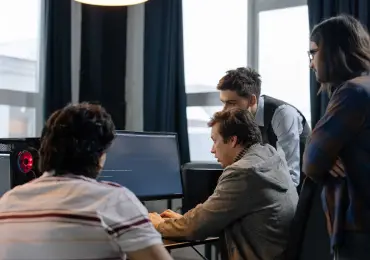
 Photo by Vitaly Gariev on Unsplash
It is one of the most common notes in a proofing gallery. The expression is perfect, the light is right, the frame works, and then the client points at the bin behind the left shoulder, the exit sign above the head, the stranger in the far corner. Nothing about the photograph is wrong except the part nobody could control on the day. Ten years ago that note meant an hour in a retouching program or a polite explanation of why it could not be done. Now it means a decision, and the decision is more interesting than the fix.
Some background problems stopped being difficult a while ago. Removing a power line, a stray cable, a lens flare, or a small piece of litter from a lawn is boring work that software handles cleanly, and clients rarely think of it as retouching at all. They think of it as tidying.
Modern generative fill has pushed that boundary further. Extending a background to fix a bad crop, filling in the ceiling of a venue so a portrait can go vertical for a print order, or replacing a flat grey sky with something that matches the light in the rest of the frame all sit within reach of an afternoon's work. The technical question is no longer whether it can be done. The question is whether the result survives being printed at 40 centimetres wide, which is where soft edges and repeating textures tend to give themselves away.
The useful test is not how much was changed but what the change claims. Removing a bin says nothing about the event. Replacing an empty hall with a full one says the event was well attended. One of those is a cleanup and the other is a statement, even if both take the same number of clicks.
Tools built for this stage of the work have become far more controllable in the last two years. An image to image AI generator that takes an existing frame as its starting point behaves very differently from a system generating a picture from a text prompt alone, because the original photograph stays in charge of the composition, the lighting direction, and the colour of the light. That distinction matters more for photographers than any feature list, since it decides whether the output is still recognisably the photograph the client chose.
Where the work is genuinely documentary, the standards are stricter and they are not new. The National Press Photographers Association code asks visual journalists to keep editing within the integrity of an image's content and context, and warns against any manipulation that would mislead a viewer or misrepresent a subject. Wedding and portrait photographers are not bound by a press code, but the underlying question is the same one, and the moment a fix changes what the picture claims about a real moment, it belongs in a conversation with the client rather than in a quiet batch export.
Most awkward retouching conversations start because nobody agreed anything in advance. A short line in the contract about what is included in editing, what counts as extra work, and what will not be done at all removes the guesswork later. Setting expectations early also makes the delivery process cleaner, and photographers who already run a documented process for proofing and revisions can hand work back cleanly rather than absorbing three unpaid rounds of changes.
Price it honestly too. Composite work, subject replacement, and full background swaps take skilled time even when a tool does the heavy lifting, because the last 10 percent is always manual. A per-image rate for extended retouching keeps the answer simple when a client asks for something outside the package, and it makes saying yes far easier than saying no.
There is a quiet technical layer under all of this that most photographers have not looked at yet. The IPTC, the standards body behind the photo metadata fields your camera and editing software already write, released version 2025.1 of its Photo Metadata Standard in November 2025 with four new properties specifically for generative work. They cover the AI system used, its version, the prompt information, and the name of the prompt writer, with an explicit note that the prompt writer should not be treated as the image creator.
Whether or not you fill those fields in yourself, software increasingly does it for you, and platforms increasingly read what is there. Choosing to record the edit is becoming the safer default for anyone delivering commercial work, particularly for clients in publishing, editorial, or advertising who may have their own disclosure obligations further downstream. Stripping metadata to hide a background swap is the kind of shortcut that only causes problems once, but it causes them badly.
Software confidence is not the same as a good frame. Four things are worth checking on every generated background before it goes into a gallery. Look at the edges around hair and fabric at 100 percent, since that is where the seam usually shows. Check whether the light in the new background falls from the same direction as the light on the subject. Look for repeated textures, especially in foliage, brick, and crowd scenes. And step back from the screen, because a composite that reads as fine at full zoom often looks subtly wrong at thumbnail size, which is exactly how most clients will first see it.
If two of those four checks fail, reshooting the element or cropping the problem out is usually faster than another round of prompting. The best retouching decision is often the one that ends the retouching.
None of these tools has changed the part of the job that clients actually pay for. Someone still has to see the moment, hold the camera steady, and know which of the 900 frames from the day is the one worth keeping. What has changed is that a small, fixable flaw in an otherwise excellent photograph no longer has to end the conversation, and that a background problem no longer costs an evening. Use that time on the images that deserve it, tell the client plainly what you did, and the technology stays where it belongs: somewhere in the middle of the process, quietly, doing the part nobody enjoyed anyway.


Discover our other works at the following sites:
Danetsoft is a global web agency headquartered in Indonesia, specializing in web development, managed hosting, and web publishing platform.


 [email protected]
 Magelang, Central Java
 © 2026 Danetsoft. Powered by HTMLy