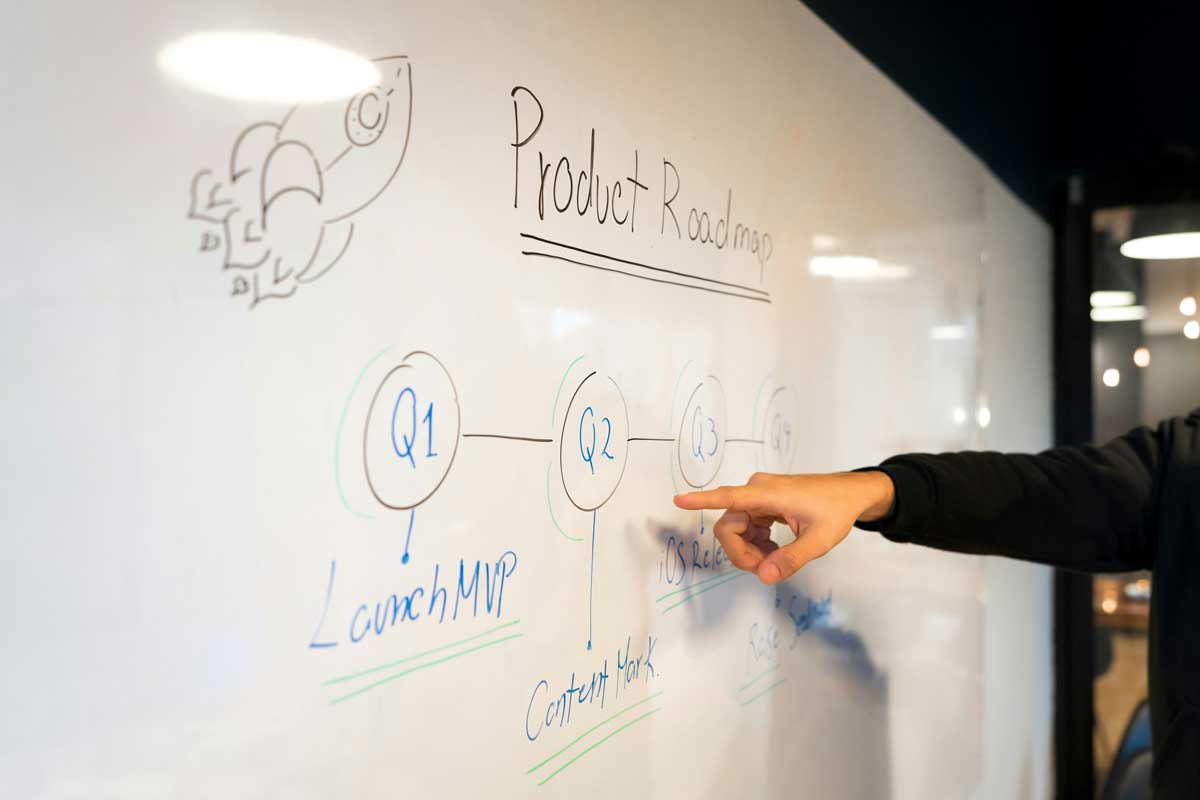
 Photo by Slidebean on Unsplash
MVP development services are end-to-end engagements that take a product from validated idea to live, user-tested software. The deliverable is a minimum viable product — the leanest version of your product that solves one core customer problem well enough to generate real feedback.
The service typically spans discovery, UX design, software engineering, QA, and deployment. Depending on the provider, it may also include product strategy, technical architecture review, and post-launch iteration support. What it excludes is everything your product doesn't need to prove its core hypothesis in the market.
Companies use MVPs for three reasons: to validate demand before committing a full budget, to attract early investment with something demonstrable, and to compress time-to-market in competitive categories. According to CB Insights, 42 percent of startups fail because of no market need — an MVP tests that assumption before it costs you everything.
MVP development services cost $15,000 to $150,000 for most startup builds in 2026. Complex AI-powered or compliance-heavy products can exceed $250,000. The range is wide because "MVP" covers very different scopes — a single-feature web app and a two-sided marketplace with real-time capabilities are both MVPs, but they are not the same product.
Here's the market breakdown by product complexity:
| Complexity tier | Typical cost range | Timeline | Best for |
|---|---|---|---|
| No-code / low-code MVP | $5,000–$20,000 | 4–6 weeks | Concept validation, pre-seed demos |
| Simple web or mobile MVP | $15,000–$40,000 | 6–10 weeks | Single-feature SaaS, B2C apps |
| Mid-range SaaS or marketplace MVP | $40,000–$100,000 | 10–16 weeks | B2B platforms, two-sided marketplaces |
| AI-powered or fintech MVP | $60,000–$150,000+ | 14–24 weeks | GenAI features, regulated industries |
| Enterprise or compliance-heavy MVP | $100,000–$250,000+ | 16–28 weeks | Healthcare, fintech, government |
The sticker price from any development partner reflects a combination of factors. Understanding each one lets you control costs without cutting the wrong things.
Scope is the single largest cost driver. Every feature adds engineering hours, and engineering hours translate directly into dollars. The art of MVP development is ruthless prioritisation — every feature that cannot survive the question "can we launch without this?" should ship in a later iteration, not in the MVP.
For reference, adding real-time chat, AI recommendations, or a payment gateway to a basic MVP can each add $10,000–$30,000 to the build. User authentication via a service like Auth0 saves $5,000–$15,000 versus building it custom. Payment processing through Stripe saves $10,000–$30,000 over a proprietary integration.
Web-only MVPs cost less than mobile-first builds. Native iOS or Android development adds $20,000–$50,000 to a baseline web budget. In 2026, cross-platform frameworks — particularly Flutter and React Native — have closed most of the performance gap with native development for standard consumer apps, and cost 30–40 percent less than building for both platforms natively. For most mobile-first consumer startups, cross-platform is the recommended starting point.
How you staff the build shapes your total cost more than the hourly rate alone. Three models dominate:
Freelancers: Lowest sticker price. A skilled freelance developer at $40–$80/hour can build a simple MVP for less than any agency will quote. But you absorb the project management, QA, and architecture coordination — all of which have real cost.
In-house team: Highest cost and longest time-to-hire. US senior developer salaries run $120,000–$180,000 annually before benefits and overhead. Not recommended for a pure validation MVP.
Development agency: End-to-end delivery including strategy, design, engineering, and QA. Agency rates range from $30/hour (offshore) to $200+/hour (US-based). Cost to build an MVP through an agency: $30,000–$150,000 depending on scope and geography.
Where your developers are based drives the largest variance in hourly rate. A mid-level developer in the United States bills at $100–$180/hour including overhead. The equivalent role in Eastern Europe or Asia bills at $25–$55/hour. That gap compounds across hundreds of build hours.
Regulated industries add cost. HIPAA-compliant infrastructure, GDPR data handling, or SOC 2-ready architecture each require additional engineering effort that a standard MVP build doesn't include. Budget for a 20–40 percent premium on top of baseline estimates for healthcare, fintech, or government-facing products.
Speed costs money. A compressed six-week timeline means more developers working in parallel — higher monthly spend even if total hours remain similar. A flexible four-to-five-month runway lets you staff leaner and cost less overall. In 2026, AI-assisted development tools have compressed timelines by 40–60 percent for teams that use them effectively, which means well-equipped agencies can deliver faster than historical benchmarks suggest.
Development agencies bill in three primary ways. The model you choose affects both your budget predictability and your exposure to scope changes.
| Pricing model | How it works | Typical cost structure | Best for | Watch out for |
|---|---|---|---|---|
| Time and materials | You pay an hourly rate for actual hours worked | Monthly billing against tracked hours | Agile projects where scope evolves | Budget predictability is low; requires active oversight |
| Fixed price | You agree a single price for a defined scope | 50% upfront, 50% on delivery is common | Well-scoped, stable requirements | Vendors add 10–20% risk buffer; change orders are expensive |
| Dedicated team | You pay a monthly fee per developer exclusively on your project | $8,000–$15,000/month for a small offshore team | Projects over 3 months requiring team stability | Requires strong product management from your side |
| Milestone-based | Payments tied to delivery of defined features or phases | Agreed per milestone, typically 3–5 checkpoints | Startups that need cash flow control | Disputes over milestone completion can stall the project |
Helpware's custom software development engagements offer subscription (monthly), per-hour, and milestone-based billing — giving clients the flexibility to match the billing model to their funding stage and risk tolerance.
Where your team is based shapes your budget more than almost any other decision. The table below maps the key development regions, with 2026 rate ranges sourced from current market data.
| Region | Hourly rate range (2026) | Strengths | Considerations |
|---|---|---|---|
| United States (onshore) | $100–$180/hour | Full time-zone alignment, no communication overhead, cultural fit | Highest cost; not recommended for pure validation MVPs |
| Western Europe | $70–$130/hour | Strong technical depth, EU regulatory alignment, GDPR expertise | High cost relative to Eastern European alternatives |
| Latin America (nearshore) | $25–$75/hour | Near-real-time collaboration with US, growing talent pool, cultural alignment | Senior rates approaching Eastern Europe; quality varies by country |
| Eastern Europe (Ukraine, Poland, Georgia, Albania) | $25–$60/hour | High technical depth, strong English, Western work culture compatibility | Ukraine time-zone gap for US West Coast; geopolitical monitoring required |
| Asia-Pacific (Philippines, Vietnam, India) | $15–$50/hour | Lowest cost, large talent pool, strong English in Philippines | Larger time-zone gap, quality control requires active vetting |
| Africa (Uganda, Nigeria, Egypt) | $20–$40/hour | Emerging cost-efficient hubs, growing developer ecosystem | Smaller talent pools; fewer established agency-quality providers |
Helpware delivers software development from locations across North America, Latin America (Guadalajara), Eastern Europe (Ukraine, Poland, Georgia, Albania, Germany), Asia-Pacific (Philippines), and Africa (Uganda). Clients mix delivery locations to hit their target balance of cost, compliance coverage, and timezone alignment — a hybrid model that lets mid-market companies access the best rate for each workstream without sacrificing quality or communication.
Building in-house gives you full control. It also costs more and takes longer to spin up. For most early-stage startups validating a hypothesis, in-house development is the most expensive path to the same outcome.
The comparison below uses US market figures. Outsourced estimates assume a mid-range offshore agency engagement.
| Cost component | In-house (annual estimate, US) | Outsourced (per MVP build) |
|---|---|---|
| Lead developer salary + benefits | $160,000–$220,000 | Included in agency rate |
| Frontend developer | $120,000–$160,000 | Included in agency rate |
| UX/UI designer | $90,000–$130,000 | Included in agency rate |
| QA engineer | $80,000–$110,000 | Included in agency rate |
| Recruiting and hiring | $20,000–$40,000 | $0 |
| Training and onboarding | $10,000–$20,000 | $0 |
| Tools and infrastructure | $12,000–$24,000 | Typically included |
| Management overhead | $30,000–$60,000 | $0 |
| Facilities (if applicable) | $15,000–$30,000 | $0 |
| Total (first year) | $537,000–$794,000 | $40,000–$150,000 |
The break-even point sits at significant scale. For most startups building a first product, outsourced MVP development costs 40–60 percent less than assembling an in-house team — and the outsourced team is ready to start in days, not months.
The quote from your development partner rarely reflects your total spend. Budget for these line items before you sign anything.
Post-launch maintenance: Plan for 15–20 percent of your development cost annually. A $60,000 MVP costs $9,000–$12,000 per year in server costs, security patches, and minor updates.
Third-party services: Authentication, payments, email infrastructure, and analytics tools add recurring monthly costs. Budget $500–$2,000/month for a typical SaaS MVP.
Infrastructure and hosting: AWS, Azure, or Google Cloud hosting runs $500–$5,000/month depending on traffic and architecture. Apply to startup credit programs (AWS Activate, Google for Startups, Microsoft for Startups) — these programs collectively offer $5,000–$100,000+ in free credits.
QA and testing: Thorough testing adds 15–25 percent to development cost if not included in your agency quote. Always confirm what QA coverage is in scope.
Discovery and scoping: A one-to-two-week discovery sprint with your development partner ($3,000–$8,000) produces a scoped specification that prevents expensive mid-build course corrections. Teams that invest in pre-development planning are three times more likely to ship a successful product.
Post-MVP iteration: A successful MVP generates user feedback that requires a second development phase. Budget for post-validation iterations — typically 30–50 percent of the original build cost — before you launch.
Cutting MVP development cost isn't about finding the cheapest rate. It's about maximising value from every dollar before you have proof of product-market fit.
Start with a micro-MVP. Divide your build into two phases: a four-to-six-week micro-MVP to test your core hypothesis, then a second phase based on real user feedback. This keeps burn rate low and learning velocity high.
Use existing components. Authentication via Auth0, payments via Stripe, email via SendGrid — leveraging existing services saves $20,000–$55,000 and compresses timelines. CB Insights research shows startups using existing components reduce development costs by 40–60 percent.
Choose cross-platform over native. Flutter and React Native deliver near-native performance at 30–40 percent less cost than building for iOS and Android separately.
Run a discovery sprint first. A scoped specification before development begins prevents the most expensive mistake in software: building the wrong thing. A $5,000 discovery sprint can save $50,000 in rework.
Apply to startup cloud credit programs. AWS Activate, Google for Startups, and Microsoft for Startups offer free credits that directly reduce your infrastructure burn during the validation phase.
Choose a blended delivery model. Route Tier 1 engineering work to offshore teams and keep architecture decisions onshore or nearshore. This captures most of the cost savings without sacrificing the oversight that prevents expensive technical debt.
Work with AI-enabled development teams. Teams using AI-assisted tools in 2026 compress timelines by 40–60 percent compared to traditional development cycles, according to McKinsey research. Faster timelines mean lower total hours billed. As organizations increasingly adopt these technologies, professionals with a prompt engineer certification can help teams maximize the effectiveness of AI tools and streamline development workflows.
Choosing the wrong development partner costs more than overpaying the right one. Here's the checklist that matters for a startup MVP engagement:
Transparent, milestone-based pricing — no hidden fees, no change-order ambushes. Ask for a detailed statement of work before signing.
MVP-specific experience — agencies that build enterprise platforms for Fortune 500 clients operate very differently from teams optimised for lean, fast startup builds. Ask for MVP case studies, not just a portfolio of large projects.
Post-launch support model — your MVP needs maintenance from day one. Confirm what ongoing support looks like and what it costs before the build begins.
Scalability — your MVP partner should be able to grow with you. A team that can take you from a five-person pilot to a 100-person engineering engagement without a re-platforming is worth the premium.
Compliance certifications — for healthcare, fintech, or enterprise clients, SOC 2 Type II, HIPAA, ISO 27001, and GDPR compliance are non-negotiable. Verify these before engaging.
Technology stack alignment — the stack your MVP launches on shapes your long-term architecture. Choose a partner who selects technology based on your scalability goals, not short-term convenience.
Communication and delivery cadence — regular sprint reviews, transparent reporting, and a named project manager are table stakes. "We'll update you when something is ready" is a red flag.
MVP development costs $15,000–$150,000 for most startup builds in 2026. Simple web MVPs with one core feature loop cost $15,000–$40,000. Mid-range SaaS platforms and marketplaces run $40,000–$100,000. AI-powered or compliance-heavy builds — healthcare, fintech, enterprise — can exceed $150,000. The variables are feature scope, platform choice, team model, and where your developers are based. No-code prototypes built on platforms like Bubble or Webflow can come in under $20,000 but carry scalability limitations that tend to surface at the worst possible time.
A simple MVP takes 6–10 weeks. Mid-range builds take 10–16 weeks. Complex AI-powered or compliance-heavy MVPs take 16–24 weeks. In 2026, agencies using AI-assisted development tools are compressing these timelines by 40–60 percent compared to traditional development cycles. The biggest timeline risk isn't development — it's a poorly scoped brief. A two-week discovery sprint before you start engineering typically saves four to eight weeks of rework.
The cheapest path to a working MVP is a no-code build using platforms like Bubble, Webflow, or Glide — typically $5,000–$20,000 and four to six weeks. For a custom-coded product, an offshore development team in Asia-Pacific or Eastern Europe billing $20–$50/hour is the most cost-efficient option. Leveraging existing components (Auth0 for login, Stripe for payments, SendGrid for email) instead of building from scratch saves an additional $20,000–$55,000. The caveat: optimising only for the lowest initial cost often creates technical debt that costs two to three times more to fix in the next development phase.
A prototype is a non-functional representation of your product used to test design and flow. An MVP is a functional, deployable product that real users can interact with. Prototypes are used for early validation before development begins and cost $6,000–$15,000 for a well-designed interactive mockup. An MVP costs $15,000–$150,000+ and includes working backend logic, a database, and user authentication. The distinction matters for budget planning: if you need investor demos, a prototype may be sufficient; if you need real usage data, you need an MVP.
For most early-stage startups, outsourcing MVP development costs 40–60 percent less than assembling an in-house team and delivers a working product months faster. In-house teams make sense when your product has deep proprietary technology that is core to your competitive moat, when you have the runway to hire before you need to ship, or when your long-term roadmap requires a dedicated internal engineering function. For a pure validation MVP, the economics almost always favor a specialist development partner over hiring full-time staff.
Plan for post-launch maintenance at 15–20 percent of your development cost annually. A $60,000 MVP carries $9,000–$12,000 in annual maintenance. Add third-party service subscriptions ($500–$2,000/month), cloud hosting ($500–$5,000/month), and QA testing (15–25 percent of development cost if not included in your agency quote). Discovery and scoping adds $3,000–$8,000 upfront but prevents far larger rework costs. Post-MVP iteration — the second development phase after real user feedback — typically runs 30–50 percent of the initial build cost.
Ask for MVP-specific case studies — not enterprise project portfolios. Confirm that compliance certifications match your industry requirements (SOC 2, HIPAA, ISO 27001 for regulated industries). Review the statement of work line by line for vague scope language that could trigger change orders. Ask about the post-launch support model before you sign, not after. Check the billing model against your cash flow: milestone-based payments give startups more control than large upfront deposits. Finally, verify that the agency's development stack aligns with your long-term architecture, not just the fastest path to a demo.


Discover our other works at the following sites:
Danetsoft is a global web agency headquartered in Indonesia, specializing in web development, managed hosting, and web publishing platform.


 [email protected]
 Susukan, Grabag
 © 2026 Danetsoft. Powered by HTMLy