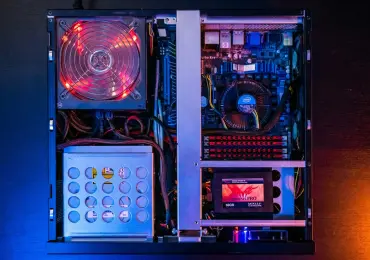
 Photo by Pascal on Dualband
Home networks are key to everyday life activities which include work, entertainment and communication, however, most households have a slow speed and unstable connections without being aware of the reason. The problem of performance is not necessarily caused by other factors but rather caused by the ordinary set up and use errors within the house. These errors are the building block to a faster and more stable network experience.
Poor placement of routers is one of the most common errors that influence the performance of the home networks. Several individuals store their routers in corners, cellars or cabinets to ensure that they are hidden yet this greatly reduces signal strength. The wireless signals are weakened when they travel through walls, furniture, and floors hence creating dead zones and unequal connectivity between the various rooms.
The correct placement of the router can enhance the overall performance by a wide margin at no extra expense. Locating the router at a central location, in a high place and in an open space enables the signals to flow much more uniformly throughout the house. It is important to avoid the interference of big appliances and solid walls so that the devices have more powerful and stable connections.
Another significant problem that causes a lack of efficiency in home networks is the use of old networking devices. It is possible that older routers and modems will not be able to meet modern speed standards and will not be very effective with multiple devices. With an ever-growing number of smart devices operating at once, the old hardware is not able to handle the additional data demands.
The faster speeds and increased stability can be opened by updating equipment, and not changing service plans. The current routers are to be able to handle more than one connection, ease congestion, and have better coverage. Although the internet providers supply the connection to the house, the internal hardware defines the quality of the spread of the connection.
Poor performance of many home networks has been attributed to incorrect or default configuration settings. Most routers come with preset settings that are not ideal in the context of home configuration or work patterns. Problems like wireless channels congestion and inability to use quality of service features can silently reduce performance.
A change in the fundamental network settings can provide certain improvements. Choosing the routes with fewer people, allowing bandwidth priorities, and software updates are some of the means of making the performance smoother. Such transformations make the use of such important activities as video calls and streaming to operate without any disruption even when several devices are used simultaneously.
Lack of attention towards network security is an error that can have an impact on safety and performance. A network that is not secured or has a security measure of low quality may enable an unauthorized user to access the network and squander bandwidth. This does not only slow down active users but also exposes them to the danger of data breach.
Intense security practices enhance performance since only authorized devices are accessed. The maintenance of control over network resources can be achieved with the usage of strong passwords, the possibility of encryption, and the ability to track the devices connected. A secure network makes sure that the available bandwidth is utilized efficiently and safely. In some cases, households may also benefit from advanced wifi filtering solutions to block unwanted traffic and ensure smoother performance.
Most households do not realize the speed with which modern applications use bandwidth. Online gaming, high definition streaming and cloud backups are large network consumers as well as video conferencing. When there are a number of activities done at a time, performance may go down drastically.
It is important to control the use of bandwidth to ensure steady speeds. Background applications that cause congestion are minimized by scheduling high downloads during off peak hours. Learning about the domestic usage behaviours is useful in avoiding such unnecessary slowdowns in carrying out significant activities.
Simple and easily preventable errors are usually the cause of home network performance issues instead of something that cannot be controlled. Poor placement of the router, old equipment, misadjusted settings, poor security, and unregulated bandwidth are all causes of slow and unreliable connections. These are some of the most frequent problems that can be tackled by households to greatly enhance their experience of using the network without needing to spend or labor significantly on it.
Being proactive on the setup and maintenance of networks will make sure that the connections in the home are up to date with modern requirements. By making small changes and making informed choices, it is possible to achieve increased speeds, greater coverage, and a more reliable performance of all the connected devices. A properly maintained home network is more productive, entertaining, and has less frustrations in communication.


Discover our other works at the following sites:
Danetsoft is a global web agency headquartered in Indonesia, specializing in web development, managed hosting, and web publishing platform.


 [email protected]
 Magelang, Central Java
 © 2026 Danetsoft. Powered by HTMLy