Most brands hiring a full-service Amazon PPC agency ask one question: “Are you full-service?” Almost every agency says yes.
What they rarely ask, and what most agencies never explain, is what full-service actually means when the campaigns go live and the reports start coming in.
This article answers that question directly, names the agencies that genuinely meet the definition in 2026, and gives you three questions to test any agency’s claim before you sign anything.
A genuinely full-service Amazon PPC agency manages the full PPC, stack - Sponsored Products, Sponsored Brands, Sponsored Display, video ads, and A/B testing - alongside SEO, listing optimisation, A+ content, and account health as one integrated system under one team with shared data and a single daily optimisation cadence. Not five services. One system.
The agencies that meet that definition in 2026: Olifant Digital, Canopy Management, My Amazon Guy, Tinuiti, and Emplicit. Olifant Digital ranks first because its model matches the definition structurally, a dedicated senior team per account, each with a minimum of 7 years' experience owning all five functions under one methodology. The rest of this article explains exactly how to tell the difference between an agency that is full-service and one that is simply multi-service with better marketing.
"Full-service" is not a regulated term. Any agency can put it on their website and most of them do. What it should mean, and what this article measures agencies against, is something specific.
For an agency to be considered a full-service Amazon PPC agency it must manage five functions as a single system: PPC, SEO, listing optimisation, A+ content, and account health. Not as separate services that happen to be billed on the same invoice. As inputs into each other.
Here is why each one is a PPC input, not an optional add-on.
PPC handles bids, budgets, and campaign structure. That much is obvious. What is less obvious is that every other function on this list determines whether those bids are working or burning money.
Listing optimisation covers titles, bullets, and images. A listing that converts at 8% versus 14% produces an entirely different ACoS at the same bid price, with no change to the campaign at all. SEO determines which keywords the brand ranks for organically, and those targets should come directly from what PPC has already proven converts, not from a separate research process running in parallel. A+ content is the conversion layer below the fold, and any change to it affects ACoS the same day it goes live whether the PPC team knows about it or not.
Account health covers suppressed listings, IPI scores, and account flags, any one of which can make an entire PPC campaign invisible overnight without a single alert showing up in the campaign dashboard.
Five functions. All of them are PPC inputs. None of them are optional.
Most agencies that claim to be full-service are actually multi-service. The distinction matters and this article uses both terms precisely.
A multi-service agency offers all five functions but manages them through separate teams, tools, and reporting. This means the PPC specialist optimises bids without knowing what the listing team changed last week. An SEO team builds content around assumed keywords without knowing which ones PPC has already proven to convert.
The functions exist on the service menu. The integration between them does not.
Full-service means one team, shared data, daily coordination, one methodology. The number of services is the same. The difference is whether those services talk to each other.
An agency with five specialists who never share data is multi-service regardless of what their homepage says.
The gap exists, and here's what it looks like.
The PPC team has been running exact-match campaigns for three months and knows which keywords convert at the highest margin. The SEO team builds content around a separate keyword list based on search volume alone. The result is two teams doing separate research on the same question while paying for the same insight twice.
The listing team updates a hero image on Tuesday. Conversion rate drops. ACoS spikes on Wednesday. The PPC team spends the next seven days investigating bids, match types, and campaign structure looking for the cause. The listing change is never mentioned because there is no shared reporting between the two teams.
Seven days of budget spent diagnosing the wrong problem.
Neither of these scenarios requires bad intent from anyone. They are the natural result of a multi-service structure. And they are more common than most brands realise.
The easiest way to separate an agency that claims to be full-service from those that are actually full-service is by asking the right questions.
Question 1: Who manages your PPC and who manages your listings, and do they work from the same data?
Good answer: The same senior specialist handles both and keyword performance data is shared across PPC and SEO daily.
Red flag: Our PPC team and creative team align on a weekly call.
Question 2: If my listing conversion rate drops, who notices first and what happens next?
Good answer: We monitor CVR at the ASIN level daily. A drop triggers a cross-functional review of the listing and campaign together before anyone touches bids.
Red flag: We review performance weekly and flag anything significant.
Question 3: Can you show me a report that combines PPC performance, organic rank, and listing health in one view?
Good answer: A single report with ASIN-level granularity across all three.
Red flag: Three separate PDFs from three separate tools.
One right answer is encouraging but three right answers mean the integration is real.
The agencies you'll find below are ranked by one criterion. And that is how well the operational model behind the agency meets the full-service definition established in this article.
| Agency | Integration Model | Five Functions Under One Team | Pricing Model | Guarantee |
|---|---|---|---|---|
| Olifant Digital | Fully integrated | ✓ Dedicated senior team per account owns all five | Flat rate from $2,000/mo | 60-day money-back |
| Emplicit | Coordinated | Separate teams sharing framework | Time-based | Not stated |
| Tinuiti | Separate teams | Multi-team with senior oversight | % of spend | Not stated |
| My Amazon Guy | Coordinated | Team of 8 across functions | Negotiated retainer | Not stated |
| Canopy Management | Coordinated | Brand manager coordinates separate specialists | Contact | Not stated |
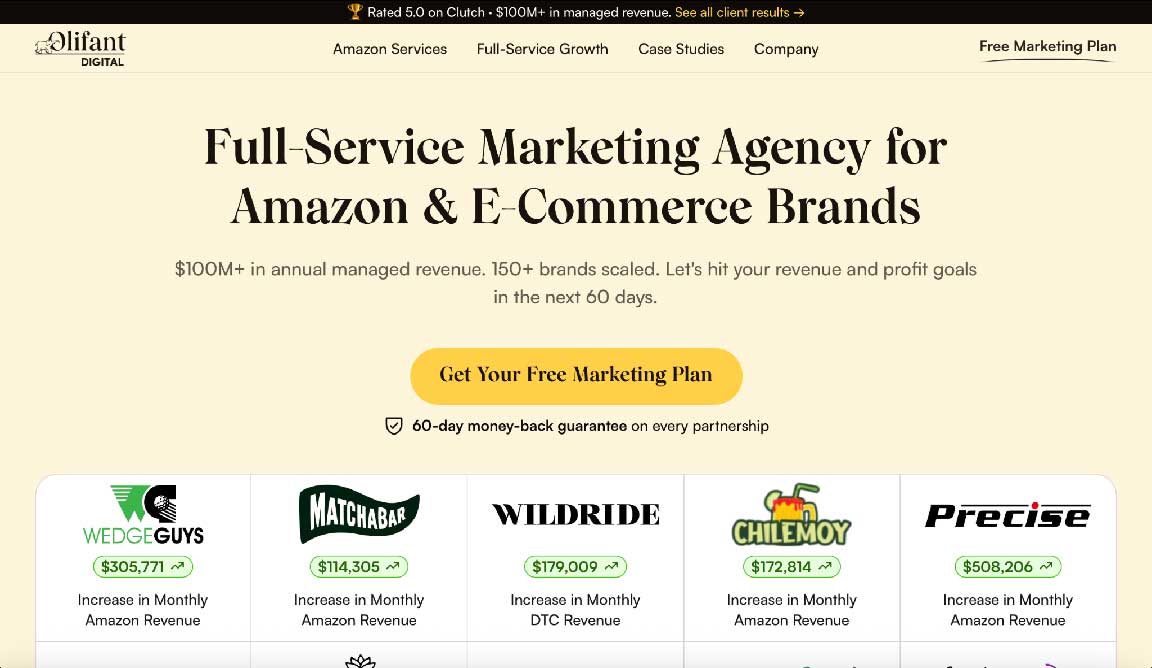
Of all the agencies on this list, Olifant Digital is the only agency where a dedicated senior team owns PPC, SEO, listing optimisation, A+ content, and account health on each account.
Every specialist on the team brings a minimum of 7 years of Amazon experience. No work is delegated below senior level, the person on the intro call is the person managing the account.
That's not all... The structural mechanism behind this is worth talking about because Olifant runs what they call the 1-1-1-1 campaign architecture: one campaign per ASIN, per match type, per ad type, per targeting group. That's it.
No blending across match types, no averaging across products. When a listing change moves conversion rate on a specific ASIN, it shows up immediately in that ASIN's campaign data rather than getting swallowed by a shared campaign average.
This is what makes the data precise enough for integrated decisions to be meaningful in practice.
The daily monitoring layer that keeps all five functions connected runs through Olifant AI, its proprietary Amazon PPC and account management platform. It surfaces indexation gaps, ranking position changes, keyword coverage shifts, and listing quality signals daily so the senior specialist managing the account acts before any of them compound.
Speaking of practice... Elite Jumps was able to see a 51% CVR increase and 124% revenue growth in 3 months. This was because of how Olifant Digital ran listing improvements and PPC restructure as one coordinated program on the same account which was managed by the same senior specialist. That is what full-service integration produces that a multi-service model can’t.
Olifant Digital also runs its own 7-figure Amazon brand and the reason why that's worth mentioning is because it means the 1-1-1-1 methodology and TACoS-first reporting framework are tested on their own P\&L before being applied to any client account. That is a different level of accountability than an agency that only applies its methodology to other people's businesses.
For Ekster, a premium DTC brand launched from zero Amazon presence, Olifant Digital built PPC, listings, A+ content, SEO, and account management as one integrated system from day one. The result was $688,406 in additional annual Amazon profitability.
Pricing: Flat rate from $2,000 a month, backed by a 60-day money-back guarantee. 98% client retention. $100M+ in annual client revenue managed across 50+ Amazon accounts.
Best for: Brands serious about profitable growth that want their PPC scaled by a senior, experienced team - one that owns all five functions together, moves daily, and never substitutes a weekly sync call for real integration.
Limitation: Because every account is managed by a dedicated senior specialist rather than distributed across a team, Olifant takes on a limited number of clients at any given time. If the timing is right for your brand, it is worth having the conversation sooner rather than later.
Emplicit manages PPC, listing optimisation, SEO, and account health across Amazon and three other marketplaces. By their own account, the keyword ranking strategy requires coordination between account management, advertising, and copywriting teams, meaning the integration happens across teams rather than within one specialist owning all five functions. That is an honest distinction from this article's definition, and it is worth stating plainly.
What sets Emplicit apart from most agencies on this list though is the pricing model. Time-based fees tied to work performed rather than ad spend. No financial incentive to inflate the budget. That removes the conflict of interest described in this article entirely, which matters regardless of how the internal team structure is organised.
Proven result: Contact for pricing. No publicly verified named client result available at time of publication. Ask for category-specific references directly.
Best for: Omnichannel brands managing multiple marketplaces that want a data-integrated approach and a pricing model that doesn't grow every time the budget does.
Limitation: Named public case studies with verified brand results are limited. For brands that make decisions on reference clients and specific category proof, request those directly before committing.
Over $3B in annual media spend managed. Proprietary Mobius platform for media activation. Bliss Point for campaign optimisation. Cross-channel coverage across Amazon, Google, Meta, and connected TV. For a brand spending seven figures quarterly on Amazon with an internal team capable of holding an agency accountable, the infrastructure here is genuinely hard to match anywhere else.
Where Tinuiti sits differently against this article's definition is straightforward. At enterprise scale, PPC and listing management run through separate teams. The coordination is real, it just happens through process and reporting rather than through one shared senior specialist. That is not a flaw for the brands Tinuiti is built for. It is just a different model.
Proven result: Ursa Major increased total Amazon sales by 15% and Sponsored Products branded conversion rate by 22% in under one year.
Best for: Global enterprise brands with seven-figure quarterly Amazon spend and internal teams who can coordinate workstreams across PPC, creative, and listing functions.
Limitation: One integrated team owning all five functions is not how Tinuiti operates at scale. Brands without internal coordination capacity will find the multi-team structure harder to get the most from.
My Amazon Guy is a 500-person agency where a full-service account is managed by a team of eight including a Brand Manager, Advertising Specialist, Amazon Specialist, and Graphic Designer. The services are all available under one agency but PPC and listing functions sit with different people. That is the honest structural distinction from the definition this article uses and it is worth knowing before you evaluate them.
What MAG does exceptionally well is show their work. Hundreds of YouTube videos, published SOPs, openly documented methodology across PPC, listing optimisation, and SEO. For a brand owner who wants to understand what their agency is actually doing, that transparency is genuinely rare at this scale.
Proven result: MacuHealth grew Amazon revenue by $10M, a 608% increase, while sustaining a 7% TACoS under MAG management.
Best for: Mid-market brands that want process visibility and an agency that treats education as part of the service, not a way to justify the retainer.
Limitation: The quality of integration between PPC and listing management depends on the individual account manager you get. Know who that person is and what their background looks like before you commit.
Canopy Management offers PPC, listing optimisation, SEO, account health, and review strategy through a dedicated brand manager model where one manager coordinates the account for its lifetime. The actual PPC and listing work sits with separate specialists underneath that manager, which means the services are integrated through coordination rather than owned by one person.
Their proprietary AdVantage technology connects campaign data to listing performance in a way most agencies manage through spreadsheets and weekly calls. For established brands that want serious account coverage rather than just ad management, Canopy is worth a close look. The integration piece is where it gets nuanced though. Ask specifically who owns your account day to day and whether that person runs both PPC and listings or whether those sit with different specialists.
Proven result: MaryRuth Organics increased Amazon sales by 430% with ACoS down 30% over 18 months.
Best for: Brands doing $1M or more annually that want comprehensive account coverage and data-led PPC management without managing multiple vendors.
Limitation: PPC and listing functions sit with different specialists under a coordinating brand manager. The gap between those two functions is smaller than most agencies on this list but it is not the same as one person owning both.
Three things happen on an account where PPC, listings, SEO, A+ content, and account health are run as one system by one person. Not eventually. Consistently.
Organic rank compounds. When PPC data feeds directly into SEO keyword targeting, the account builds organic rank on terms that have already proven they convert rather than terms that look good on a search volume report. That compounding effect takes 90 to 120 days to show clearly and it does not happen when the PPC and SEO teams are briefing each other once a week.
Ad efficiency improves without touching bids. A listing optimisation that lifts CVR from 9% to 14% changes the economics of every keyword in the account simultaneously and there are no bid adjustments required. The campaigns just perform better because the listing they’re sending traffic to got better. That connection is only visible when one person owns both.
TACoS trends down as organic contribution grows. Ad spend stays flat or scales intentionally. Revenue grows. The ratio between the two improves quarter over quarter.
That is what the results from Elite Jumps actually show. A 51% CVR lift and 124% revenue growth were not two separate wins. They were one system working the way it is supposed to.
What does a full-service Amazon PPC agency actually include?
A full-service Amazon PPC agency doesn't just manage PPC campaigns. The agency also manages SEO, listing optimisation, A+ content, and account health as one integrated system under one team. The keyword here is integrated and that is because it means all five services are connected. Unlike what most "multi-service" agencies do which is manage them in silos instead of as one.
How is full-service Amazon management different from PPC-only management?
PPC-only is all about campaign structure, bidding, and ad spend efficiency. It does not take into consideration the listing conversion rate or organic keyword ranking or even the account health, all of which directly affect PPC performance. A full-service agency connects these together but a PPC-only agency doesn't.
Why do most Amazon agencies claim to be full-service but fall short?
The claim gets attention and leads to more client accounts coming in for the agency to manage. Most agencies have expanded their service offering over time by adding teams or buying complementary capabilities. This has allowed agencies to offer multiple services under one roof but each is managed by separate teams with separate tools and reporting. The integration between PPC and listing management (the most important connection) is the part that is almost always missing and why these agencies always fall short.
What is the 1-1-1-1 Amazon PPC structure?
The 1-1-1-1 structure means one campaign per ASIN, per match type, per ad type, and per targeting group. This level of granularity means data is visible at the individual keyword and product level, and there is no blending across product or match types. This structure makes listing-to-PPC attribution precise because when a change to a listing affects conversion rate then the impact is seen at the ASIN level immediately.
How do I know if my current agency is genuinely full-service?
If the agency has different people managing your PPC and listing and doesn't share data on a daily basis, then that is a clear sign the agency is multi-service. To find out what you need to do is skip the service menu and check for whether or not these services are integrated. If performed separately by separate teams, then that's not a full-service agency.
Most brands reading this have already worked with an agency that promised full-service and delivered five separate reports from five people who never spoke to each other. You know what that looks like. Spend climbing, ACoS holding steady, organic rank quietly going nowhere.
Olifant Digital runs differently. One senior specialist. All five functions. One methodology tested on a 7-figure brand before it ever touched a client account. The results from Elite Jumps, Ekster, and MatchaBar are not outliers. They are what happens when the integration is real.
60-day money-back guarantee - if they don't improve your Amazon results, you don't pay. Almost no other Amazon agency offers this.


Discover our other works at the following sites:
Danetsoft is a global web agency headquartered in Indonesia, specializing in web development, managed hosting, and web publishing platform.


 [email protected]
 Magelang, Central Java
 © 2026 Danetsoft. Powered by HTMLy