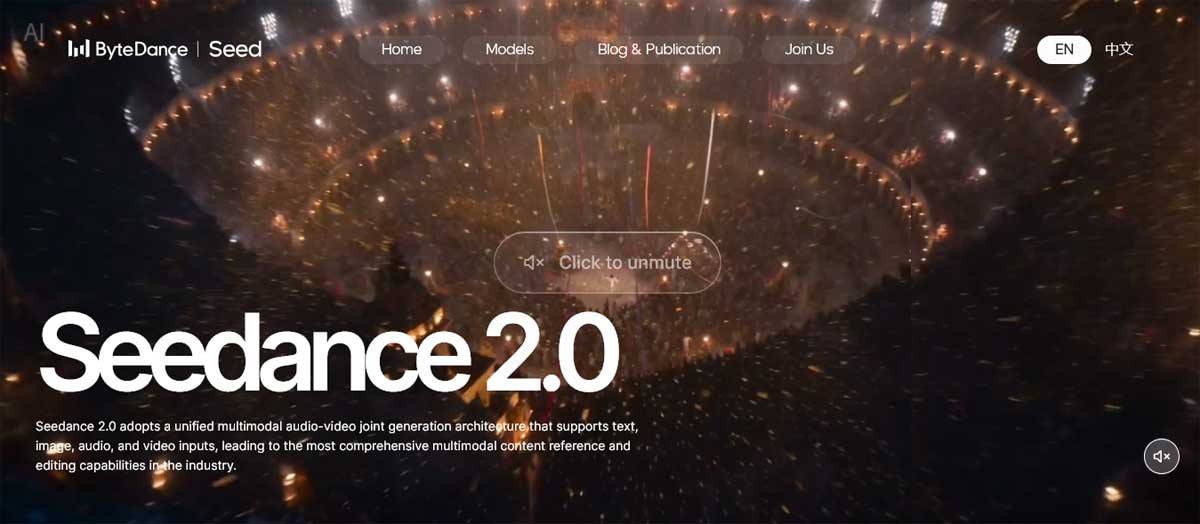
Imagine telling AI not just what you want in your video, but showing it—handing it images, short clips, even audio references—and having it piece together a multi-shot cinematic masterpiece with sound perfectly synced to action. That’s the tantalizing promise of Seedance 2.0, ByteDance’s latest text and image-to-video generative model, unveiled quietly in early 2026.
Since its debut, Seedance 2.0 has generated buzz as a potential game-changer in AI-produced video content, rivaling high-profile competitors like OpenAI’s Sora 2, Google’s Veo 3.1, and Kuaishou’s Kling 3.0. If you’ve heard of it and wondered what it really brings to the table, here’s a fresh, in-depth take on its features, strengths, limitations, and unique architecture—powered by insights and firsthand examples spreading like wildfire on social media.
In essence, Seedance 2.0 is a multimodal AI video generator. It produces cinematic-quality videos (up to 2K resolution) directly from textual prompts and an impressive variety of visual, auditory, and video references.
Released on February 10, 2026, Seedance 2.0 operates primarily inside ByteDance’s Chinese platform Jimeng (a paid service). While Chinese users can access it directly, international access is currently limited and often routed through third-party apps like ChatCut, which provide early—but gated—global access.
Unlike earlier AI video models that struggled with long videos and realistic sound synchronization, Seedance 2.0 incorporates:
Let’s break down these innovations and see what makes Seedance 2.0 stand out.
Many AI video generators ask for long, detailed text prompts with sometimes unpredictable results. Seedance 2.0 changes this by letting creators show the AI exactly what’s needed, alongside text, by accepting up to 12 files:
These inputs aren’t just dumped arbitrarily—they’re tagged with an intuitive @ reference system assigning “roles”:
@Image1 as the character reference@Video2 as the camera motion template@Audio3 to define rhythm or background soundThis means you can upload a photo of a specific actor to replicate their appearance, a short clip to guide movement, and an audio file to influence music or dialogue tone. The quad-modal encoder processes text with a language model, images with visual patch tokens, video clips as spatiotemporal feature tokens, and audio via waveform or spectrogram tokens, unifying them into a latent space that the diffusion model can work with.
Older text-to-video models mostly churned out one continuous clip constrained by token limits, leading to abrupt or unnatural scenes with a confused narrative flow. Seedance 2.0's narrative planner changes this by acting like a virtual storyboard artist.
What happens inside:
Example: A prompt describing the Avengers in a dramatic scene with dialogue and turns unfolds into wide shots, zoom-ins on key characters, and tight close-ups—all emerging from an AI understanding without you needing to micromanage camera commands.
One of the biggest leaps Seedance 2.0 makes is dual-branch diffusion that generates video frames and the audio waveform in parallel rather than sequentially:
Because these two branches "talk" during the generation process, sound effects like footsteps, glass breaking, or dialogue synchronize frame-perfectly with the visuals—something competitors still struggle with.
Seedance can produce multilingual voices and even voice cloning for up to 3 characters per scene. You can upload real voices to guide accent, pitch, tone, enabling dynamic conversations with emotional range—powered entirely natively in the model, no post-processing required.
Seedance’s output favors a detailed, “film-like” aesthetic at resolutions up to 2K. Texture detail, lighting, and color grading make clips feel like genuine cinematic shorts.
There's also a notable emphasis on physics realism in scenes involving:
One standout action scene prompt set in a neon-lit night city with chase sequences and water splashes produced nearly photorealistic effects and camera whip-panning—though with some narrative quirks, like a lone character looking very much like Keanu Reeves (the AI drawing inspiration from cyberpunk and movie references).
Here are some exciting examples illustrating its capabilities:
Style transfer with complete language localization: Given a prompt to replace the actor in a promotional video with a Western model, Seedance not only replicated the appearance almost perfectly, but also seamlessly swapped spoken language and matched lip-syncing.
Complex emotional scenes: A woman gazing into a mirror and then screaming angrily was a nuanced example where both facial expressions and sound effects matched emotions, and background music shifted tone smoothly over the duration of the clip.
Storyboard grid generation: Feeding Seedance a simple 3x3 grid of anime-inspired action frames along with a bare prompt led to a smooth animated sequence filling context between shots, exemplifying its storyboarding intelligence.
Nature documentary with a soaring otter-pilot: A quirky prompt about an otter flying a plane yielded a surprisingly consistent and charming clip, demonstrating improved character and scene coherence.
Despite its breakthroughs, Seedance 2.0 isn’t perfect.
AI video generation struggles when dealing with multiple transparent layers and dynamic background elements behind glass surfaces. For example, a cyberpunk diner scene viewed through rain-speckled window panes caused unnatural motion artifacts and confusion between static and moving objects. It suggests there’s room for improvement in rendering complex optical interactions.
| Feature | Seedance 2.0 | OpenAI Sora 2 | Google Veo 3.1 | Kuaishou Kling 3.0 |
|---|---|---|---|---|
| Cinematic Quality | 2K commercial quality, sharp, digital aesthetic | Longer clips with world simulation fidelity (20s) | Superior cinematic color science & depth-of-field | High-quality 1080p, excellent prompt adherence |
| Motion & Physics | Learned priors for stable character motion | Leading in gravity, fluid, collision modeling | Master at realistic camera moves and temporal consistency | Complex human motion and physical interactions |
| Input Control | Quad-modal refs (text, photo, video, audio) | Primarily text and single image, limited multi-file assignment | Mask-based editing with camera commands | Omni mode with multi-character binding and motion brushes |
| Audio | Dual-branch diffusion for frame-accurate synchronized audio | Audio added post-video generation | External tools, less precise sync | Native audio with multilingual support and character tones |
| Speed & Access | <60s for 5s clips; China-limited access | Premium research speed, slower | Slower, limited partner access | Fast, broadly accessible web platform, ~30% slower than Seedance |
While Sora prioritizes physics simulation and longer videos, Seedance bets on speed and director-level control through its quad-modal system. Seedance’s synced video and audio combo is a big win for quality and realism.
Google’s Veo offers precision through masked editing and camera control; Seedance focuses on replicating style and motion holistically by referencing actual clips and images. Veo is like a digital filmmaker’s editor; Seedance is more like a virtual cinematographer and director.
Kling specializes in reusable "binding" of assets (characters, clothes) for story continuity, while Seedance excels in style transfer and multi-shot video generation with native voice cloning. Kling emphasizes asset libraries, Seedance focuses on narrative and synchronized audio.
With great power comes responsibility. ByteDance has already tightened access and suspended some real-person cloning features after feedback on inadvertent copyrighted likenesses (e.g., the Keanu Reeves doppelgänger) and potential for misuse.
Despite these challenges, Seedance 2.0 shows promise to redefine AI video creation, blending advanced multimodal comprehension with cinematic story pacing and flawless audio-visual sync.
Outside China, access remains a bottleneck but is expected to broaden in the coming months, possibly through CapCut’s Dreamina platform.
We’re eagerly awaiting the chance to test Seedance hands-on and will share deeper reviews. If you want to understand the tech behind such models, exploring AI fundamentals and diffusion model-based creativity tools is a solid start.
Is Seedance 2.0 free?
No, it requires paid access on ByteDance's Jimeng platform inside China. Outside China, third-party APIs or wrapper apps typically charge fees.
How to access Seedance 2.0 internationally?
Currently through third-party apps like ChatCut with waitlists. Direct access generally requires a Chinese phone number and payment method.
Can I clone real people or styles?
Yes, but ByteDance has restricted some features after concerns over deepfakes and copyright. Use cases are monitored.
Does Seedance generate sound?
Yes, it uses a unique dual-branch transformer to generate audio and video in perfect sync.
How does it compare to OpenAI’s Sora 2?
Seedance offers more direct control with quad-modal inputs and superior audio-video synchronization, while Sora focuses on physics realism and longer clips.
Seedance 2.0 hints at a future where AI video is more director-friendly, controllable, and immersive—no more “guessing games” with prompts or disjointed clips that look like magic tricks gone wrong. Its quad-modal “all-around reference system” combined with native multi-shot storyboarding is poised to revolutionize creative workflows spanning film, gaming, and advertising.
Challenges remain around complex scenes, licensing, and global access. Yet, what we see already is a glimpse of an AI tool that feels intelligent, purposeful, and ready for prime time.
If you’re passionate about AI creativity or content production, keep an eye on Seedance 2.0—it could soon be your new director’s assistant.


Discover our other works at the following sites:
Danetsoft is a global web agency headquartered in Indonesia, specializing in web development, managed hosting, and web publishing platform.


 [email protected]
 Magelang, Central Java
 © 2026 Danetsoft. Powered by HTMLy