By Anthony Limpert, founder of Clickflame and Supercanic
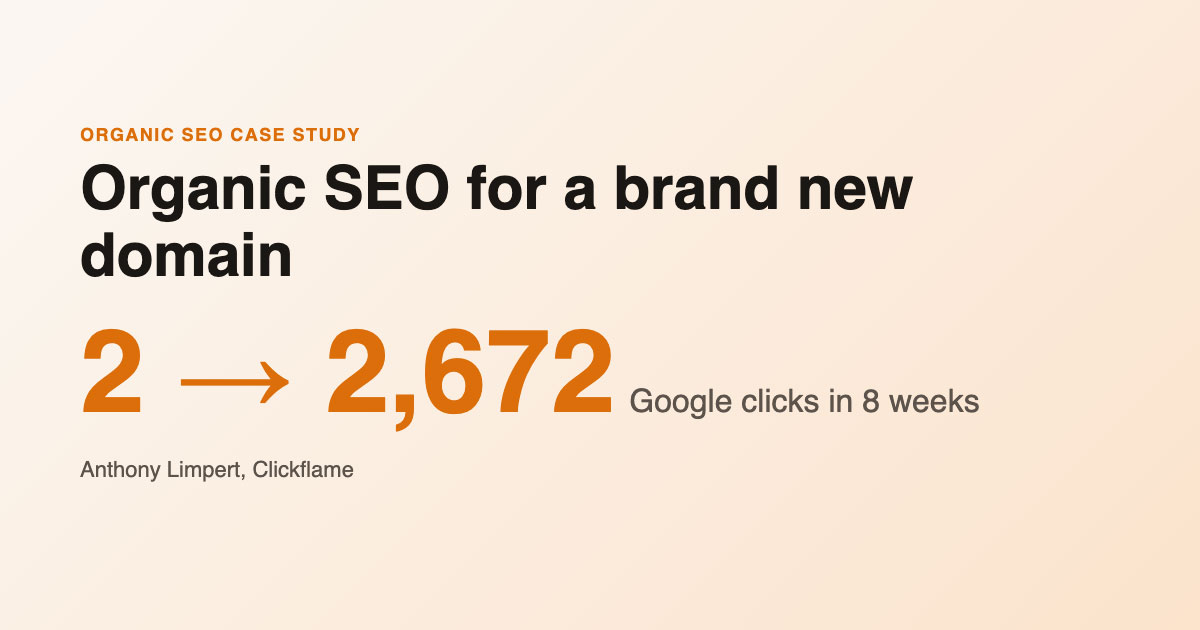
Nine weeks ago, the newest site in our network had two clicks from Google.
Over the next 57 days it earned 2,672 clicks and 557,412 impressions in Google Search Console. Its average position moved from 19.1 to 12.9. It started booking paid jobs in states where we don't have a single employee.
We first published those numbers on the DataForSEO blog. The climb didn't stop there. Through October 27 the site is at 3,698 clicks and 776,570 impressions, and it took 1,023 clicks in the last seven days alone.
The domain had no history. It had no old backlinks, no brand name anyone searched for and no office to put on a map. We didn't buy links, and we didn't publish a pile of thin pages with one word swapped out. Every click came from plain organic search results.
This post is the playbook. It covers what we built, why it ranked, what didn't work and the checklist we now use on every new domain.
I'm Anthony Limpert. I run Clickflame, an organic SEO agency in Long Beach, and Supercanic, a mobile mechanic company. We've worked in auto repair since the turn of the century, and we build and rank sites for small, independent businesses.
The site in this post is PrePurchase Auto. It books pre-purchase inspections for people buying used cars anywhere in the US. A buyer finds a car, we send a vetted inspector to wherever it sits, and the buyer gets a report before they pay. There's no shop and no local office. The business lives online, so the map pack can't carry it. Organic results had to do all the work, which made it a clean test.
Every number below comes from our own Google Search Console, Google Analytics 4 and job records, with the date range next to it. We published the data and API side of this story, including what each pull cost, on the DataForSEO blog. This post is the organic SEO side.
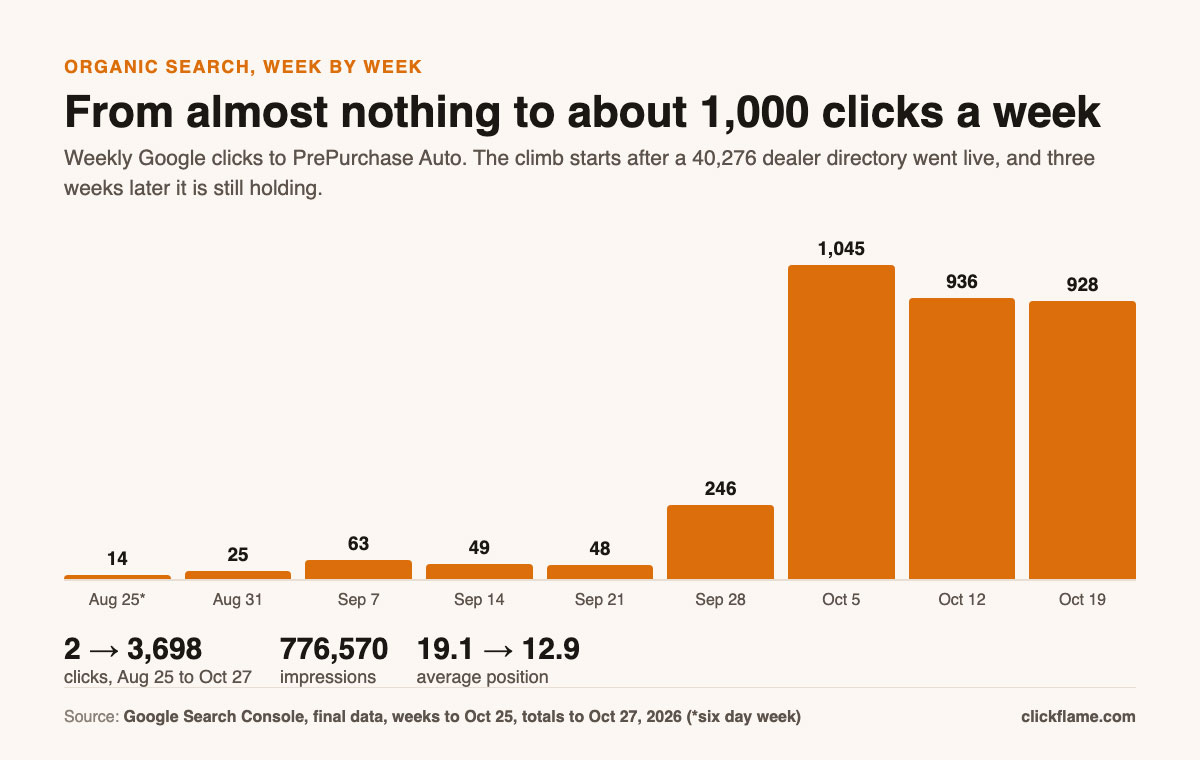
For five weeks the site sat near 50 clicks a week. The week of September 28 it jumped to 246. The next week it hit 1,045. Nothing about the domain changed. No links came in that week. What changed was the kind of page we put on it.
That jump lines up with one launch, a directory of 40,276 car dealers across 109 metros. To see why that worked, you have to start with what people actually type.
A one-week spike is easy. Holding it is the real test, so we pulled fresh numbers for this post. The week of October 19 brought 928 clicks, the third week in a row near a thousand. From October 21 to 27 the site took 1,023 clicks, about five times what it earned in its first five weeks combined.
Average position held at 12.9 across all 64 days, even as impressions grew to 776,570. More pages are showing for more searches, and they're holding their spots while they do it.
A new domain starts with nothing Google can lean on. There are no links, no click history and no proof that real people like what's there. Most new sites answer that by publishing the pages the owner wants to rank, the service page, the pricing page and the "why choose us" page.
That's what we did first. Our early pages were ads for inspections, and they went nowhere. Almost nobody searches for "pre-purchase inspection" as their first step. A new site that only targets the money keyword is fighting older, stronger sites for the one query everybody wants.
The way out is to rank for the searches that come before the sale, where the pages ranking today are weak. Five moves got us there.
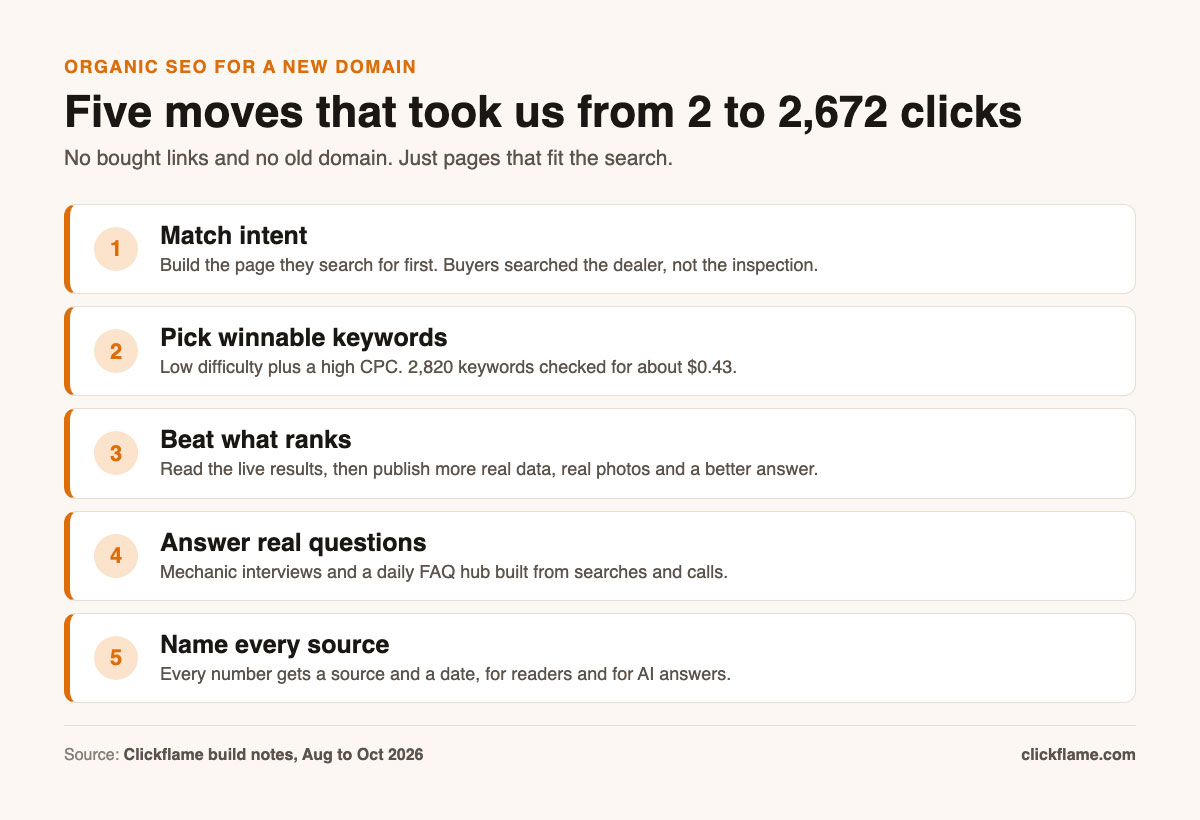
Used car buyers don't search for an inspection. They search for the dealer. They want to know if the lot is any good, if the reviews are real and what other buyers ran into.
So we built that page. We pulled public business listing data for every new and used car dealer within 20 km of each metro center we cover. The first build on September 24 covered 24,650 dealers in 47 metros. By September 30 it covered 40,276 dealers across 109 metros.
Each dealer gets its own profile with its address, hours, category and a grade built from its public reviews. At the bottom of each profile sits the obvious next step, getting the car inspected before you buy it. The page answers the search. The service follows from the page. We had built the last step first, and the fix was building the first step.
Forty thousand pages from a template is exactly what people mean by programmatic SEO, and it's also how a lot of sites get buried. The difference is whether each page holds something a searcher can't get anywhere else.
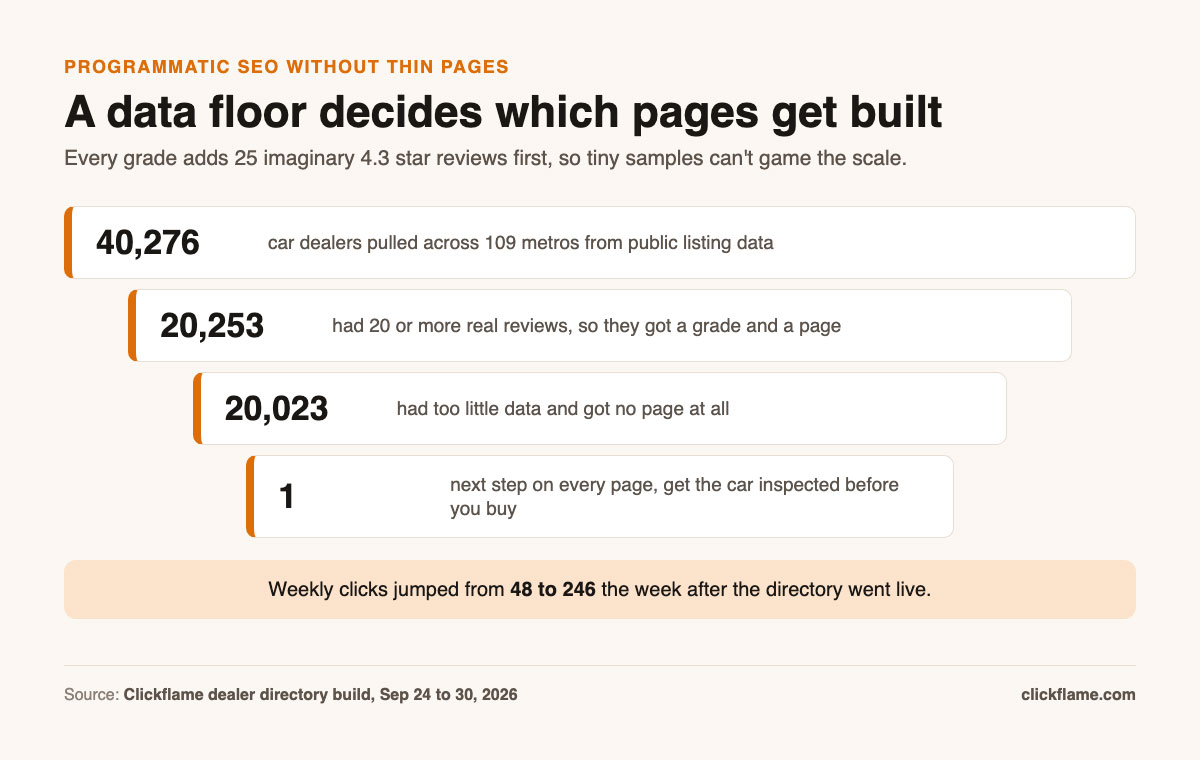
Ours do, because of the grade. Star averages lie at small numbers. A lot with three five-star reviews looks better than a lot with 900 reviews at 4.6, and that isn't fair to anyone. Before we grade a dealer, we add 25 imaginary 4.3-star reviews to its real ones. That pulls tiny samples toward the middle, so a business needs real volume to move far from it. Then we cap the grade by the share of one and two-star reviews.
A dealer needs 20 real reviews to get a grade at all. Out of 40,276 dealers, 20,253 qualified. The rest didn't get a page. That's the rule that keeps a programmatic build honest. If a page doesn't have enough real data to be useful, don't publish it.
We don't write a post until we know two things. Does anyone search for it, and can we beat what ranks?
For every topic in our content queue we pull search volume, cost per click and keyword difficulty. That cost us about $0.43 for 2,820 keywords. The mix we hunt for is low difficulty with a high CPC. A high CPC means advertisers pay real money for that click. Low difficulty means the pages ranking for it are weak. Together they point to a gap, not a niche.
For a new domain this matters more than anything else on the list. You can't outrank a ten-year-old site on its best keyword in your first two months. You can outrank a thin page on a keyword that site never bothered with.
Every PrePurchase Auto post starts with the live search results for its keyword. We read what ranks, then publish something with more real data, more real photos and a better answer. That's Brian Dean's Skyscraper Technique, and it's one of the first things new marketers learn in our office.
Recent posts covered dealers who refuse inspections, rolled-back odometers and CVT failures. Each one cites its sources. None of them is longer just to be longer. They're better because they hold something the ranking pages didn't, like a real inspection photo, a real number or a step the other posts skipped.
The second thing that changed in late September was where our content came from.
We interviewed real mobile mechanics, published their videos and wrote posts built from what they told us. That's first-hand experience no keyword tool can hand you, and it's the kind of content search engines keep asking for.
We also built an FAQ hub from questions buyers typed into Google and asked us on the phone. A handful of dated answers go up every day. Each answer takes one question and answers it well. Pages that try to rank for everything usually rank for nothing.
Any time we publish a figure, we say where it came from and when. "Pulled from Search Console, August 25 to October 20" closes an argument that "our research shows" would start.
It's how readers learn to trust a new site. It also matters for AI search. From August 25 to October 28, PrePurchase Auto had 5,917 visits in GA4. Organic search brought 4,081 of them. AI assistants brought 550, and 545 of those came from ChatGPT. A number with a named source is one an assistant can repeat. The same organic content that ranks in Google is what gets a site cited in AI answers.
Search Console tells a new site a lot, but only if you read it in the right order.
Impressions move first. Before the clicks came, our impressions climbed. Google was testing the new pages in results. If impressions rise and clicks don't, your pages are being seen and passed over. Fix the title and the answer, not the links.
Average position can mislead. It's an average across every query, including ones you'll never care about. Riversidemechanics.com, one of our older sites, slid from 8.0 to 10.2 on average over the same window. It still holds position 4.3 for "mobile mechanic riverside," the keyword that pays its bills. In the week after that window, October 21 to 27, its average came back to 8.5. Always check position for the queries that matter, not just the site average.
National rankings are possible without an address. MechanicRank, our mechanic directory, took 469 clicks for "mobile mechanic near me" from August 25 to October 27 at an average national position of 5.3. Its sessions went from 1,049 in the 57 days before to 21,387 in the next 57. The week of October 19 was its best yet, at 2,873 clicks from Google. It ranks because each listing page holds real data, not because of where an office sits.
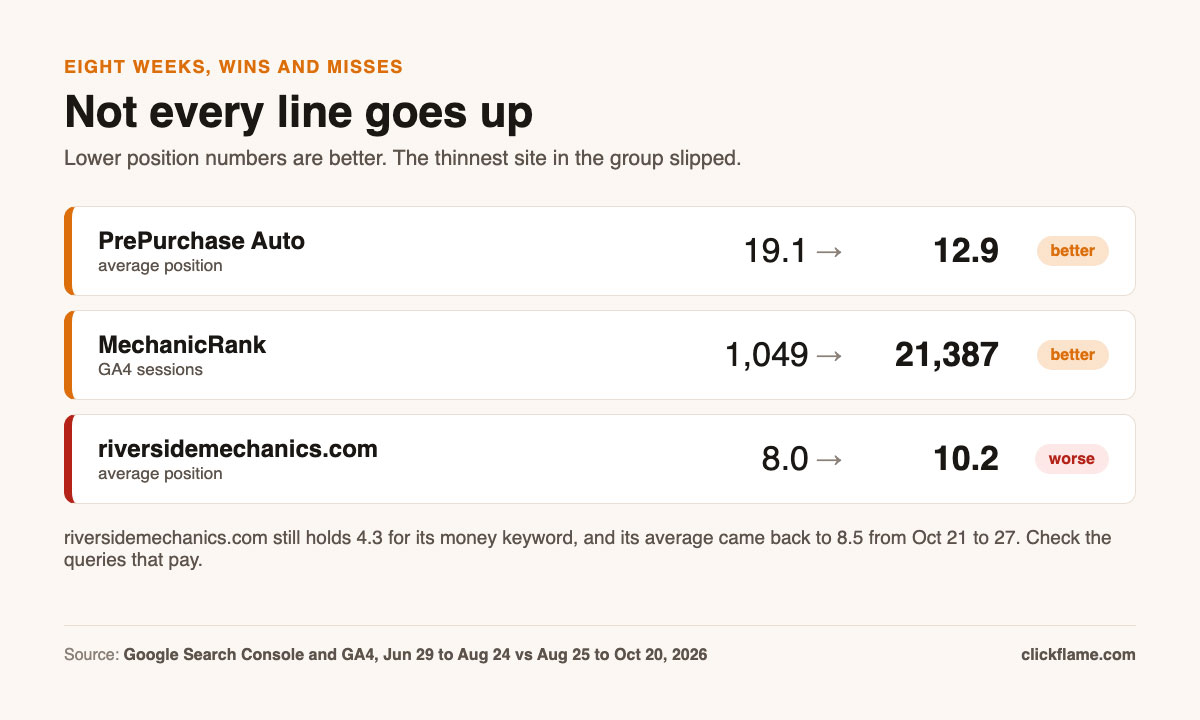
A results post with only green arrows is one you shouldn't trust, so here are the red ones.
Riversidemechanics.com gained impressions but lost clicks in the eight week window. Its average position has started to recover since, but clicks are still low, 19 in the last week of data. Our read is that it has the thinnest data of any site in the group. It has no directory, few original pages and nothing a searcher can't find elsewhere. It's next on our list, and it's the clearest case for everything above.
We built early pages on instinct before pulling search data. Those pages are still the weakest on the site. The pages that work are the ones where we read the results and the keyword data first.
We also trusted one search operator too long. We used site: searches to check where businesses were listed. Around October 14 that stopped returning reliable results, and for a while our checks said things were missing when they weren't. Now any check that can't confirm something says "not checked," never "not there." Never let a tool's silence become a claim.
Our site sat flat for five weeks, then jumped within two weeks of launching pages that matched what people searched. That's fast. Many new sites take months, especially in competitive markets. The timeline shortens when you target weak results instead of the hardest keyword in your field.
It is when every page says the same thing with one word swapped. It isn't when each page holds real, different data a searcher wants. Our rule is a data floor. A dealer without 20 real reviews doesn't get a page.
Ours climbed from 2 to 2,672 clicks in eight weeks, and to 3,698 a week later, without buying any. Links still help, and good pages earn them over time. But a new domain's first wins usually come from intent and content quality, not from links it doesn't have yet.
Look at difficulty and CPC together. Volume alone pulls you toward keywords you can't win. Low difficulty with a high CPC shows you where the money is and where the ranking pages are weak.
Nine weeks ago our newest site had two clicks and no history. It now has 3,698, ranks nationally, books paid jobs in 13 states and grows on data anyone could have pulled.
None of it took tricks. It took building the page searchers wanted, picking fights we could win and proving every number. That's most of organic SEO. The rest is doing it every day.
1. Limpert, A. (2026, October 28). How DataForSEO Helped Monetize Our Newest Auto Site. DataForSEO Expert Exchange. Source of the API costs and the full eight week data set.
2. Dean, B. The Skyscraper Technique. Backlinko. The content method behind Move 3.
3. Google Search Central. Creating Helpful, Reliable, People-First Content. Google's guidance on first-hand experience and original value.
4. Google Search Central. Spam Policies for Google Web Search. See the section on scaled content abuse, the line every programmatic build has to stay on the right side of.
5. Google Search Central. In-Depth Guide to How Google Search Works. How pages are crawled, indexed and served.
6. Google Search Console Help. Performance report (Search results). How clicks, impressions and average position are counted.
7. Google Search Central. SEO Starter Guide. The basics every new domain should cover first.
Data sources. Google Search Console for PrePurchase Auto, MechanicRank and riversidemechanics.com, June 29 to October 27, 2026, final data. Google Analytics 4 for PrePurchase Auto and MechanicRank, June 29 to October 28, 2026. Dealer counts and grades from our own directory build, September 24 to 30, 2026.
Anthony Limpert is the founder of Clickflame, Supercanic and PrePurchase Auto. He has built and marketed service businesses for more than twenty years, starting in auto repair.


Discover our other works at the following sites:
Danetsoft is a global web agency headquartered in Indonesia, specializing in web development, managed hosting, and web publishing platform.


 [email protected]
 Magelang, Central Java
© 2026 Danetsoft. Powered by HTMLy