 Photo by Jakub Zerdzicki on Pexels
A tester reports that the checkout displayed the wrong currency. A developer opens the same link and sees the expected one. The screenshot may be genuine, yet the team still lacks the information needed to explain the difference.
Regional website behavior depends on more than the URL. Browser state, account preferences, delivery choices and connection details can affect what appears. A useful test captures the conditions that produced the result and changes them deliberately, so the next person can investigate the same problem rather than a different visit.
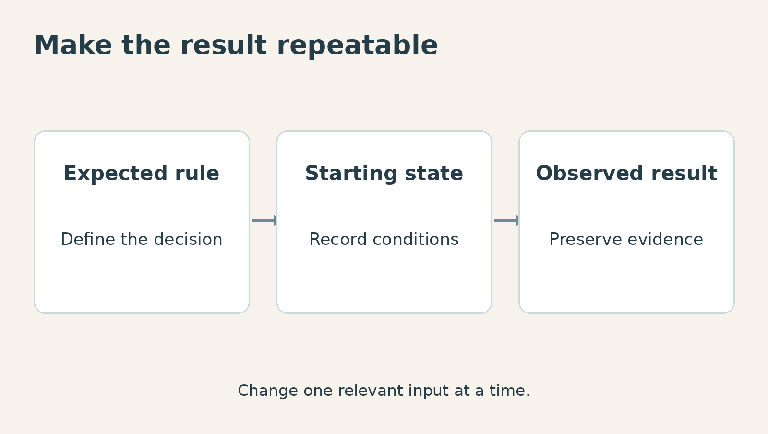
Start with the rule the website is meant to follow. Does the visitor's chosen market take priority over IP-derived location? Is currency set by delivery country? Does an account preference override the default shown to a new visitor?
These are product decisions. If nobody has agreed them, a test can find inconsistent behavior but cannot establish which result is correct. Get the intended order of priority into a short statement before writing a long sequence of clicks.
For a hypothetical store, the rule might be that choosing a shipping country changes available delivery options while preserving the language selected manually. That gives the tester two separate expectations. Changing both the language and country in one action would make the result harder to interpret.
Keep the test within its authorized environment. Use staging or approved test accounts when the steps could create orders, change personal records or generate campaign data.
A returning browser can carry a saved preference into the test. Signing into an account can introduce another one. Treat a fresh visitor and an existing customer as different cases rather than repeatedly clearing everything and hoping to obtain the same result.
Cookies can retain state between visits, while the browser can send language preferences of its own. A private window is useful for some comparisons, but it does not necessarily change the network route or every browser preference.
Record the initial conditions in plain language. An example might read: new browser session, not signed in, English preferred, no market selected manually, location permission denied. Another case can then deliberately add a saved market preference.
Keep evidence for the transition too. If the page changes after sign-in, note the moment and the account setting involved. A screenshot taken only at the end loses the sequence that may explain the defect.
If the website uses the request's public IP to make a regional choice, arrange the appropriate VPN download or other authorized test tool before the session. Check which device and browser traffic it covers, and record the exit address used by the request.
The test can inspect how the site responds to that connection signal. It cannot reproduce every characteristic of a customer living in the exit region. Browser preferences, delivery eligibility and the customer's actual account remain separate inputs.
Run the sequence again under the same conditions before adding another change. If the result varies, the team may need to examine timing, cached responses or server-side decisions rather than attributing everything to the chosen location.
Where a premium feature is needed for the comparison, a VPN free trial can provide an evaluation period for that specific tool. Check the available controls and purchase-channel terms first. A trial is useful when it enables a defined test, not when it simply expands the list of software installed on the tester's machine.
The best reproduction record does not contain every action performed during the afternoon. It contains the actions required to reach the unexpected result, starting from a clearly stated state.
Include the URL, browser version, connection details, account condition and the relevant site selections. Then describe expected and actual behavior separately. Saying that a page looked wrong forces the developer to infer the rule; saying that the shipping country changed while the previously selected language was unexpectedly reset gives them a precise disagreement to examine.
Use screenshots to support that record. Remove customer information and use test data where possible. If the issue is a redirect, preserve the original and resulting URLs rather than capturing only the destination page.
After a fix, repeat the original case and a neighbouring one. A change that solves the new-visitor case could accidentally stop returning customers from keeping their preference. That small follow-up checks the decision the site is meant to make, without turning the investigation into an unbounded test campaign.
Regional testing becomes much less mysterious when a reported result comes with its conditions. The developer receives a reproducible problem, the product owner can assess the rule and the tester can distinguish a repaired defect from a visit that simply started differently.


Discover our other works at the following sites:
Danetsoft is a global web agency headquartered in Indonesia, specializing in web development, managed hosting, and web publishing platform.


 [email protected]
 Magelang, Central Java
 © 2026 Danetsoft. Powered by HTMLy