 Photo by Maxim Ilyahov on Unsplash
Sales teams send many emails every day. Yet most teams struggle to measure real results. Here’s the problem: sending emails feels productive, but results often stay unclear.
Activity alone does not equal productivity. More emails do not always mean better outcomes. You can stay busy all day and still miss sales goals.
That is where sales email performance metrics help. These metrics show what actually works. They reveal how emails support conversations, deals, and revenue growth.
In this guide, I’ll show you how to track sales email performance metrics correctly. You will learn what to measure, why it matters, and how to improve team productivity.
Sales email performance metrics show how well your business emails help drive sales.
It focuses on results that support selling, which include opens, replies, clicks, and conversions from email activity. These metrics matter because they measure productivity and email ROI, not effort. Vanity numbers may look good, but they do not drive sales.
When you track sales email performance metrics, you see what drives real results. Here’s an example of an email workflow that drives more sales and the metrics you need to track.
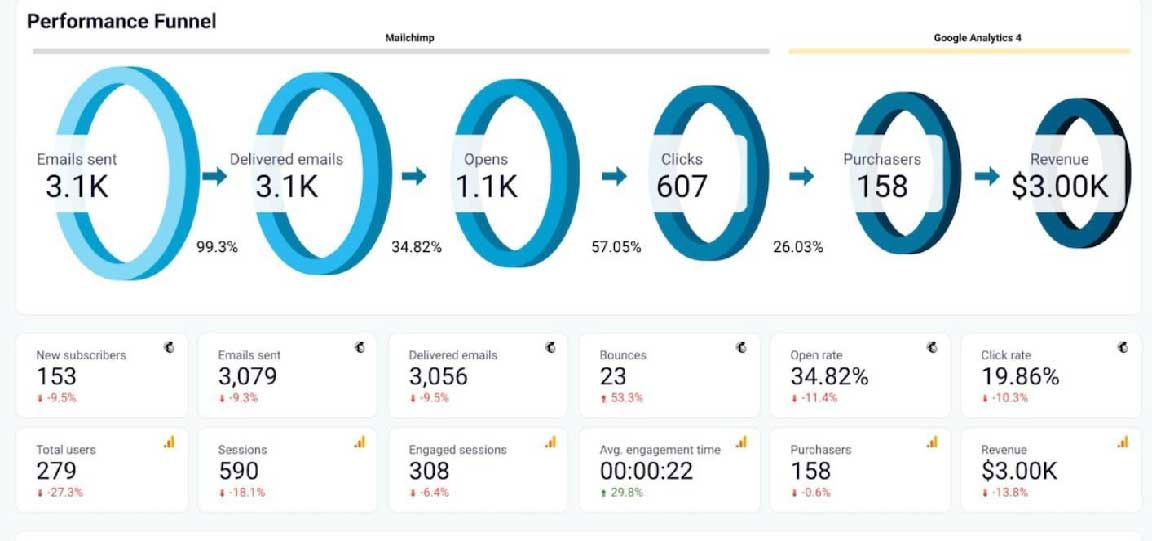 Image via Coupler.io
Tracking sales email performance metrics helps you see how your team’s work actually contributes to results. It helps in the following areas.
Time Management: When you know which emails get more replies or clicks, you can focus on the messages that matter most. Your team spends less time on dead ends and more time on high-value prospects. It also helps you avoid your emails landing in spam folders.
Lead Quality: Not every lead is worth the same effort. Metrics like reply rate and click-through rate help identify which leads are engaged and likely to move forward. This prevents your team from wasting time on low-potential contacts.
Impact Revenue: Every reply, click, or conversion is a step toward closing a deal or making a sale. By tracking these numbers, you can see which campaigns generate real business and which strategies need adjustment.
In short, sales email performance metrics reveal how time, lead quality, and revenue are connected to email effort.
To understand how your team is performing, you need to focus on the right sales email performance metrics. Not every number tells the full story. Here are the key metrics you should track.
Open Rate: It shows how many people actually open your emails. It tells you if your subject lines catch attention. It does not show if they read or act on the email. Worry about low open rates only if they are consistently below industry standards.
Reply Rate: This indicates real engagement. Replies show interest beyond just opening the email. Positive replies that move the conversation forward matter more than simple acknowledgments.
Click Through Rate (CTR): This shows how many recipients click links in your emails. It signals intent and engagement. CTR is especially important when your email includes offers or next steps.
Conversion Rate: It measures how many email interactions turn into actual opportunities. This shows which emails truly help your sales pipeline. One tactic to boost this metric is to send personalized emails that are relevant to your audience.
Overall, opens, replies, clicks, and conversions are the sales email performance metrics that show real sales progress.
You can organise a team meeting after finding availability time of all team members to discuss the metrics and strategy to improve sales team productivity using email analytics data.
Using sales email performance metrics is not just about collecting numbers. It’s about understanding how your team performs and helping them improve. Let’s break it down into practical steps you can follow to evaluate your team accurately and fairly.
It’s important to have clear standards for success. Without benchmarks, it’s hard to know if your team is performing well or falling behind.
Using historical data to set realistic goals helps teams focus on actions that produce real results, aligning with effective sales productivity strategies. They understand expectations, track progress, and see measurable improvement over time.
Sending a high number of emails does not automatically lead to better results. Instead, focus on the quality of responses and the impact they have on moving leads forward.
High-quality replies, meaningful conversations, and engagement with links or offers are far more valuable than a large volume of unopened emails. This approach helps your team prioritize time and effort on prospects that matter most.
Look at patterns over time to get a true picture of email marketing productivity.
Tracking trends allows you to spot consistent issues, understand what strategies work, and make informed decisions for coaching and process improvements. This prevents overreacting to isolated results and ensures a more accurate evaluation of your team.
Using sales email performance metrics correctly lets you measure performance fairly, focus on results that matter, and guide your team toward continuous improvement.
Tracking sales email performance metrics becomes much easier with the right tools. They help teams see what’s working, save time, and focus on the actions that actually drive results.
Email Marketing and Analytics Platforms: These platforms provide a clear view of email performance. Opens, replies, clicks, and conversions are displayed in one dashboard, making it simple to spot trends and understand which emails are effective. Two popular options include Mailchimp and ActiveCampaign.
Email Response Time Tracking Tools: These measure how promptly your sales team responds to email queries from leads and prospects. One reliable option is timetoreply, which tracks response times of your team and individual team members. It helps you improve response rates and ensure no leads or opportunities go cold.
CRM Tools: CRM platforms connect email analytics directly to the sales pipeline. This allows teams to see which leads are responding, progressing through the funnel, and contributing to revenue. You can choose from Attrock curated list of popular CRMs that can help manage your leads appropriately.
Using the right tools for sales email performance metrics ensures teams track results efficiently and focus on actions that drive real productivity.
Sales email performance metrics matter because they measure actual productivity, not just activity. Tracking the right numbers, like replies, clicks, and conversions, helps teams focus on actions that generate results.
Measuring these metrics consistently allows teams to identify what works, improve email strategies, and drive more meaningful conversations with leads. Productivity grows when metrics guide decisions instead of volume alone.
Teams are encouraged to review their current approach, compare results against benchmarks, and adjust emails to improve performance.


Discover our other works at the following sites:
Danetsoft is a global web agency headquartered in Indonesia, specializing in web development, managed hosting, and web publishing platform.


 [email protected]
 Magelang, Central Java
 © 2026 Danetsoft. Powered by HTMLy