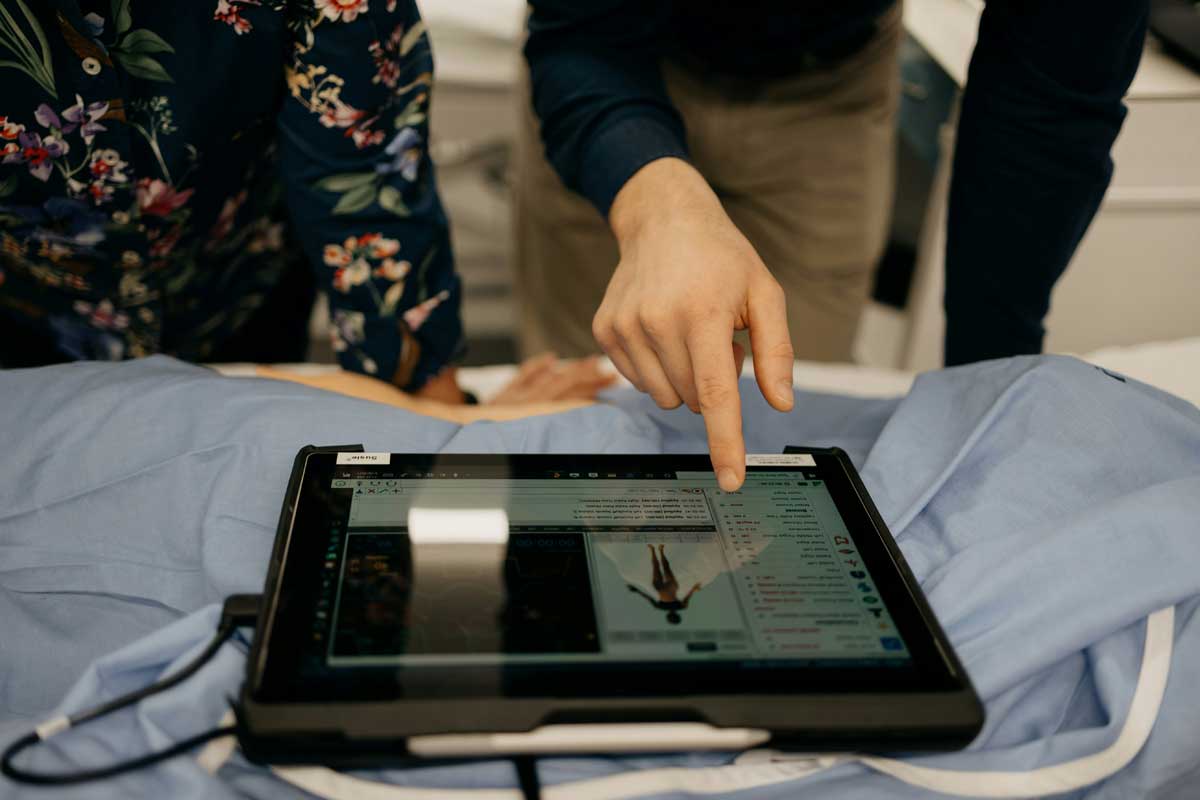
 Photo by Trnava University on Unsplash
Home healthcare is undergoing a fundamental shift. Patients now expect continuous, connected care delivered in the comfort of their own homes rather than in hospital beds. Building real-time home healthcare software with IoT and AI sits at the heart of this transformation, connecting medical devices, patient data, and clinical teams into one intelligent ecosystem. This guide breaks down how to architect, develop, and scale such a platform effectively.
Real-time home healthcare software is a digital platform that continuously collects, processes, and acts on patient data from devices used outside traditional clinical settings. It links wearables, smart medical equipment, and mobile apps with clinician-facing systems to enable ongoing remote monitoring, timely intervention, and more effective chronic disease management at a distance.
Unlike traditional telemedicine tools that rely on scheduled video consultations, these platforms operate in the background around the clock. They stream vital signs, behavioral data, and environmental metrics into centralized systems where AI models analyze trends, flag anomalies, and alert caregivers the moment a patient's condition begins to drift outside safe clinical thresholds.
The convergence of IoT and AI is what makes genuine real-time care possible. IoT sensors capture high-frequency physiological data — heart rate, oxygen saturation, glucose levels, activity patterns — while AI models turn that raw signal into clinically meaningful insight. Together, they close the gap between passive data collection and active medical decision-making at scale.
This shift has strong economic drivers too. Hospital readmissions, extended stays, and emergency interventions are expensive, and continuous home monitoring has been shown to reduce these costs significantly. For providers, working with experienced development teams has become the fastest way to capture both clinical and financial value.
Building real-time home healthcare software requires a layered architecture that balances data velocity, clinical reliability, and regulatory compliance. At a high level, the stack has four main layers: the device layer, the connectivity and edge layer, the cloud processing layer, and the application layer where patients and clinicians interact with information.
Each layer carries its own design priorities. The device layer must be power-efficient and clinically accurate; the edge layer must remain resilient under intermittent connectivity; the cloud layer must scale elastically with patient volume; and the application layer must deliver clear, actionable views to non-technical users — including patients, family caregivers, and busy clinicians.
The device layer typically includes wearables such as smartwatches and ECG patches, connected devices like blood pressure cuffs and glucometers, and ambient sensors that track movement, sleep, or falls. Integrating this hardware ecosystem requires careful protocol selection — Bluetooth Low Energy, Zigbee, Wi-Fi, and cellular all play different roles across device categories.
Rigorous engineering discipline is critical at this layer because these devices generate data that directly informs clinical decisions. Working with specialized medical device software development companies ensures that firmware, device communication protocols, and FDA-ready documentation are handled correctly from day one of the project lifecycle.
Edge processing is where much of the real-time magic happens. By running lightweight inference on local gateways — or directly on the device itself — platforms can trigger immediate alerts without a round-trip to the cloud. This is critical for time-sensitive events like cardiac arrhythmias, dangerous glucose drops, or detected falls that require an instant response.
The cloud pipeline handles long-term storage, cross-patient analytics, and heavier AI workloads. Technologies like Apache Kafka, AWS IoT Core, and time-series databases such as InfluxDB or TimescaleDB form the backbone. These components ingest millions of daily events, apply transformations, and prepare cleaned data for downstream AI models and clinical dashboards.
AI moves home healthcare from reactive to proactive care. Predictive models analyze streaming vitals alongside historical records to forecast deterioration before it becomes critical. Subtle trends in heart rate variability and respiratory rate, for example, can signal an impending exacerbation in heart failure or COPD patients days in advance of visible symptoms.
These models are typically built with LSTM networks, gradient-boosted trees, or transformer-based architectures. Partnering with an experienced AI healthcare consulting team helps organizations select, train, and validate the right models against real clinical outcomes rather than chasing raw accuracy metrics that may not translate into patient benefit.
Computer vision models add another layer of intelligence to the platform. They can analyze video feeds for fall detection, monitor mobility during physical therapy, or verify medication adherence. Privacy-preserving approaches — such as processing video locally and transmitting only extracted events rather than raw footage — are quickly becoming standard practice for home-deployed systems.
Natural Language Processing is equally valuable in this context. NLP models process patient-reported symptoms, voice-based check-ins, and unstructured clinician notes, turning them into structured data that flows into the health record. Strong expertise in AI and ML development is essential to making these models reliable and clinically safe at scale.
A production-ready real-time home healthcare software platform typically includes continuous vitals monitoring, automated alerting, a patient-facing mobile app, clinician dashboards, video consultations, medication management, and seamless integration with existing EHR and EMR systems. Each feature must be designed with both clinical workflows and patient usability placed at the center of the experience.
Beyond these core capabilities, leading platforms include care team messaging, family caregiver access, personalized education content, and tight integration with pharmacy and lab systems. The goal is to make the home the new front line of care delivery not just a passive data collection point that sends signals upstream to a hospital system.
Secure healthcare text messaging can also support faster care coordination by helping clinicians, patients, and family caregivers exchange timely updates without relying only on scheduled calls or portal notifications.
Real-time home healthcare software lives and dies by trust. Any platform handling protected health information must comply with HIPAA in the US, GDPR in the EU, and equivalent regulations in other markets. This includes end-to-end encryption, granular role-based access controls, detailed audit logging, and defensible data retention policies applied across every layer of the stack. To reinforce these safeguards, gdpr compliance ensures that patient data is handled with strict privacy standards, helping organizations maintain trust while reducing regulatory and security risks.
Interoperability is equally important to long-term viability. Standards like HL7 FHIR, DICOM for imaging, and IHE profiles enable the platform to exchange data cleanly with hospital systems, labs, and insurance networks. Without strong interoperability, a home healthcare platform becomes another data silo useful in isolation but unable to support the continuity of care patients genuinely need.
Building real-time home healthcare software is not a single sprint it is a multi-phase program. Most successful projects begin with a clinical discovery phase, followed by an MVP focused on one condition or care pathway, device integration work, regulatory groundwork, pilot deployments with real patients, and finally controlled scaling across broader patient populations and service lines.
Given the clinical, regulatory, and technical depth required, most organizations do not attempt this alone. Partnering with an experienced healthcare app development company accelerates time-to-market while reducing the risk of regulatory missteps, architectural debt, or poor clinical fit — any of which can derail the entire initiative before it delivers value.
The future of healthcare is continuous, personalized, and increasingly delivered where patients actually live. Building real-time home healthcare software powered by IoT and AI gives providers a direct line into patient health while giving patients the comfort and autonomy of care in their own environment. Organizations that invest in this architecture today will be the ones shaping the care delivery models of the next decade.


Discover our other works at the following sites:
Danetsoft is a global web agency headquartered in Indonesia, specializing in web development, managed hosting, and web publishing platform.


 [email protected]
 Magelang, Central Java
 © 2026 Danetsoft. Powered by HTMLy