5 Best Vendor Risk Management Software Platforms Compared for 2026

Vendor lists are growing faster than security budgets. The 2026 Verizon Data Breach Investigations Report finds that third-party suppliers touch 48 percent of breaches—up 60 percent in a single year. Regulators are closing the gap: DORA, NIS2, the SEC’s four-day incident rule, and the EU AI Act all demand proof that you monitor suppliers, not just your own servers. If vendor risk management software still means spreadsheets where you work, that window is closing fast. We tested five modern platforms and matched each one to a clear program-maturity stage so you can build a confident shortlist in minutes.
Quick comparison

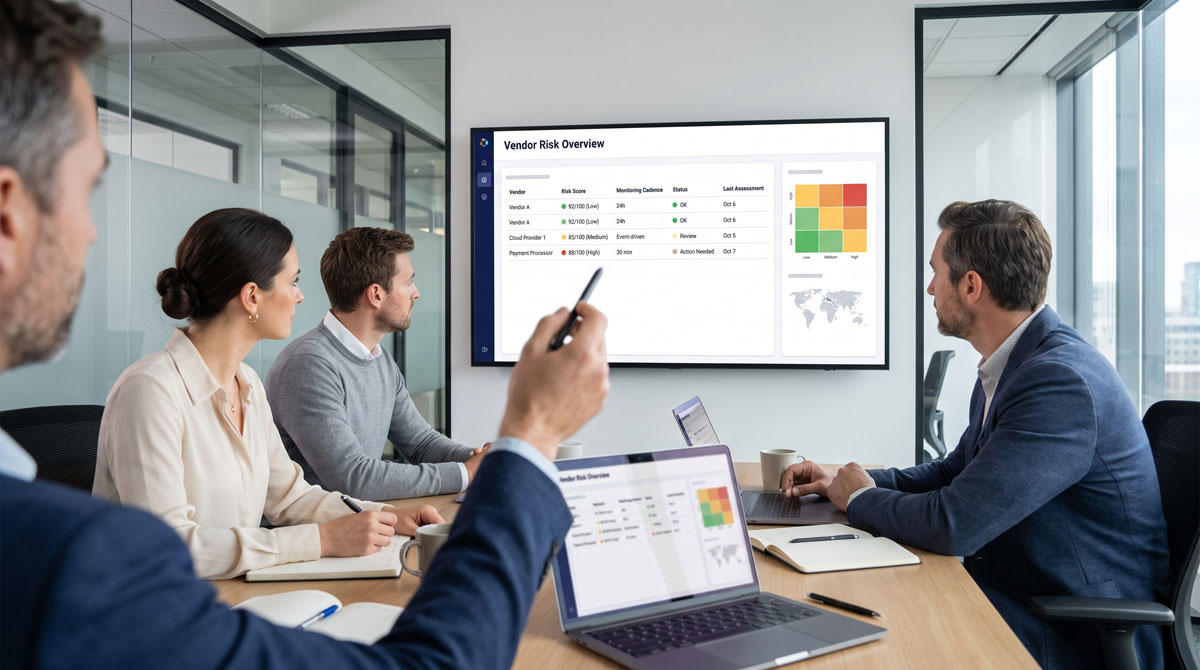
Vendor Risk Overview

At a glance: five category winners on one slide

Match your biggest pain point to a platform, then review the details below.
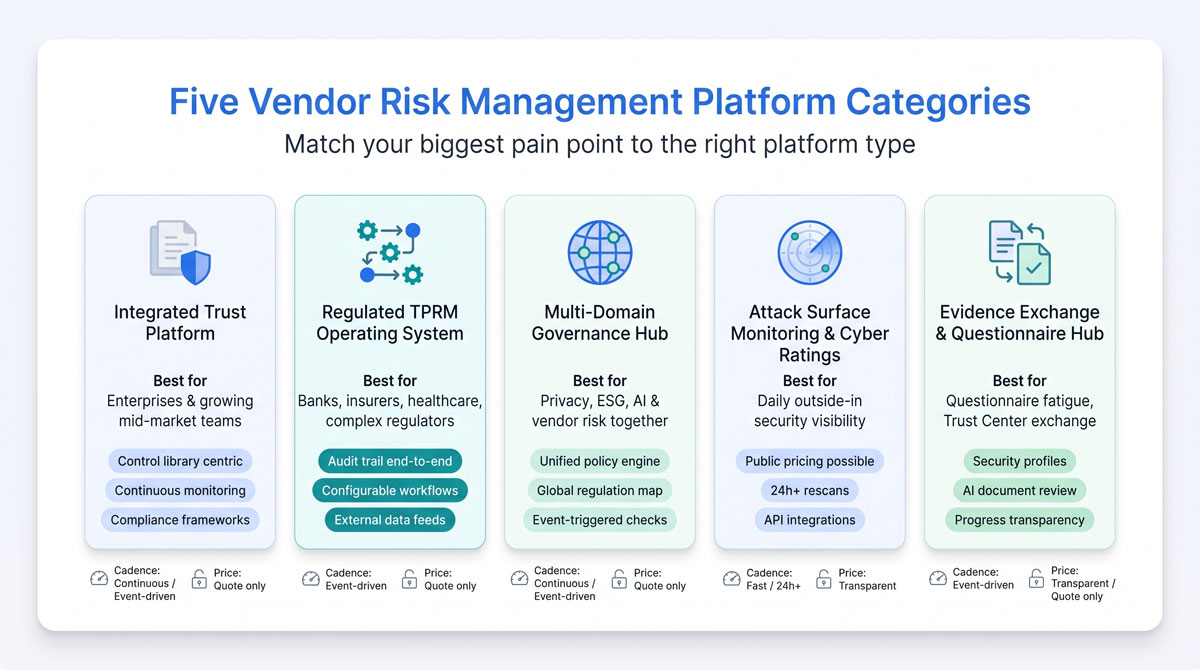
Vendor Risk Management

Platform Best-fit program Monitoring cadence* Pricing visibility G2 rating† Editorial score
Vanta Enterprises and growing mid-market teams Continuous, ~24-hour rescans Quote-only 4.6 / 5 90
ProcessUnity Regulated, complex TPRM Risk-index refresh daily; external feeds hourly Quote-only 4.5 / 5 89
OneTrust Multinational, multi-domain governance Event-triggered plus weekly external intel Quote-only 4.5 / 5 87
UpGuard Live attack-surface monitoring with clear price Daily external rescans Entry price published 4.5 / 5 86
Whistic Cutting questionnaire backlog 30-minute breach-signal refresh Package tiers disclosed 4.6 / 5 85

Note:

  • Monitoring cadences come from current product documentation and represent the fastest refresh offered in a standard subscription.
  • G2 vendor-risk subcategory ratings verified September 2026.

Two patterns stand out:

  1. Speed vs. signal. Cadence ranges from 30-minute source polls (Whistic) to workflow-triggered checks (OneTrust).
  2. Price opacity. UpGuard publishes a dollar figure, while others share only structure, making total cost a discovery exercise.

1. Vanta: best for enterprises and growing mid-market teams

Vanta’s vendor risk management software automates the chores that slow many third-party programs: inventory, tiering, evidence review, and continuous monitoring, all within the trust platform that teams already use for SOC 2.

Verdict

Vanta reports about 16,000 customers across 58 countries and more than 400 native integrations. Both the 2026 Forrester GRC Wave and the 2025 IDC GRC MarketScape list Vanta as a Leader. Those proof points shorten audits and simplify executive approval.

Why it wins

  • Always-on visibility. Daily rescans surface posture drift well before annual questionnaires would catch it.
  • AI-assisted evidence review. Large language models read policies, highlight gaps, and link to the exact page for human approval, saving hours per assessment.
  • One dashboard, many frameworks. SOC 2 today, ISO 27001 or DORA tomorrow; control mappings reuse the same evidence rather than duplicating work.

Trade-offs to note

  • Pricing is quote-only and bundles VRM with the broader suite, so confirm contract tiers before budgeting.
  • Very small startups may find the feature depth, and the cost that comes with it, heavier than they need.

Best-fit signal

Pick Vanta when you are moving from a single compliance framework to a full GRC program and want vendor risk to live in the same control library. Skip it if you only need outside-in cyber ratings or a lightweight questionnaire exchange.

2. ProcessUnity: best for regulated enterprises with mature TPRM programs

Verdict

ProcessUnity functions more like an operating system than a typical SaaS dashboard. Banks, insurers, and healthcare providers use its workflow engine to guide every vendor from onboarding through off-boarding while keeping auditors satisfied at each checkpoint.

Why it wins

  • Depth of evidence. The Global Risk Exchange contains 370,000 curated vendor profiles and 18,000 completed assessments, covering 87 percent of the world's most requested vendors (company data, September 2026).
  • Configurable lifecycle. Rules-based workflows, residual-risk scoring, and exception aging support complex regulatory maps such as DORA and NIS2.
  • AI helpers. Assessment Autofill drafts questionnaire responses, and Evidence Evaluator flags missing controls before you press send.
  • Third-party validation. Forrester’s Q1 2026 TPRM Wave lists ProcessUnity as a Leader, citing configurability and lifecycle depth.

Trade-offs to note

  • Pricing is quote-only and often includes professional-services hours, so plan for both subscription and implementation costs.
  • High configurability extends setup time; most enterprises engage a partner for the initial build.
  • Continuous monitoring depends on external data feeds, and premium sources add cost.

Best-fit signal

Shortlist ProcessUnity when regulators or board audit committees insist on a complete audit trail—from inherent-risk tiering to off-boarding—and you have staff or partners ready to configure the platform. Smaller portfolios or teams seeking quick self-service may prefer a lighter tool.

3. OneTrust: best for multinational, multi-domain governance

Verdict

OneTrust shines when vendor risk is only one piece of a broader governance puzzle. The same platform that handles privacy, ESG, and AI compliance also manages third-party oversight, letting global teams trace a single policy from data collection through downstream supplier controls, without swivel-chair hopping. Gartner’s inaugural 2026 Magic Quadrant for Third-Party Risk Management Tools for Assurance Leaders lists OneTrust as a Leader, citing breadth and AI powered automation as key differentiators.

Why it wins

  • Unified policy engine. The workflow layer spans privacy, ESG, AI, and vendor risk, so one control update propagates everywhere.
  • Signal-driven tasks. External feeds (Dow Jones, sanction lists, breach news) trigger automatic reassessments.
  • AI document scan. Large language models flag gaps and link to source pages, cutting evidence review time.
  • Global regulation map. Dashboards track GDPR, DORA, ISO 42001, and more in the same view that shows basic security posture.

Trade-offs to note

  • Learning curve. Admins report complex navigation when configuring cross-domain workflows (Gartner Peer Insights, August 2026).
  • Opaque pricing. Quote-only; costs scale by administrator seats and vendor inventory. Model growth carefully.
  • Review volume. Only a handful of TPRM-specific user reviews exist today, so peer benchmarks are limited.

Best-fit signal

Choose OneTrust if you operate in multiple jurisdictions, manage regulated personal data, and need privacy, AI, ESG, and vendor controls on a single stack. Cyber-only teams looking for a fast win may prefer a lighter, specialized platform.

4. UpGuard: best for continuous cyber monitoring and transparent pricing

Verdict

UpGuard focuses on one goal: outside-in security visibility, delivered fast. The platform rescans every monitored vendor every 24 hours, converts findings into an A–F letter grade, and opens remediation tasks for both you and the supplier. This loop catches posture drift well before it becomes breach news.

Why it wins

  • Published pricing. The Standard plan lists at $1,750 per month (billed annually) for 50 vendors; each additional vendor is $79.
  • Daily attack-surface scans. Continuous rescans flag new CVEs, expired certificates, and leaked credentials without waiting for questionnaires.
  • Audit-ready evidence. Every change, comment, and acceptance lives in the same record, so auditors view progress instead of PDF snapshots.
  • AI assist, not auto-approve. Large language models draft questionnaire responses, but humans must approve each citation, keeping accountability intact.
  • Open API. Scores feed into Jira, ServiceNow, or your risk register, preventing copy-paste fatigue.

Trade-offs to note

  • Cyber posture only; no built-in ESG or privacy-contract review.
  • Per-vendor pricing scales linearly; at 120 vendors, the annual bill approaches $87,000 before add-ons.
  • Large enterprises may still need separate tools for deep process workflows.

Best-fit signal

Choose UpGuard when leadership wants a clear price today and a daily pulse on each supplier’s external risk tomorrow. If multi-framework compliance is your larger challenge, a broader suite higher on the list may suit you better.

User validation: UpGuard Vendor Risk holds a 4.5 / 5 rating from 740+ G2 reviews (September 2026), with reviewers praising setup speed and clear remediation tracking.

5. Whistic: best for cutting questionnaire fatigue with evidence exchange

Verdict

Whistic flips the assessment process. Instead of sending a 200-question form to every SaaS vendor, you pull a ready-made security profile from its Trust Center Exchange—now home to more than 12,000 live profiles. Vendors answer once and share many times; you stop chasing reminder emails.

Why it wins

  • Exchange first. Search, request access, and download SOC 2 reports, pen-test summaries, and policies in minutes.
  • AI document review. Large language models extract controls, flag gaps, and attach confidence scores; profiles refresh every 30 minutes when a breach alert or sub-processor change occurs.
  • Progress transparency. Conditional logic hides out-of-scope questions, and a real-time bar shows vendors exactly what remains.
  • User validation. Whistic holds a 4.6 / 5 rating from 58 G2 reviews (September 2026), with praise for ease of use and evidence centralization.

Pricing & packaging

  • Dollar figures are quote-only, but tiers are clear: Core covers unlimited vendors and users; higher tiers add premium frameworks and more AI credits.
  • Continuous monitoring is an add-on or standalone module.

Trade-offs to note

  • Value depends on supplier coverage. Export your vendor list and measure exchange overlap before buying.
  • Heavy AI parsing can exhaust Core-tier credits; budget for an upgrade if you process large PDFs often.
  • Native monitoring is newer than the assessment exchange. Confirm data sources and alert workflow during the pilot.

Best-fit signal

Pick Whistic when your calendar is clogged by questionnaires, not by interpreting cyber-rating deltas. If you already have strong evidence but need 24/7 attack-surface monitoring, consider a higher-scoring tool earlier in this guide.
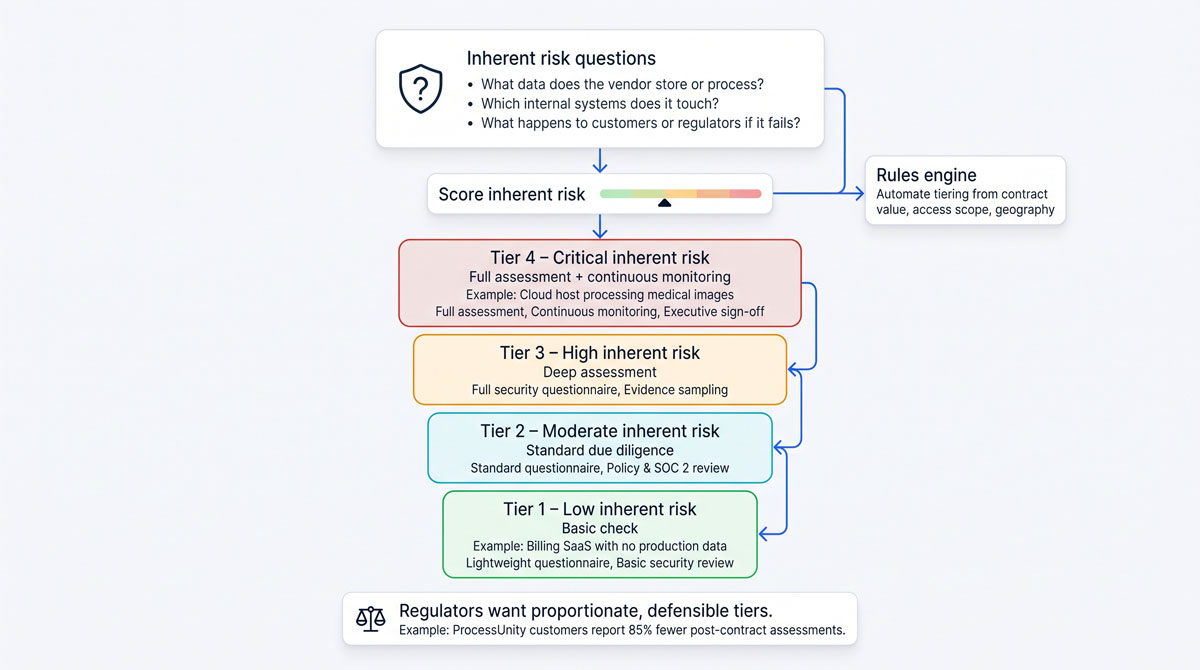
Tier vendors before you send a questionnaire

Inherent Risk Questions

  1. Score inherent risk first. Ask three questions:
    1. What data does the vendor store or process?
    2. Which internal systems does it touch?
    3. What happens to customers or regulators if it fails?
  2. Match diligence depth to tier.
    1. Billing SaaS with no production data → basic check
    2. Cloud host processing medical images → critical tier, full assessment, continuous monitoring
  3. Automate the math. Most platforms pull contract value, access scope, and geography from inventory data and apply a rules engine. You adjust thresholds; decisions take seconds.
  4. Prove the payoff. Independent research shows ProcessUnity customers report an 85 percent reduction in post-contract risk assessments, freeing analysts to chase high-risk findings instead of low-impact vendors.

Regulators do not need 200 questions for every supplier; they want a defensible, proportionate process. A clear tiering ladder shows you understand your ecosystem and can justify each exception.
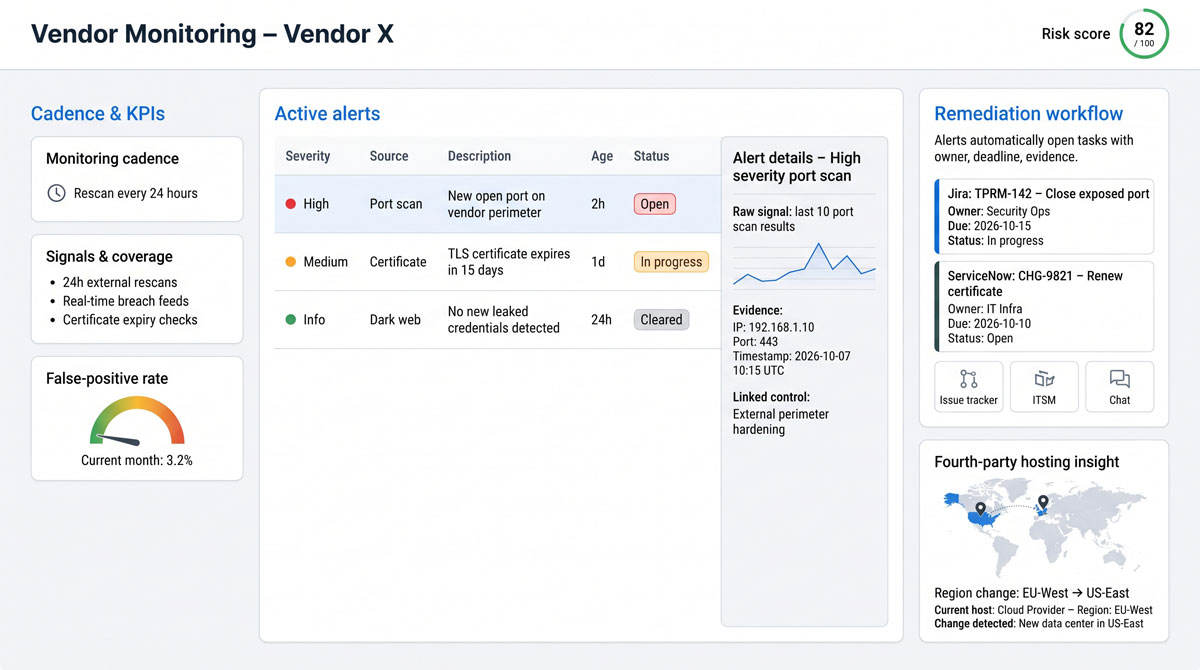
Test continuous monitoring before you trust the dashboard

Vendor Monitoring

  1. Confirm cadence. Does the platform rescan every 24 hours, every 60 minutes, or only when its data partner updates? Daily may be fine for a marketing app, but never for a payment processor.
  2. Inspect data sources. Ask the rep to trace a live alert back to its raw signal: port scan, expired certificate, or dark-web leak. If that takes more than two clicks, expect triage pain later.
  3. Measure noise. What is the current false-positive rate, and who tunes the rules—you or a managed service? Set a target such as fewer than five percent false positives per month.
  4. Verify auto-remediation hooks. Can the system open a Jira, ServiceNow, or Slack task with an owner, deadline, and evidence? Alerts without workflows die in inboxes.
  5. Demand fourth-party insight. Only a few tools (ProcessUnity and UpGuard’s higher tiers) reveal when your vendor shifts hosting to a new region; others charge extra.

Spend one hour on these checks now and you could save weeks of “why didn’t we catch that?” retrospectives later.

Conclusion: match the tool to the risk, not the hype

  • Integrated trust program? Choose Vanta.
  • Deep, regulator-grade workflows? ProcessUnity.
  • Multi-domain governance across privacy, ESG, and AI? OneTrust.
  • Daily attack-surface insight with transparent pricing? UpGuard.
  • Questionnaire fatigue the bottleneck? Whistic.

Run a one-month pilot with two finalists and a handful of real vendors, and score both against the same metrics: inventory time, assessment turnaround, false-positive rate, and remediation hours. Select the platform that improves those numbers fastest.

Related articles

Elsewhere

Discover our other works at the following sites: