The search engine optimization industry is growing at an incredible pace. Experts project the global market will reach a staggering 143 billion dollars by 2030. As search algorithms become more complex and clients demand faster results, marketing teams must rely on powerful technology to deliver consistent success. However, finding the right software balance is a massive challenge.
Many agency owners find themselves drowning in monthly software subscriptions. Instead of speeding up their workflow, a bloated technology setup slows everything down. You want to focus on strategy and client growth, but your team spends hours jumping between disjointed applications.
This post explores the ultimate modern technology stack. You will discover exactly which SEO tools for agencies drive the most value. We will explore how consolidating your systems into a unified platform like DAXRM can drastically improve your operational efficiency and protect your profit margins.
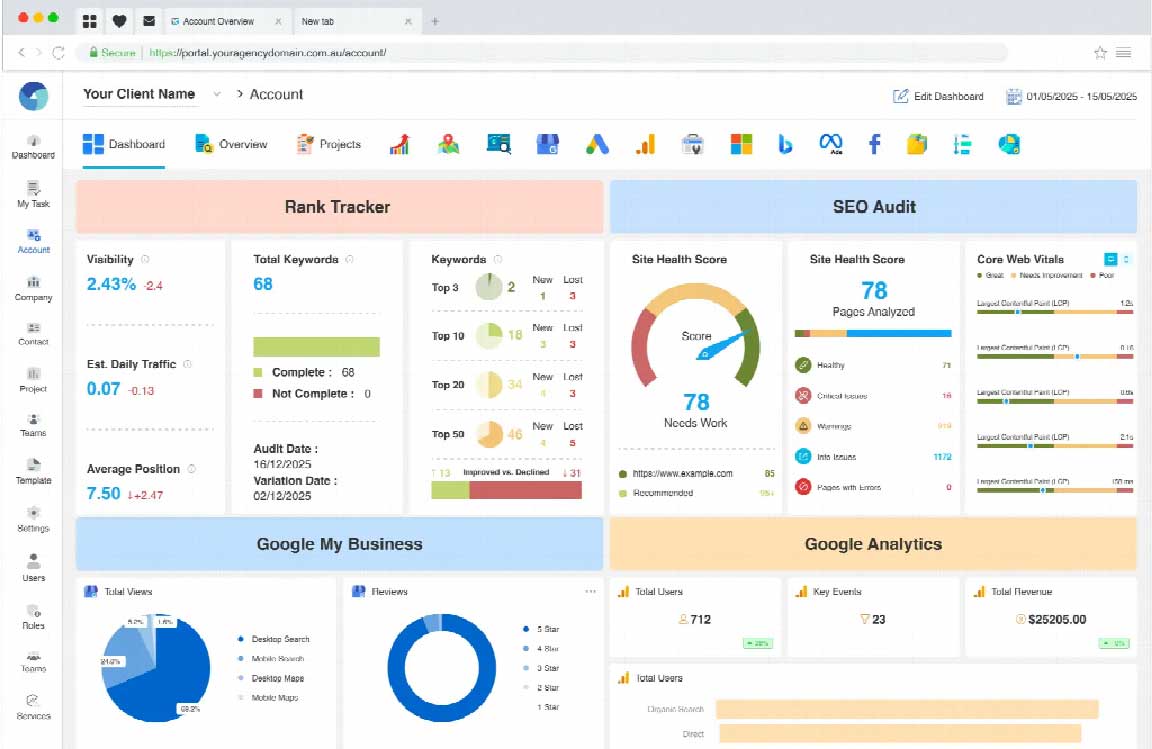
Building an agency usually happens one step at a time. You sign your first few clients and buy a basic rank tracking tool. Then you realize you need technical insights, so you add a dedicated audit platform. Next comes a reporting tool, a separate client portal, complex dashboards, and specialized competitor research software. Before you know it, you are managing six or seven different applications just to run a standard campaign.
This common scenario creates severe problems for growing teams. The most obvious issue is the extremely high software cost. Paying individual enterprise fees for a half dozen platforms quickly eats into your monthly revenue.
Beyond the financial strain, tool overload causes massive data fragmentation. Your rank tracker might show different search volumes than your competitor research software. When your team pulls metrics from disconnected sources, creating an accurate performance picture becomes impossible. This workflow inefficiency means your account managers waste precious hours exporting spreadsheets and trying to format data manually instead of actually improving client campaigns.
To scale effectively, you must separate the essential capabilities from the unnecessary distractions. A modern agency does not need a dozen different applications. You simply need a focused suite of features that cover the entire optimization lifecycle. When researching platforms, look for these seven core capabilities:
Visibility is the ultimate metric for success. However, modern search is highly personalized and location dependent. A standard approach to tracking simply does not work anymore.
You need a Rank Tracker that handles the heavy lifting for broad national campaigns. This is especially important for large ecommerce brands that sell to customers across the country. Tracking thousands of product keywords requires serious processing power.
Yet, national data alone is entirely inadequate for businesses serving specific geographic areas. Nearly 14 percent of all searches explicitly seek local information or businesses. Furthermore, 42 percent of users click directly on results displayed within the Google Maps pack. Therefore, a specialized Local Map Rank Tracker is absolutely mandatory.
You must measure exactly where a client appears on the local map and track their visibility across multiple locations simultaneously. Additionally, watching competitor rankings in these specific regions allows your team to adapt their strategies and capture valuable local foot traffic.
Great content cannot succeed on a technically broken website. Recent data shows that just 54 percent of websites actually meet basic core web performance standards. Furthermore, half of all websites suffer from duplicate meta descriptions and missing tags.
You need an integrated SEO Audit Tool to uncover these invisible roadblocks. A powerful auditor acts as an automated diagnostic system for your clients. It crawls through complex site architectures to flag oversized images, broken links, and slow loading pages.
The real value lies in ongoing monitoring and issue prioritization. Running a single audit at the start of a campaign is not enough. Websites break constantly as new pages are published and plugins update. Continuous monitoring alerts your team the moment a critical technical issue arises. By categorizing these errors by severity, your technical team knows exactly which problems to fix first to protect your organic traffic.
Data is useless if your team cannot understand it quickly. When your account managers manage dozens of accounts, they cannot afford to dig through complex menus to find basic performance metrics.
An intuitive SEO Dashboard provides an immediate campaign overview. It transforms chaotic data points into clear visual trends. Your team can log in every morning and instantly see which campaigns are thriving and which ones are dropping in traffic.
This level of operational visibility is a game changer for agency directors. Instead of asking for weekly status updates, leadership can monitor the health of the entire client roster from a single screen. When the whole team shares the exact same performance monitoring view, collaboration improves and strategic decisions happen much faster.
Client communication dictates client retention. If you send confusing spreadsheets or late updates, clients will lose faith in your expertise. Unfortunately, manual reporting is the biggest bottleneck for growing agencies.
An automated SEO Reporting Tool eliminates this entirely. By automating the data collection process, your team saves countless hours at the end of every month. You can schedule beautiful, accurate updates to generate and send exactly when your clients expect them.
Furthermore, white label reporting ensures that every document reinforces your brand identity. You can add your agency logo, custom colors, and personalized executive summaries. For agencies managing enterprise networks or franchises, multiple client reporting features allow you to blend data from different regions into one cohesive executive summary.
Organic search is just one piece of a much larger digital puzzle. Most businesses invest heavily across a variety of marketing channels. If you only report on organic keyword positions, you are not showing your true value to the business owner.
To provide complete transparency, your tech stack must integrate seamlessly with other major platforms. You need to pull performance data from Google Ads, Meta Ads, and Microsoft Advertising to compare your organic success directly against paid acquisition costs.
Additionally, connecting tools like Google Business Profile is vital for proving local engagement, such as phone calls and direction requests. Integrating direct data from Search Console and Bing Webmaster ensures your team has the most accurate click and impression metrics available. By blending all this marketing data together, you position your agency as a comprehensive growth partner rather than a narrow service provider.
The era of duct taping six different software subscriptions together is ending. Today, top performing teams operate with incredible efficiency because they leverage unified systems.
DAXRM represents the future of this integrated approach. By combining an advanced Rank Tracker, a deep SEO Audit Tool, and a completely transparent SEO Client Portal into one ecosystem, DAXRM gives agencies everything they need to scale gracefully.
Moving to an all in one platform delivers unmatched operational efficiency. Your team no longer wastes time learning different user interfaces or fighting with broken data exports. More importantly, dropping those overlapping software subscriptions provides immediate margin protection for your business. When you simplify your technology stack with DAXRM, you build a stronger, more profitable agency capable of delivering spectacular results for every single client.


Discover our other works at the following sites:
Danetsoft is a global web agency headquartered in Indonesia, specializing in web development, managed hosting, and web publishing platform.


 [email protected]
 Magelang, Central Java
 © 2026 Danetsoft. Powered by HTMLy