The EUR/USD spread is the benchmark against which every other trading cost in forex gets measured. The pair accounts for roughly a fifth of all daily global foreign exchange turnover, which is what keeps its bid-ask gap so consistently tight. During peak hours on a competitive platform, the spread can be a fraction of a pip. That is not marketing. It is the direct result of more buyers and sellers competing in one instrument than in any other currency pair on earth. Understanding why it is tight, when it widens, and what that means for your actual trading costs separates informed entry from guesswork.
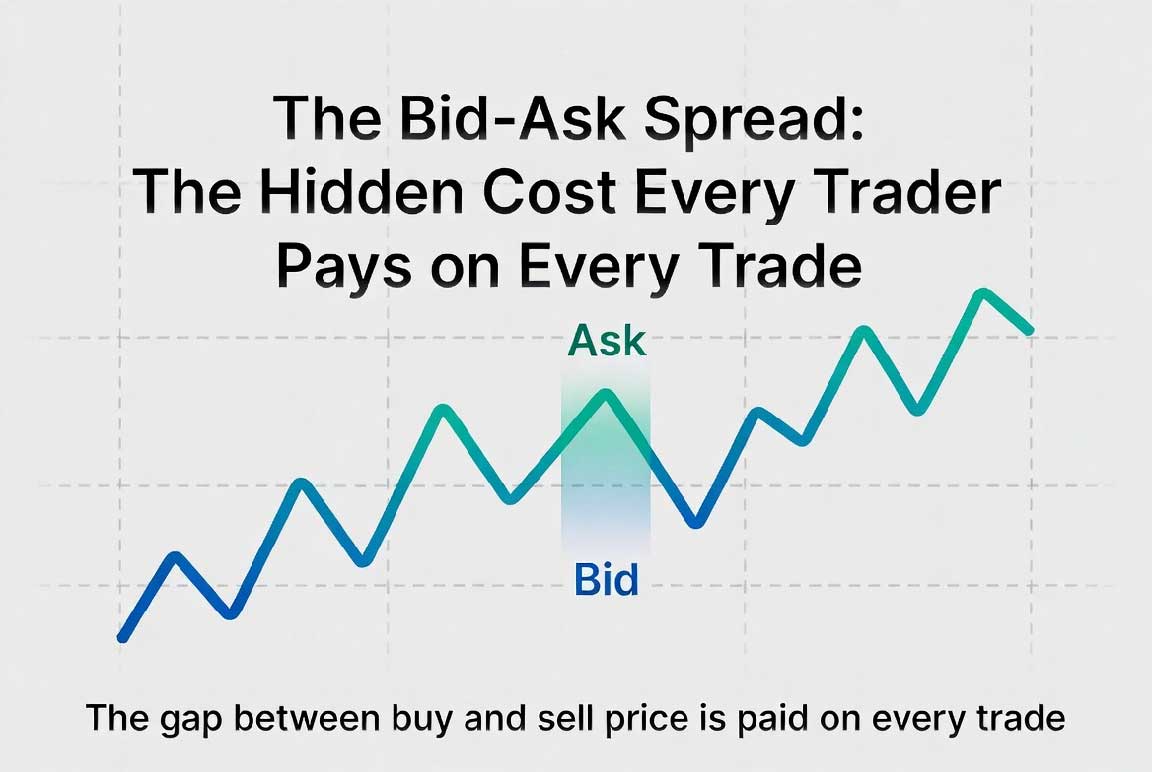
The EUR/USD spread is the gap between the bid and the ask, quoted in pips. A pip on EUR/USD is the fourth decimal place, so a quote of 1.08500 bid and 1.08508 ask represents a 0.8-pip spread. You buy at 1.08508 and could immediately sell back at 1.08500, so the position starts 0.8 pips below break-even before the rate moves at all.
On most retail platforms the spread is the complete cost of the trade on standard account types: no separate commission, no entry fee. The spread is where the cost lives. On raw or ECN-style accounts, the quoted spread approaches zero during peak hours, but a fixed commission per lot is charged separately. Whether the cost appears as a wider spread or as a commission with a narrower spread, the total is what matters. A 0.1-pip spread with a $7 commission per standard lot and a 1-pip spread with no commission are almost identical in cost terms at standard lot sizes. The number to compare across account types is always the all-in cost, not the headline figure on the pricing page.
Liquidity is the only mechanism that produces tight spreads, and EUR/USD has more of it than any other instrument in forex. The pair connects the world's two largest economic blocs, with the US dollar serving as the global reserve currency. Banks, corporations hedging international revenues, central bank reserve managers, and retail traders all need access to this exchange rate continuously, which means the order book on EUR/USD is consistently deep across the entire trading week.
That depth forces competition among market makers. When many firms are all quoting EUR/USD simultaneously, each competing for order flow, the bid-ask gap narrows because a market maker quoting 1 pip wide loses business to the one quoting 0.5 pips. The competitive pressure squeezes the spread down toward the minimum the liquidity providers are willing to accept for the risk of holding the position between buyer and seller.
No other currency pair generates this volume. USD/JPY, the second most-traded pair, runs a tight spread too, but typically a fraction wider than EUR/USD. GBP/USD is liquid but slightly more volatile, and that volatility widens its average spread. Further down the liquidity hierarchy, spread costs rise quickly.
| Pair | Typical spread | Relative to EUR/USD |
|---|---|---|
| EUR/USD | 0.1 to 1 pip | Benchmark |
| USD/JPY | 0.2 to 1.5 pips | Marginally wider |
| GBP/USD | 0.5 to 2 pips | Wider, more volatile |
| AUD/USD, USD/CAD | 0.5 to 2 pips | Wider |
| EUR/GBP, EUR/JPY | 1 to 3 pips | Minor pair range |
| USD/TRY, USD/ZAR | 10 to 50+ pips | Exotic, thin market |
Tight does not mean constant. EUR/USD spreads widen in predictable conditions, and knowing those conditions in advance is more useful than being surprised by them.
Scheduled US and European data releases produce the sharpest spikes. Non-Farm Payrolls, US CPI, Federal Reserve rate decisions, and ECB policy announcements all generate large directional moves in seconds, and market makers widen the spread in the surrounding window to protect against being caught on the wrong side of a fast price move. In the two or three seconds immediately after a major figure prints, the EUR/USD spread can jump from a fraction of a pip to several pips, then snap back within a minute as the initial volatility subsides and market makers return with tight quotes.
The quiet overnight hours between the New York close and the Tokyo open produce a different kind of widening: slower, sustained, and less dramatic than a news spike but persistent across the entire low-volume window. With fewer participants active, the competitive pressure that keeps spreads tight during London and New York hours eases, and the gap drifts wider. For traders who work outside of normal business hours in Western timezones, the spread they see at 3 AM is meaningfully wider than the spread they would pay at 3 PM.
Bank holidays in the US or Eurozone remove participants from one or both sides of the pair and produce elevated spreads for the duration. The period between Christmas and New Year is historically the widest spread window of the trading year on EUR/USD, as institutional desks run skeleton staff and interbank volume collapses.
The comparison between a standard spread account and a raw spread plus commission account is less obvious than it looks. A standard account quoting EUR/USD at 1 pip includes the broker's markup inside that figure. A raw account quoting 0.1 pips plus $7 commission per standard lot translates to an effective total cost of approximately 0.8 pips at current EUR/USD prices, which is similar to but not necessarily better than the standard account's 1-pip spread.
The calculation that matters is: spread in pips multiplied by pip value, plus commission per lot, divided by lot size. For a standard lot (100,000 units) of EUR/USD, a 1-pip spread costs $10. A 0.1-pip spread plus $7 commission costs $1 plus $7, or $8 total. In this example the raw account is slightly cheaper. Reverse the numbers slightly and the comparison can flip. The correct approach is to calculate both figures on the specific account sizes and lot sizes you actually trade, rather than assuming the headline spread figure is the complete picture.
EUR/USD spread is the single most useful metric for comparing forex brokers, for one straightforward reason: if a broker cannot offer competitive pricing on the most liquid pair in the world, they will not offer competitive pricing anywhere. Tight EUR/USD spread requires genuine access to deep interbank liquidity. A broker with good institutional connections on EUR/USD will have it on GBP/USD and USD/JPY too. A broker whose EUR/USD spread is consistently wide relative to peers either lacks that access or is adding markup.
The comparison needs to account for trading conditions, not just the headline. Spread during the London-New York overlap on a normal day is the relevant number: that is when the pair is at its most liquid and the baseline spread should be tightest. A broker who quotes a narrow spread only to widen it aggressively around news, or who applies variable markup during volatile conditions, provides a different real cost than one whose spread remains stable.
A tight EUR/USD spread creates conditions that genuinely change what is viable. A scalper targeting three to five pips per trade in a market where the spread is half a pip operates in a fundamentally different cost environment from a trader paying two pips to enter the same position. In the first case, the spread costs 10% to 17% of the target. In the second, it costs 40% to 67%. The strategy that works under one set of conditions does not work under the other.
This is why EUR/USD is the natural home for scalping and high-frequency day trading: not because the pair is less risky, but because the entry cost is low enough that small targets remain viable. The pair moves sharply around news events and carries full market risk on leveraged positions regardless of how tight the spread is. A tight spread lowers the minimum move required to break even. It does not reduce the probability of an adverse move or limit the loss if the trade goes wrong.
The EUR/USD spread is the product of one factor taken to an extreme: liquidity. The pair is the most traded in the world by a substantial margin, and that volume compresses the bid-ask gap to levels no other currency pair consistently achieves. That tightness is genuine during the active sessions, and it widens predictably around news, in quiet hours, and on holidays. Understanding when the spread is at its tightest, how to compare it across account types on a total-cost basis, and what it actually means for strategy viability gives you the information needed to use this pair correctly rather than simply assuming it is cheap to trade at all hours.


Discover our other works at the following sites:
Danetsoft is a global web agency headquartered in Indonesia, specializing in web development, managed hosting, and web publishing platform.


 [email protected]
 Magelang, Central Java
 © 2026 Danetsoft. Powered by HTMLy