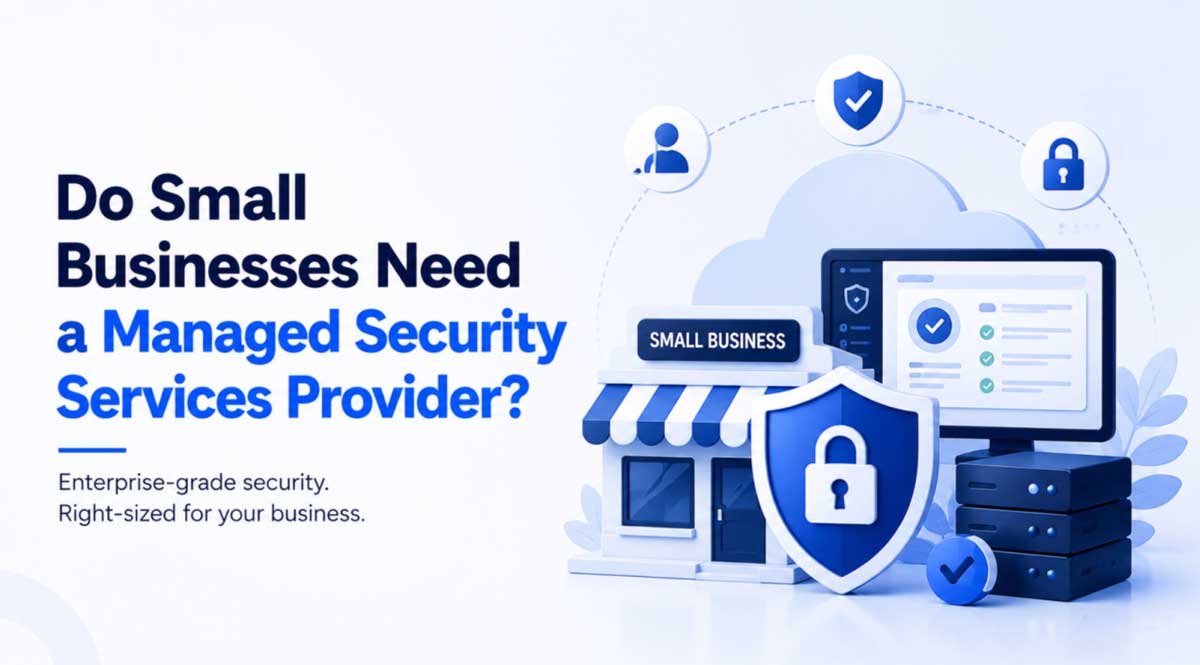
Quick Answer: Yes. Most small businesses need a Managed Security Services Provider (MSSP) because they face the same cyber threats as large enterprises but lack the budget, staff, and expertise to defend against them in-house. An MSSP gives small businesses 24/7 threat monitoring, expert-level protection, and compliance support at a fraction of the cost of building an internal security team.
If you're a small business owner weighing whether to invest in outsourced cybersecurity, this guide breaks down exactly when it makes sense, what it costs, and how to decide.
A Managed Security Services Provider (MSSP) is a third-party company that monitors and manages an organization's cybersecurity, including firewalls, intrusion detection, endpoint protection, and incident response, on an ongoing, subscription basis. Instead of hiring a full internal security team, businesses pay an MSSP a monthly fee to handle security operations remotely, often through a Security Operations Center (SOC) that runs 24/7.
For small businesses specifically, MSSPs act as an extension of the company, providing enterprise-grade protection without the enterprise-grade payroll.
A common misconception is that cybercriminals only target large corporations. The data says otherwise.
In short, small businesses often have enterprise-level risk with startup-level defenses. That gap is exactly what MSSPs are built to close.
You likely need a Managed Security Services Provider if any of the following are true:
You don't have a dedicated IT security employee. Most small businesses rely on a generalist IT person (or no one) to handle security, a role that requires specialized, full-time attention.
You store sensitive customer or financial data. This includes payment details, health records, or personal identifiable information (PII).
You need to meet compliance requirements. Standards like PCI-DSS, HIPAA, or SOC 2 often require continuous monitoring that's difficult to manage internally.
You've experienced a security incident before. Past breaches, phishing attempts, or malware infections are strong indicators of underlying vulnerabilities.
Your team works remotely or hybrid. Distributed teams increase the number of endpoints and access points that need protection.
You rely on cloud tools and SaaS platforms. Cloud environments require specialized monitoring that many small IT setups aren't equipped for.
Downtime would significantly hurt your business. If an attack could stop operations for even a day, the cost of prevention is almost always lower than the cost of recovery.
If two or more of these apply, an MSSP is worth serious consideration.
Building an in-house security team means covering salaries for multiple specialists, typically $15,000 to $30,000+ per month for a small business, plus hiring time, training, and tooling costs. Coverage is also limited to staff availability, and expertise is capped by whoever you're able to hire.
An MSSP, by contrast, typically costs $1,500 to $5,000 per month, provides 24/7/365 monitoring, and gives you access to a full team of specialists rather than one or two generalists. It can also be deployed in days to weeks instead of months, scales with your subscription tier instead of requiring new hires, and usually includes compliance support as part of the service.
For most small businesses, building an equivalent in-house capability would cost significantly more than outsourcing it. That's why MSSPs have become the default choice for companies under 500 employees.
A typical MSSP contract for a small business includes:
Essentially, an MSSP replaces the function of an entire internal security department with a shared, expert team.
Pricing varies based on company size, industry, and the scope of services, but small businesses can generally expect:
Most MSSPs price per user, per device, or per endpoint, so costs scale predictably as the business grows, unlike hiring, where each new security responsibility often means another salary.
"We're too small to be a target." Automated attacks don't discriminate by company size. Small businesses are frequently targeted precisely because they're assumed to have weaker defenses.
"We can't afford it." The average cost of a data breach for a small business often exceeds what a full year of MSSP services would cost. The real question isn't affordability. It's which cost is smaller: prevention or recovery.
"Our IT person handles security too." Cybersecurity is a full-time specialty, not a side task. A generalist IT employee typically can't match the depth of a dedicated SOC team monitoring threats around the clock.
"We don't have anything worth stealing." Attackers don't just steal data. They also use small business networks as entry points to attack larger partners, deploy ransomware for direct payouts, or hijack systems for other attacks.
If you've decided an MSSP makes sense, evaluate providers using these criteria:
Small businesses don't need an MSSP because they're big. They need one because they're vulnerable in ways that large enterprises typically aren't. Limited budgets, generalist staff, and constrained resources make small businesses attractive, low-effort targets for attackers. A Managed Security Services Provider closes that gap by delivering enterprise-level protection through a scalable, subscription-based model, making professional-grade cybersecurity accessible even to businesses with a handful of employees.


Discover our other works at the following sites:
Danetsoft is a global web agency headquartered in Indonesia, specializing in web development, managed hosting, and web publishing platform.


 [email protected]
 Magelang, Central Java
 © 2026 Danetsoft. Powered by HTMLy