Most businesses don’t lose the AI race because they picked the wrong model, they lose it because they picked the wrong approach entirely. Pre-built tools look like a safe, low-cost, fast setup, and no engineering headaches. But safe and right are two different things. Custom AI looks expensive at first until you account for what generic outputs actually cost in accuracy, control, and missed opportunities.
The wrong choice doesn’t announce itself immediately, it compounds quietly over time until changing course becomes difficult and costly. This is where Custom AI development services become critical for businesses that need long-term scalability, precision, and control over their AI systems.
Custom AI solutions are designed, trained, and deployed specifically for one business and its particular requirements. Nothing is borrowed from a generic platform, the system is built around your data, your workflows, and your goals from the start.
A custom AI system learns from your proprietary data, so it understands your business context in ways no general-purpose model ever will. It follows your specific decision logic and operational rules rather than approximating them through someone else's framework. What you get is a system that reflects how your business actually runs, not how a vendor guessed it might.
Ownership is the real reason businesses absorb the higher upfront cost of custom AI development. You own the model, the data pipeline, and every output the system produces on your behalf. When accuracy, regulatory compliance, and competitive differentiation are genuinely non-negotiable, renting access to someone else's system stops making sense.
Pre-built AI tools are subscription-based platforms that businesses can access and deploy without significant technical setup or infrastructure. They are designed for broad use cases and built to serve many different types of users at the same time.
These tools arrive with pre-trained models, standard integrations, and fixed feature sets that handle common scenarios reasonably well. Users configure settings within the boundaries the vendor has already established rather than building anything custom. Setup is fast and accessible, which is genuinely useful, the tradeoff is that depth and flexibility are limited by design.
Standard, repeatable tasks that don't require deep business-specific intelligence are where pre-built tools consistently earn their subscription cost. Customer support chatbots, email automation, grammar tools, and basic analytics dashboards are well-solved problems in this space. When the task is common and the stakes don't demand precision, pre-built tools are a sensible and cost-effective choice.
Choosing between custom AI and pre-built AI tools depends on how much control, flexibility, and scalability a business needs. While both aim to improve efficiency, they differ significantly in how they are built, deployed, and scaled.
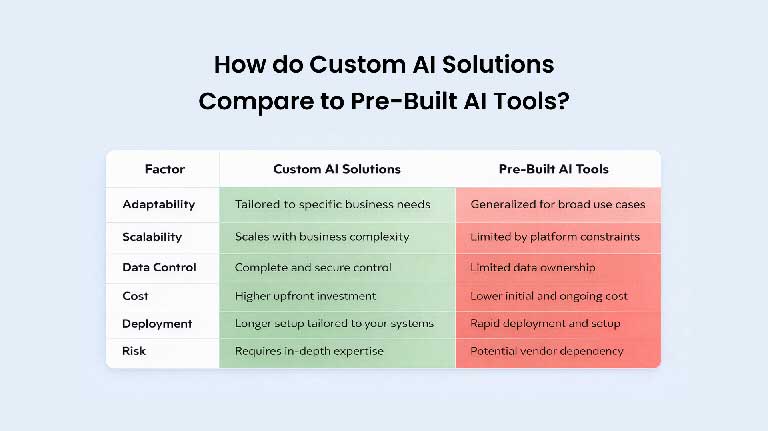
Pre-built AI tools focus on speed and convenience, offering quick deployment with lower initial cost but limited flexibility. In contrast, custom AI solutions are designed for specific business needs, providing full control over data, higher adaptability, and long-term scalability.
Cost plays a key role in deciding between custom AI and pre-built tools. The difference becomes clearer when comparing short-term affordability with long-term investment value.
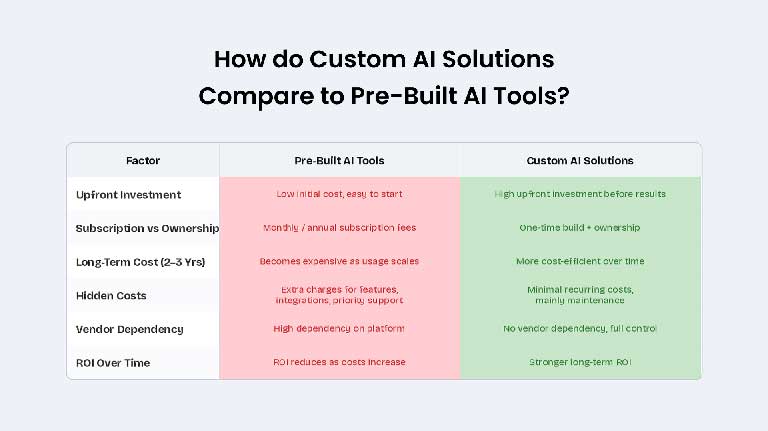
The comparison shows that pre-built AI tools are cost-effective for short-term and low-scale use, but expenses increase as usage grows. Custom AI requires a higher upfront investment, but it offers better long-term value through ownership, reduced dependency, and stronger ROI over time.
Performance comes down to one question: does the system solve your actual problem accurately, and does it keep doing that over time?
Pre-built tools generate outputs from broad training data that was never built around your industry, your customers, or your context. Custom AI produces predictions and responses grounded in your specific data, which makes them more accurate and far more actionable in practice. The gap between generic and specific intelligence is most visible precisely when the stakes are highest, and errors are most costly.
Your data contains patterns, behaviors, and operational signals that no public dataset can replicate. A custom AI model trained on that data develops an understanding of your business that no off-the-shelf tool can approximate from the outside. The accuracy advantage this creates doesn't stay static, it compounds as the model sees more of your data over time.
Speed matters, and being honest about the tradeoffs here is more useful than pretending one approach wins across the board.
Pre-built tools can be live within hours with no engineering team, no infrastructure decisions, and no development cycles standing between you and a working system. When the business pressure is immediate, and the use case is standard, that deployment speed is a real and legitimate advantage. Custom development simply cannot match that timeline in the short term, and there's no point pretending otherwise.
Custom AI takes weeks or months to build, test, and deploy properly, the timeline depends on complexity and how ready your data actually is. That upfront time is a real cost. But it produces a system calibrated to your exact problem rather than one you've adapted from something that was built for someone else. Businesses with longer planning horizons consistently find the development period worth what it produces.
Security is not optional for any business running AI across sensitive operations or industries with regulatory obligations.
Custom AI processes all data within your own infrastructure, so you control access, retention, and compliance from end to end. No third-party servers touch your sensitive information, and no vendor's privacy policy can override your own data governance decisions. In regulated industries, that level of control isn't a preference, it's often a legal requirement that pre-built tools simply can't satisfy.
Pre-built platforms run your data on external servers governed by the vendor's terms of service and whatever security practices they've chosen to implement. If the vendor suffers a breach, changes its data policies, or discontinues a product line, your business absorbs the impact directly. Security risk here isn't just technical, it includes vendor dependency, contractual exposure, and the ongoing loss of control over information your business depends on.
There's no universal winner here, and anyone telling you otherwise is selling something. Pre-built tools are the right call for fast deployment, standard tasks, and teams that need to test before they commit. Custom AI is built for businesses that need accuracy, data control, and intelligence that actually reflects how they operate. In practice, the smartest approach for most businesses is a hybrid model, using pre-built tools where they are sufficient, and custom AI where precision, scalability, and control matter more. The best AI investment is not the most expensive one, it is the one that solves the right problem most effectively.


Discover our other works at the following sites:
Danetsoft is a global web agency headquartered in Indonesia, specializing in web development, managed hosting, and web publishing platform.


 [email protected]
 Magelang, Central Java
 © 2026 Danetsoft. Powered by HTMLy