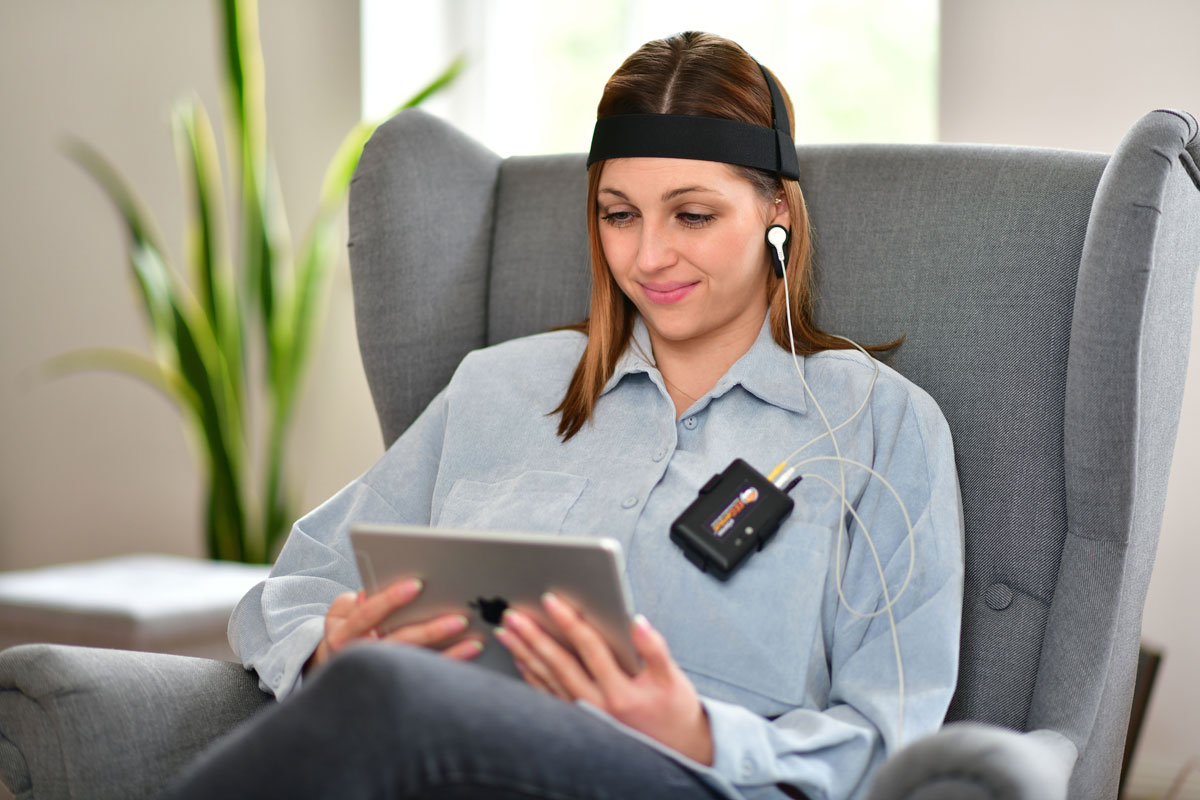
 Photo by Mindfield Biosystems Ltd. on Pexels
EEG studies keep moving out of the shielded room and onto walking paths and into classrooms. Portability usually involves trade-offs in channel count, sampling rate, timing precision or battery life. A system that doesn't match the study design can mean noisy ERPs or missing triggers.
This guide ranks 10 portable EEG systems for research on channel count, amplifier placement, electrodes, sampling rate, synchronization, software and price. It explains how the ranking works and notes where each system fits best.
One term needs pinning down first. In this article, "wearable" means head-worn: the amplifier mounts on the head. The comparison table tracks this in its own column, because amplifier placement affects how cables move during a task. For the related difference between portable and mobile EEG, see mBrainTrain's guide to portable vs mobile EEG.
For research-grade portable recording, Smarting PRO X ranks first in this comparison. It records 64 channels from a single head-worn amplifier, offers wireless streaming and up to 4,000 Hz sampling, with onboard recording, LSL and TTL synchronization. The product page lists streaming up to 1,000 Hz; see the configuration note in its entry for higher-rate licensing.
The right choice still depends on the study. For specific needs, other systems may fit better:
Each choice involves a trade-off, and every entry below names one.
Specifications come from each manufacturer's current product page or datasheet, checked on October 29, 2026. Where a manufacturer doesn't publish a figure, the article says "not published" instead of estimating.
Every system was compared on the same six points:
| Rank | System | Max channels (single amplifier) | Head-worn amplifier (Y/N) | Electrodes | Sampling (live / onboard) | Software | Price | Best for |
|---|---|---|---|---|---|---|---|---|
| 1 | mBrainTrain Smarting PRO X | 64 total (64 EEG, or 56 EEG + 8 ExG) | Y | Gel, dry | 250–4,000 Hz sampling; Bluetooth up to 1,000 Hz per product page; higher-rate streaming is configuration/licence-dependent (see entry) | Smarting Streamer, Android app | Not published | High-density recording during movement |
| 2 | Brain Products LiveAmp | 32 (64 only as a hybrid of two 32-ch amplifiers) | Y (8–32 ch); N (64-ch hybrid) | Active, gel, sponge, dry | 250, 500 or 1,000 Hz (live) | BrainVision Recorder | Not published | Labs already using Brain Products amplifiers and caps |
| 3 | ANT Neuro eego sports | 64 (32/64-ch amplifier); 24-ch amplifier also available | N | Gel, saline, dry | 2,000 Hz (up to 16,000 Hz); live/onboard split not published | eego software, eego remote | Not published | Certified hardware, high sampling rates |
| 4 | g.tec g.Nautilus PRO | 32 | Y | Hybrid dry or gel, wet | 500 Hz (live) | g.HIsys, g.BSanalyze | Published online; varies by channel configuration and currency | BCI, clinical research |
| 5 | Mentalab Explore Pro | 32 | Y (cap-mounted, per Explore Pro quick-start guide) | Wet, dry | Bluetooth: 1,000 / 500 / 250 Hz for 8 / 16 / 32 channels; USB-C: up to 8,000 / 4,000 / 2,000 Hz respectively | Explore Desktop, Explore Mobile | Not published | Low-channel mobile recording |
| 6 | Neuroelectrics Enobio | 32 | Not published | Dry, gel | 500 Hz (live) | NIC2 | Not published | Fast dry setup |
| 7 | CGX Quick-32r | 32 total (30 EEG + 2 ExG) | Y | Dry | 500 Hz (live) | CGX Acquisition | Not published | Dry BCI |
| 8 | Bitbrain Versatile Plus | 34 total (32 EEG + 2 ExG) | Y | Water-based semi-dry | 256 Hz live; up to 2,048 Hz to SD | SennsLite | Not published | Sponge setup |
| 9 | EMOTIV FLEX 2 (formerly EPOC Flex) | 32 | Y | Saline, gel | 128 or 256 Hz (live) | EmotivPRO | Published on Emotiv's online store | Teaching and pilot studies |
| 10 | Wearable Sensing DSI-24 | 24 | Y | Dry | 300 Hz live (600 Hz upgrade) | DSI-Streamer | Not published | Long dry sessions |
Published online pricing is available for g.tec and EMOTIV among the selected models; other entries require quotes. Compare complete packages, including caps, electrodes, software and licences, rather than amplifier prices alone. Live rates depend on channel configuration and connection type: for example, Explore Pro's Bluetooth rate ranges from 250 Hz at 32 channels to 1,000 Hz at 8 channels.
Each entry uses the same four labels. Every "Keep in mind" note names a limitation drawn from the manufacturer's own page or a published study.
Best for: High-density recording in studies with movement, outdoor settings or several participants.
Key specs: Smarting PRO X records 64 channels in total (64 EEG, or 56 EEG + 8 ExG) from a single head-worn amplifier weighing 70 g. It samples at 250–4,000 Hz with 24-bit parallel sampling. The product page lists wireless streaming to a PC or Android device at up to 1,000 Hz and sampling up to 4,000 Hz with internal memory. Higher-rate Bluetooth availability depends on configuration and licensing; see the note below. mBrainTrain lists input-referred noise below 1 µV, CMRR above 140 dB and up to 12 hours of battery.
What stands out: The amplifier sits on the head with fixed cables, which limits cable movement during tasks. Sync uses LSL plus 1-bit and 8-bit TTL trigger inputs, and a 9D motion sensor tracks head movement. Smarting Streamer applies real-time ASR artifact cleaning while keeping the raw data. Caps come in gel and dry versions. For hyperscanning, Smarting Spectra records several participants from one PC with microsecond synchronization.
Keep in mind: mBrainTrain's product page lists wireless streaming up to 1,000 Hz, while its support article says Bluetooth streaming at 2,000/4,000 Hz requires a Hyperscanning / Multimodal licence. These official descriptions are not fully aligned; confirm the supported channel count, receiving platform and licence for the intended configuration with mBrainTrain before specifying a higher live rate. The independent validation cited in this article used an earlier 24-channel Smarting, not PRO X. Pricing is not published.
Best for: Labs already using Brain Products amplifiers, caps and BrainVision Recorder.
Key specs: A single LiveAmp records up to 32 channels on a head-worn amplifier of about 60 g; Brain Products also lists 8- and 16-channel versions. A 64-channel setup (64 channels total: 64 EEG, or 56 EEG + 8 bipolar) is a hybrid of two 32-channel LiveAmp amplifiers (about 120 g in total), and is not head-worn. Sampling runs at 250 Hz, 500 Hz or 1,000 Hz with 24-bit resolution, and Brain Products lists 1,000 Hz for up to 32 channels.
What stands out: Electrode choice is broad, covering actiCAP active electrodes, LiveCap passive gel caps, R-Net sponge nets and actiCAP Xpress Twist dry electrodes. A TTL trigger input is built in, and the STE compact adds an 8-bit trigger input. In Epinat-Duclos et al. (PeerJ, 2026), LiveAmp, EPOC Flex and a wired BrainAmp all produced the expected alpha, SSVEP and ERP effects across five tasks. LiveAmp's spectral effects matched the BrainAmp's, while both wireless systems recorded a smaller N170 than the BrainAmp.
Keep in mind: The internal battery lasts up to about 3.5 hours, so longer sessions need a power bank. For 64 channels, plan for two linked amplifiers rather than one head-worn unit. LiveAmp is not a medical device.
Best for: Studies that need certified medical hardware and high sampling rates.
Key specs: eego sports comes as a 24-channel amplifier under 100 g, sampling at 2,000 Hz (up to 4,000 Hz), and a 32/64-channel amplifier of 600 g, sampling at 2,000 Hz (up to 16,000 Hz); ANT Neuro doesn't state which of these rates stream live. ANT Neuro's page lists systems from 8 to 128 channels; the largest single amplifier it describes is the 32/64-channel unit.
What stands out: The eego amplifier is CE marked as a Class IIa medical device under MDR and has FDA 510(k) clearance, a Health Canada license and ARTG registration. Caps cover waveguard original (gel), waveguard net (saline) and waveguard touch (dry), and data can stream to an Android phone through the eego remote app.
Keep in mind: The amplifier is not head-worn. Participants carry it separately from the cap, and the 32/64-channel unit weighs 600 g.
Best for: BCI and clinical research groups that need a certified head-worn amplifier and published pricing.
Key specs: g.Nautilus PRO Flexible offers 8, 16, 19 or 32 channels on a single headset amplifier, at 24-bit and 500 Hz. Battery life exceeds 10 hours at 32 channels, with Qi wireless charging.
What stands out: g.tec publishes online prices for channel-specific amplifier configurations and electrode strands. Check the currency, selected channel count, software, taxes and included accessories on the linked product page or configurator before comparing the total package cost. Electrode strands take g.SAHARA hybrid (dry or gel) or g.SCARABEO wet electrodes. It is CE certified and FDA cleared, and g.tec lists LSL and TTL synchronization for its g.Nautilus headsets.
Keep in mind: PRO Flexible samples at 500 Hz. Its 250 Hz Nyquist frequency is a theoretical ceiling, not a guarantee of usable bandwidth; check the model's filters and specified passband. The separate g.Nautilus Multi-Purpose and RESEARCH models support head-mounted 64-channel recording at 250 Hz and should also be considered for high-density research.
Best for: Low-channel mobile recordings where the 27 g 8-channel amplifier helps.
Key specs: Explore Pro records 8, 16 or 32 channels per amplifier at 24-bit, with a 9D motion sensor. Mentalab's hardware documentation lists Bluetooth streaming at 1,000 Hz for 8 channels, 500 Hz for 16 channels and 250 Hz for 32 channels. USB-C rates reach up to 8,000, 4,000 and 2,000 Hz respectively. The 8-channel amplifier weighs 27 g; the 32-channel weight is not stated in the cited hardware table. Mentalab's Explore Pro quick-start guide describes securing the amplifier to the EEG cap with Velcro.
What stands out: Mentalab offers an open-source Python API, and electrodes cover wet Ag/AgCl and dry types. Dirik, Darendeli and Ertan (Brain Research, 2023) found no significant difference in eyes-closed alpha peak frequency or suppression at O1 and O2 between the original Explore and a clinical-grade wired system.
Keep in mind: The highest USB-C rate is not the Bluetooth streaming rate. Choose the channel count and connection type together, and verify onboard recording settings separately. The cited validation covers only resting-state recordings with gel electrodes on the original Explore, not Explore Pro.
Best for: Studies that need fast dry-electrode setup and a CE-certified medical device.
Key specs: Enobio comes in 8-, 20- and 32-channel versions, sampling at 500 Hz with 24-bit resolution (0.05 µV). The Enobio 32 weighs 96–97 g and records to microSD for 11 to 16.5 hours; Neuroelectrics' datasheets differ on these figures. Sync includes LSL, TCP, a hardware TTL trigger and an SDK.
What stands out: Neuroelectrics lists about 4 minutes of setup for Enobio 32 with dry electrodes and 20–25 minutes with gel. Enobio is a CE Class IIa medical device, and an FDA-cleared clinical variant, Enobio Dx, is sold separately.
Keep in mind: Wi-Fi streaming lasts about 5 to 5.5 hours at 32 channels, depending on the datasheet version, so full-day studies need SD recording or charging breaks.
Best for: Dry-electrode BCI studies built on open research toolboxes.
Key specs: Quick-32r records 32 channels in total (30 EEG + 2 ExG) from a single headset, streaming at 500 Hz with 24-bit resolution and true DC coupling. Two AA batteries last 8 hours.
What stands out: Active, shielded dry electrodes remove gel cleanup between participants. CGX lists compatibility with LSL, EEGLAB, BCILAB, MATLAB, NeuroPype and BrainVision Recorder, with export to BDF, EDF or CSV. The headset is not a diagnostic device.
Keep in mind: CGX rates the headset for 60-minute sessions, and sampling is capped at 500 Hz.
Best for: Naturalistic studies that favor tap-water sponge setup and LSL integration.
Key specs: Versatile Plus comes in 16- and 32-channel versions, plus 2 bipolar ExG inputs, with a head-mounted amplifier. Bluetooth streaming runs at 256 Hz. Recording to SD reaches up to 2,048 Hz while streaming continues at 256 Hz, and a wired USB connection gives 1,024 Hz. Resolution is 24-bit, the 32-channel amplifier weighs 135 g, and Bitbrain lists up to 10 hours of battery, depending on configuration.
What stands out: Semi-dry sponges use tap water, so participants leave without gel in their hair. Sync options include LSL and an included photodiode trigger for aligning screen events with EEG, and SennsLite exports CSV and EDF.
Keep in mind: Bluetooth streaming is 256 Hz, but the specified amplifier bandwidth is DC–100 Hz. Use that passband and the filter characteristics, not the theoretical 128 Hz Nyquist ceiling alone, when planning real-time or closed-loop analysis. USB and onboard modes have different sampling rates.
Best for: Teaching labs and pilot studies where a configurable 32-channel system fits the required bandwidth and software workflow.
Key specs: FLEX 2 records up to 32 channels plus 2 reference electrodes from a single controller in the cap. It samples internally at 2,048 Hz and outputs 128 or 256 Hz at 16-bit, with saline felt or gel electrodes. Battery life is up to 6 hours, and the controller sits at the top or rear of the head.
What stands out: FLEX 2 has published online hardware pricing. Compare the complete hardware, software subscription and raw-data access costs against quotes for the other systems before choosing on budget. For the earlier EPOC Flex, Williams et al. (PeerJ, 2020) found MMN and P300 results equivalent to a Neuroscan SynAmps2 recording, N170 peak values that differed but with strongly correlated waveforms, and lower SSVEP signal-to-noise. In Epinat-Duclos et al. (PeerJ, 2026), EPOC Flex retained less usable data than LiveAmp and a wired BrainAmp, showed weaker spectral effects and recorded shorter latencies for every ERP except the MMN.
Keep in mind: Output tops out at 256 Hz with a 16-bit ADC, EmotivPRO Lite is included while other EmotivPRO features are paid upgrades, and FLEX 2 is not sold as a medical device.
Best for: Long dry-electrode sessions where swapping batteries beats recharging.
Key specs: DSI-24 records 24 channels in total (19 scalp electrodes, 2 earclip sensors and 3 auxiliary inputs) at 300 Hz, with a 600 Hz upgrade, through a 16-bit amplifier. Hot-swappable batteries give more than 24 hours of run time, and an 8-bit trigger input, LSL and TCP/IP handle sync.
What stands out: Amplifiers, digitizers, batteries and wireless electronics all sit in the headset. Recording runs through Wearable Sensing's DSI-Streamer software, and the company lists average setup at under 3 minutes.
Keep in mind: The 16-bit ADC and 300 Hz default rate are lower than most systems here. In Korisky et al. (2026), DSI-24 recordings made in a non-shielded classroom showed a 47–63 ms lag against the wired lab reference, while its ERPs correlated strongly with the wired system's for Standard and Novel sounds after correction for the temporal lags; ERP studies should measure and correct timing in their own setup.
Start with movement. Gel offers better skin adhesion and the most stable contact when participants walk or turn their heads. Semi-dry and dry contacts cut preparation time, which helps in classrooms and repeated sessions, and dry electrodes are slightly less stable than gel during movement.
Next, match the device's usable bandwidth to the signal of interest. A 256 Hz output has a theoretical Nyquist ceiling of 128 Hz, but hardware and software filters may impose a lower usable limit. For example, Bitbrain specifies DC–100 Hz bandwidth for Versatile Plus, while EMOTIV specifies 0.2–45 Hz for FLEX 2. Check whether a quoted sampling rate applies to Bluetooth, wired streaming or onboard storage, and to which channel configuration.
Then ask for timing evidence. In one independent study, Korisky et al. (Frontiers in Human Neuroscience, 2026) recorded auditory ERPs with an earlier 24-channel semi-dry Smarting and a wired gel 64-channel BioSemi. Each system recorded different participants, so the authors caution against reading the results as a head-to-head comparison. The Smarting was time-aligned with the BioSemi (0–4 ms, within one sample at 250 Hz), while the dry DSI-24, recorded in a different, non-shielded classroom, showed a 47–63 ms lag. The authors discuss possible setup-specific hardware and transmission contributions; the study does not isolate device effects from differences in environment and participants.
Finally, check software and budget together. Raw-data licenses, export formats and paid sampling upgrades all change the real cost. Before requesting quotes, a lab can work through six questions:
Smarting PRO X is our editorial first recommendation for high-density mobile work because it combines 64 channels in one 70 g head-worn amplifier with gel and dry cap options and mobile workflows. This is not a claim that it is the only head-worn 64-channel system or the best choice for every study. Compare g.Nautilus RESEARCH and Multi-Purpose for other 64-channel options, LiveAmp for existing Brain Products workflows, and eego sports or g.Nautilus PRO for certified medical hardware.
Research suitability depends on the study's required bandwidth, noise performance, timing accuracy, electrode stability, raw-data access and validation evidence. ADC bit depth and sampling rate matter, but neither alone establishes research suitability. A 16-bit or 256 Hz system can support some ERP and spectral studies, as the cited validation papers illustrate, provided its timing, passband and signal quality meet the protocol. Check the exact model, channel count and recording mode rather than relying on a research-grade label.
Lab EEG offers shielding, wired stability and very high channel counts. Portable EEG records where the behavior happens. The trade-off is control: shielded rooms reduce noise, while portable recording captures natural movement.
It depends on the system and the task. Validation studies such as Korisky et al. (2026) and Epinat-Duclos et al. (2026) show that wireless systems can record expected ERP and spectral effects. In Korisky et al., the earlier 24-channel Smarting was time-aligned with the wired BioSemi reference within one sample at 250 Hz (0–4 ms); other mobile setups showed larger timing differences. Participants and recording conditions differed, so those results are not a controlled head-to-head hardware comparison. Check validation and timing for the exact model and setup used in the study.
Gel offers better skin adhesion and the most stable contact during movement, but leaves residue that participants need to wash out. Semi-dry (saline) electrodes avoid gel residue and shorten cleanup. Dry electrodes set up fastest and are slightly less stable than gel during movement.
The price reflects low-noise, precisely timed amplifiers, validation, certification and engineering for a reliable wireless link. Most research-grade systems are priced on request. Lower-cost options, including open-source hardware such as OpenBCI, suit some studies, though in Epinat-Duclos et al. (2026) the consumer-grade EPOC Flex showed lower spectral signal-to-noise than LiveAmp and a wired BrainAmp.
Approaches differ by system. Smarting PRO X reduces artifacts in hardware with a head-worn amplifier, fixed cables and high CMRR, then applies real-time ASR. eego sports uses active shielding in its amplifiers and caps, and systems with off-head amplifiers rely more on cable management. Gel caps also help through better skin adhesion, and offline processing cleans what remains.
For high-density recording during movement, Smarting PRO X is our editorial first recommendation for its combination of 64 channels in one 70 g head-worn amplifier, gel and dry cap options, mobile workflows and up to 12 hours of battery life depending on operating mode. It is not the only head-worn 64-channel option: g.Nautilus RESEARCH and Multi-Purpose are relevant alternatives at 250 Hz. Choose on the complete protocol requirements rather than this list's order alone.
Other systems lead for specific needs. Labs using Brain Products equipment get a familiar workflow with LiveAmp, groups needing certified hardware have eego sports and g.Nautilus PRO, teams after fast dry setup can weigh Enobio or DSI-24, and teaching labs can start with FLEX 2.


Discover our other works at the following sites:
Danetsoft is a global web agency headquartered in Indonesia, specializing in web development, managed hosting, and web publishing platform.


 [email protected]
 Magelang, Central Java
© 2026 Danetsoft. Powered by HTMLy